3.2 Multiple Alleles and Pleiotropy

👨👩👦👦General Genetics Unit 3 Review
3.2 Multiple Alleles and Pleiotropy
👨👩👦👦 General Genetics
Multiple alleles and pleiotropy add complexity to genetic inheritance. Instead of simple dominant-recessive patterns, genes can have several versions or affect multiple traits. This diversity allows for a wider range of phenotypes and adaptations in populations.
ABO blood types and rabbit coat colors showcase multiple alleles in action. Meanwhile, conditions like phenylketonuria and sickle cell anemia demonstrate how a single gene can influence various traits. These concepts are crucial for understanding genetic diversity and evolution.
Multiple Alleles

Top images from around the web for Multiple alleles and trait examples
Multiple Alleles | Biology for Non-Majors I View original
Is this image relevant?
Multiple Alleles | Biology for Majors I View original
Is this image relevant?
Mechanisms of Evolution · Concepts of Biology View original
Is this image relevant?
Multiple Alleles | Biology for Non-Majors I View original
Is this image relevant?
Multiple Alleles | Biology for Majors I View original
Is this image relevant?
Multiple alleles and trait examples
- Multiple alleles occur when a single gene has more than two allelic variations
- Most genes have two alleles (dominant and recessive) but some have multiple alleles
- Traits controlled by multiple alleles:
- ABO blood type system in humans
- Determined by three alleles: IA, IB, and i
- IA and IB are codominant while i is recessive
- Genotypes and phenotypes:
- IAIA and IAi: Type A
- IBIB and IBi: Type B
- IAIB: Type AB
- ii: Type O
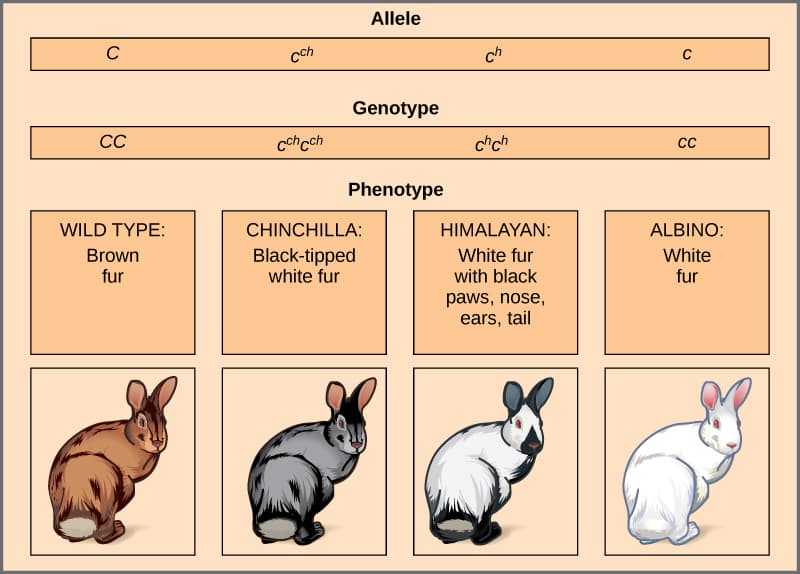
- Coat color in rabbits
- Controlled by the C gene with four alleles: C, cch, ch, and c
- Genotypes and phenotypes:
- CC: Full color
- Ccch: Chinchilla
- Cch: Himalayan
- Cc: Full color
- cchcch: Chinchilla
- cchch: Himalayan
- cchc: Himalayan
- chch: Himalayan
- chc: Himalayan
- cc: Albino
- ABO blood type system in humans

Pedigree analysis for multiple alleles
- Assign alleles to individuals based on phenotypes
- Use Punnett squares to determine possible offspring genotypes
- Consider relationships (parents, siblings) to infer genotypes
- Genetic crosses with multiple alleles:
- Set up Punnett square with all possible allele combinations
- Determine genotypic and phenotypic ratios of offspring
- Example cross between type A (IAi) and type B (IBi):
- Punnett square:
IA i IB IAIB (AB) IBi (B) i IAi (A) ii (O) - Genotypic ratio: 1 IAIB : 1 IBi : 1 IAi : 1 ii
- Phenotypic ratio: 1 AB : 1 B : 1 A : 1 O
- Punnett square:

Pleiotropy
Pleiotropy and phenotypic influence
- Pleiotropy occurs when a single gene influences multiple, seemingly unrelated phenotypic traits
- Happens when a gene has multiple functions or affects multiple biochemical pathways
- Examples of pleiotropy:
- Phenylketonuria (PKU) in humans
- Caused by mutation in PAH gene which encodes phenylalanine hydroxylase enzyme
- Affects cognitive development, pigmentation, and behavior
- Sickle cell anemia
- Caused by mutation in HBB gene which encodes beta-globin protein
- Affects red blood cell shape, oxygen transport, and malaria resistance
- Phenylketonuria (PKU) in humans
Genetic diversity from allelic variation
- Multiple alleles increase genetic diversity within populations
- More alleles for a gene means more possible genotypes and phenotypes
- Diversity allows for wider range of traits and adaptations to environments
- Pleiotropy can influence trait evolution
- If a pleiotropic gene affects multiple traits, selection pressure on one trait can indirectly affect others
- Balancing selection may maintain multiple alleles if they have both beneficial and detrimental effects on different traits
- Multiple alleles and pleiotropy are important for:
- Predicting inheritance patterns of traits
- Assessing genetic basis of diseases and disorders
- Developing targeted therapies and interventions
- Studying evolution and adaptation of populations
See Fiveable more often in Google
Mark Fiveable as a preferred source and Google is more likely to show you our guides in Top Stories, with a "preferred" badge in AI Mode and AI Overviews.