11.2 Mechanisms of Mutagenesis

👨👩👦👦General Genetics Unit 11 Review
11.2 Mechanisms of Mutagenesis
👨👩👦👦 General Genetics
Molecular Mechanisms and Consequences of Mutations
Mutations are the raw material for genetic variation and evolution. They range from single base changes to large insertions and deletions, and understanding how they arise is just as important as knowing what they do. This section covers the molecular mechanisms that cause mutations, the repair systems that prevent them, and the consequences when mutations slip through.

Top images from around the web for Mechanisms of genetic mutations
DNA Mutations | Biology for Majors I View original
Is this image relevant?
Mutations | Microbiology View original
Is this image relevant?
Mutation - wikidoc View original
Is this image relevant?
DNA Mutations | Biology for Majors I View original
Is this image relevant?
Mutations | Microbiology View original
Is this image relevant?
Mechanisms of Genetic Mutations
There are two broad categories of mutation at the DNA level: base substitutions and insertions/deletions (indels). Each arises through distinct molecular events.
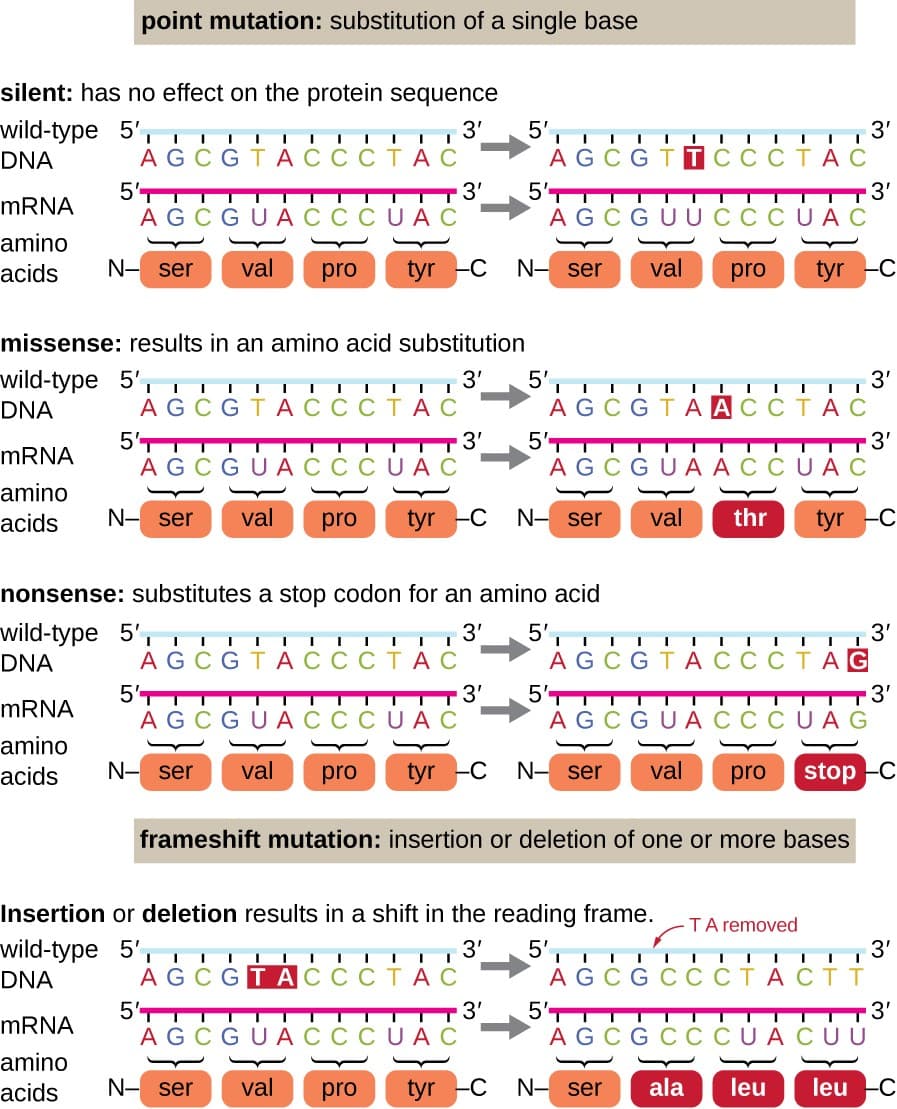
Base substitutions replace one nucleotide with another. They come in two flavors:
- Transitions swap a purine for a purine (A↔G) or a pyrimidine for a pyrimidine (C↔T). These are more common because the replacement base has a similar shape.
- Transversions exchange a purine for a pyrimidine or vice versa (e.g., A→T). These require a more drastic structural change, so they occur less frequently.
Base substitutions can be caused by replication errors, chemical modifications like alkylation (adding alkyl groups to bases), or spontaneous deamination. A classic example of spontaneous deamination is cytosine losing its amino group to become uracil, which then pairs with adenine instead of guanine, producing a C→T transition after the next round of replication.
Insertions and deletions (indels) add or remove one or more nucleotides:
- Insertions incorporate extra nucleotides. Trinucleotide repeat expansions (like the CAG repeats in Huntington disease) are a well-known example.
- Deletions remove nucleotides. The Δ508 mutation in the CFTR gene deletes three nucleotides, removing a single phenylalanine residue and causing cystic fibrosis.
- Frameshift mutations result when an indel is not a multiple of three nucleotides. This shifts the entire downstream reading frame, usually producing a nonfunctional protein. Duchenne muscular dystrophy often results from frameshift mutations in the dystrophin gene.
Indels commonly arise from slipped-strand mispairing during replication (where repetitive sequences cause the template and new strand to misalign) or from unequal crossing over during meiotic recombination.

DNA Repair and Genetic Stability
Cells have multiple repair pathways that catch different types of DNA damage. When these systems fail, mutation rates rise dramatically.
Mismatch repair (MMR) corrects base-base mismatches and small indels that escape proofreading:
- The MMR system recognizes the mismatch (in E. coli, MutS binds the mismatch; in eukaryotes, MSH proteins do this).
- It distinguishes the newly synthesized strand from the template strand (in E. coli, this relies on methylation of the parental strand at GATC sequences).
- Repair proteins excise the error-containing segment of the new strand.
- DNA polymerase resynthesizes the gap using the parental strand as a template, and ligase seals the nick.
MMR increases replication fidelity by 100- to 1000-fold. Defects in MMR genes (like MLH1 and MSH2) are associated with Lynch syndrome, a hereditary predisposition to colorectal cancer.
Base excision repair (BER) fixes small, non-bulky lesions like oxidized, deaminated, or alkylated bases:
- A specific DNA glycosylase recognizes and removes the damaged base, leaving an apurinic/apyrimidinic (AP) site.
- An AP endonuclease cleaves the sugar-phosphate backbone at the AP site.
- DNA polymerase fills the single-nucleotide gap, and ligase seals the strand.
BER is the primary defense against the ~10,000+ spontaneous depurination events that occur per human cell per day.
Nucleotide excision repair (NER) handles bulky, helix-distorting lesions like UV-induced pyrimidine dimers and chemical adducts:
- The NER complex detects distortion in the DNA helix.
- Endonucleases make incisions on both sides of the lesion, excising a short oligonucleotide segment (about 12–13 nt in prokaryotes, ~24–32 nt in eukaryotes).
- DNA polymerase fills the gap using the undamaged complementary strand, and ligase seals the nick.
Defects in NER cause xeroderma pigmentosum, a condition where patients are extremely sensitive to UV light and have a greatly elevated risk of skin cancer.
Double-strand break repair (DSBR) mends breaks in both strands, which are especially dangerous because they can lead to chromosomal rearrangements:
- Homologous recombination (HR) uses the sister chromatid as a template for error-free repair. It's available primarily in S and G2 phases of the cell cycle, when a sister chromatid is present.
- Non-homologous end joining (NHEJ) directly ligates the broken ends without a template. It's faster and available throughout the cell cycle, but it's error-prone and can introduce small insertions or deletions at the junction.

Consequences of Genomic Mutations
The impact of a mutation depends heavily on where in the genome it occurs.
Mutations in coding regions directly affect the protein product:
- Silent (synonymous) mutations change a codon but not the amino acid, thanks to redundancy in the genetic code. For example, GGU→GGC both code for glycine.
- Missense mutations substitute one amino acid for another. The effect depends on how chemically different the new amino acid is and where it sits in the protein. The sickle cell mutation (Glu→Val at position 6 of β-globin) is a single missense change with severe consequences because valine's hydrophobic side chain causes hemoglobin molecules to polymerize.
- Nonsense mutations create a premature stop codon (e.g., UAG, UAA, or UGA), producing a truncated protein that is usually nonfunctional. Some forms of Duchenne muscular dystrophy result from nonsense mutations.
- Frameshift mutations shift the reading frame downstream of the indel, altering every subsequent codon. Tay-Sachs disease is often caused by a four-base insertion in the HEXA gene that frameshifts the message and destroys enzyme activity.
Mutations in non-coding regions can be just as consequential, even though they don't change a protein's amino acid sequence:
- Promoter and enhancer mutations can increase, decrease, or abolish transcription of a gene.
- Splice site mutations disrupt the signals that guide intron removal. This can cause exon skipping, intron retention, or activation of cryptic splice sites, all of which alter the mature mRNA.
- UTR mutations (in the 5' or 3' untranslated regions) can affect mRNA stability, localization, or translation efficiency.
- Intronic mutations may seem harmless, but introns can contain regulatory elements or affect splicing patterns, so changes here sometimes have phenotypic effects.
Factors Affecting Mutation Rates
Mutation rate reflects a balance between how often errors arise and how effectively repair systems correct them.
DNA replication fidelity is the first line of defense:
- High-fidelity replicative polymerases (Pol δ and Pol ε in eukaryotes) have intrinsic error rates of roughly to per base pair.
- The 3'→5' exonuclease (proofreading) activity of these polymerases catches and removes misincorporated nucleotides, reducing the error rate by another ~100-fold.
- Mismatch repair further reduces the final error rate to approximately to per base pair per replication.
Together, these three layers (polymerase selectivity → proofreading → MMR) give human DNA replication remarkable accuracy.
Environmental mutagens push mutation rates higher by damaging DNA faster than repair systems can keep up:
- Physical mutagens:
- Ionizing radiation (X-rays, gamma rays) generates reactive oxygen species and causes double-strand breaks and oxidative base damage.
- UV radiation induces cyclobutane pyrimidine dimers (commonly thymine dimers) and 6-4 photoproducts, both of which distort the helix and block replication.
- Chemical mutagens:
- Alkylating agents (e.g., ethyl methanesulfonate, EMS) add alkyl groups to bases, causing mispairs. EMS is widely used in genetic screens because it primarily induces G:C→A:T transitions.
- Intercalating agents (e.g., ethidium bromide, acridine orange) wedge between stacked base pairs, distorting the helix and causing frameshift mutations during replication.
- Base analogs (e.g., 5-bromouracil) structurally resemble normal bases and get incorporated during replication. 5-bromouracil mimics thymine but can tautomerize to a form that pairs with guanine, causing A:T→G:C transitions.
The overall mutation rate for any organism is the net result of mutagenic pressure from endogenous and environmental sources minus the correction capacity of its DNA repair pathways.
See Fiveable more often in Google
Mark Fiveable as a preferred source and Google is more likely to show you our guides in Top Stories, with a "preferred" badge in AI Mode and AI Overviews.