11.1 Types and Causes of Mutations

👨👩👦👦General Genetics Unit 11 Review
11.1 Types and Causes of Mutations
👨👩👦👦 General Genetics
Types of Mutations

Top images from around the web for Identify the different types of mutations, including point mutations, insertions, deletions, and chromosomal rearrangements
5.8 Mutations – Human Biology View original
Is this image relevant?
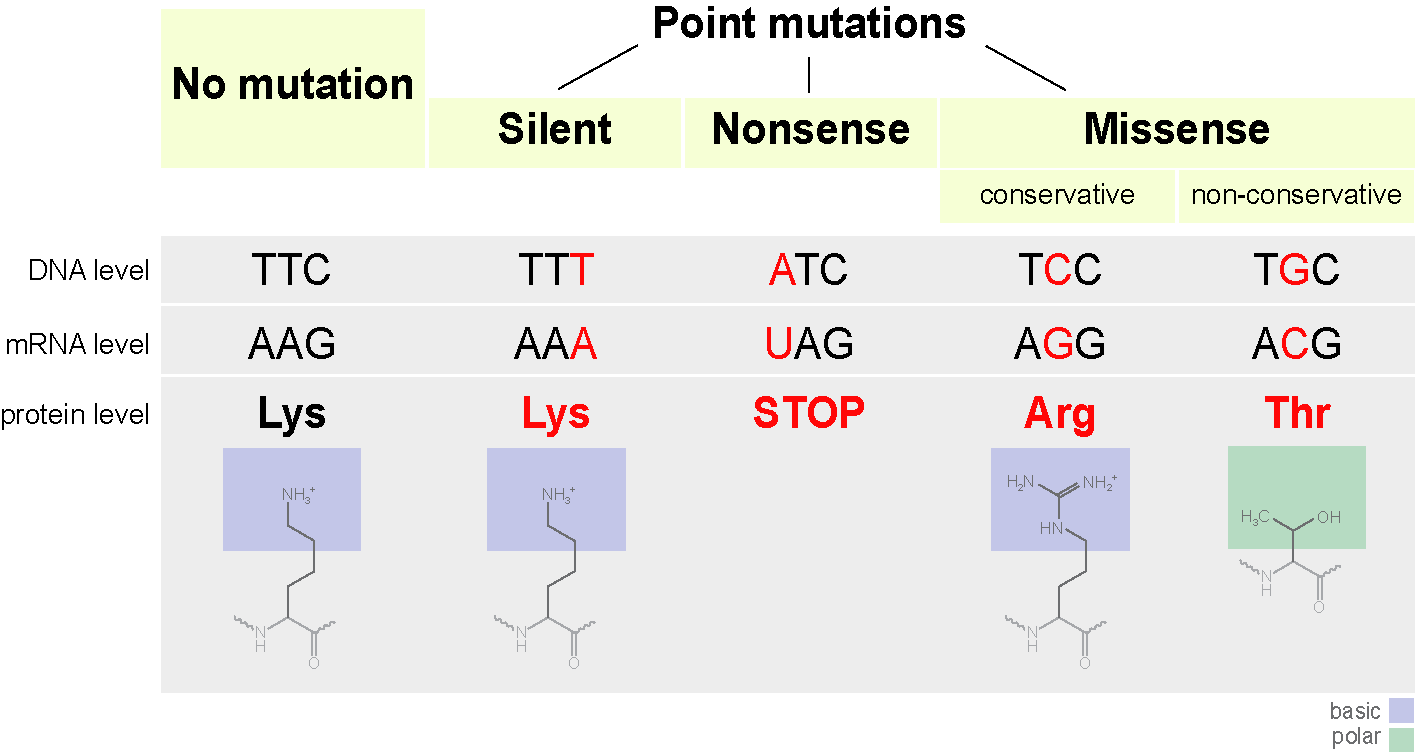
Types of Mutations – Mt Hood Community College Biology 102 View original
Is this image relevant?
Genetic Mutation ‹ OpenCurriculum View original
Is this image relevant?
5.8 Mutations – Human Biology View original
Is this image relevant?
Types of Mutations – Mt Hood Community College Biology 102 View original
Is this image relevant?
Identify the different types of mutations, including point mutations, insertions, deletions, and chromosomal rearrangements
Mutations range from single-nucleotide changes to rearrangements of entire chromosomal segments. The type of mutation determines how severely (or subtly) it affects the protein product.
Point mutations involve changes to a single nucleotide. These are the smallest-scale mutations but can still have major consequences.
- Substitution mutations replace one nucleotide with another. There are two subtypes based on the chemistry of the swap:
- Transition: a purine replaces a purine (A↔G) or a pyrimidine replaces a pyrimidine (C↔T). Transitions are more common than transversions.
- Transversion: a purine replaces a pyrimidine or vice versa (A↔C, A↔T, G↔C, G↔T).
The functional impact of a substitution depends on what happens to the codon:
- Silent mutation changes the codon but codes for the same amino acid (e.g., GGA→GGC both code for glycine). This is possible because the genetic code is degenerate, meaning multiple codons specify the same amino acid.
- Missense mutation changes the codon so it specifies a different amino acid (e.g., GAG→GUG changes glutamic acid to valine). The severity depends on how chemically different the new amino acid is and where it sits in the protein. The sickle cell mutation is a classic example of a single missense change with dramatic effects.
- Nonsense mutation converts a sense codon into a premature stop codon (UAA, UAG, or UGA), truncating the protein. Earlier stop codons generally produce more severe effects because more of the protein is lost.
Insertions and deletions (indels) add or remove nucleotides from the DNA sequence. Their impact depends on how many nucleotides are involved:
- Frameshift mutation: an insertion or deletion of a number of nucleotides not divisible by three shifts the reading frame. Every codon downstream of the mutation is misread, usually producing a nonfunctional protein. For example, inserting AU into AUG|CCC changes the grouping to AUA|UCG|CC..., scrambling the entire downstream sequence.
- In-frame insertion or deletion: adds or removes a number of nucleotides divisible by three. The reading frame stays intact, but the protein gains or loses amino acids. These can be tolerable or devastating depending on the location.
Chromosomal rearrangements involve changes to large segments of DNA and often affect multiple genes at once:
- Translocation: genetic material is exchanged between non-homologous chromosomes. The reciprocal translocation between chromosomes 9 and 22 creates the Philadelphia chromosome, which drives chronic myeloid leukemia.
- Inversion: a chromosomal segment is flipped in orientation. A pericentric inversion includes the centromere; a paracentric inversion does not. Inversions may not disrupt gene function unless a breakpoint falls within a gene.
- Duplication: an extra copy of a chromosomal segment is created. Charcot-Marie-Tooth disease type 1A results from a duplication involving the PMP22 gene.
- Deletion: a chromosomal segment is lost entirely. Cri-du-chat syndrome results from a deletion on the short arm of chromosome 5.

Causes and Types of Mutations

Explain the causes of mutations, such as replication errors, chemical mutagens, and radiation
Mutations arise either from mistakes the cell makes on its own or from damage caused by outside agents. Knowing the mechanism helps you predict what kind of mutation each cause tends to produce.
Replication errors occur during DNA synthesis:
- Polymerase slippage happens when the template or newly synthesized strand loops out during replication of repetitive sequences (like microsatellites). This causes small insertions or deletions. Trinucleotide repeat expansions, which underlie diseases like Huntington's, arise through a similar slippage mechanism.
- Misincorporation occurs when DNA polymerase inserts the wrong nucleotide (e.g., dATP instead of dGTP). Proofreading by the polymerase's 3'→5' exonuclease activity catches most of these errors, and mismatch repair fixes many of the rest, but some slip through.
Chemical mutagens alter DNA structure in distinct ways:
- Alkylating agents (e.g., ethyl methanesulfonate, or EMS) add alkyl groups to bases, changing their base-pairing properties. EMS adds an ethyl group to guanine, causing it to mispair with thymine instead of cytosine, which produces G:C → A:T transitions.
- Base analogs (e.g., 5-bromouracil) structurally resemble normal bases and get incorporated into DNA during replication. 5-bromouracil mimics thymine but can tautomerize and pair with guanine, causing A:T → G:C transitions.
- Intercalating agents (e.g., ethidium bromide, acridine orange) wedge between stacked base pairs, distorting the helix. During replication, this distortion causes insertions or deletions, often leading to frameshifts.
Radiation damages DNA through two different energy mechanisms:
- Ionizing radiation (X-rays, gamma rays) has enough energy to break chemical bonds directly. It causes double-strand breaks and oxidative damage to bases. Double-strand breaks are especially dangerous because they can lead to chromosomal rearrangements if repaired incorrectly.
- Non-ionizing radiation (UV light) has lower energy but causes pyrimidine dimers, most commonly thymine dimers, where adjacent thymine bases on the same strand become covalently linked. These dimers block replication and transcription and must be repaired by nucleotide excision repair or bypassed by error-prone translesion synthesis.
Differentiate between spontaneous and induced mutations and their relative frequencies
Spontaneous mutations arise without any external mutagen exposure. They result from:
- Inherent errors in DNA replication that escape proofreading and mismatch repair
- Tautomeric shifts, where bases temporarily adopt rare structural forms that pair with the wrong partner (e.g., the rare enol form of thymine pairs with guanine instead of adenine)
- Depurination, the spontaneous loss of a purine base (A or G) from the sugar-phosphate backbone, which leaves an abasic site
- Deamination, the spontaneous removal of an amino group from a base (e.g., cytosine deaminates to uracil, which pairs with adenine instead of guanine)
Spontaneous mutation rates are low: roughly to mutations per nucleotide per cell division. That translates to about 1 error per 100 million to 10 billion nucleotides copied.
Induced mutations are caused by exposure to chemical or physical mutagens. Their frequency depends on the type and dose of the mutagen. For perspective, UV light exposure can increase the mutation rate by roughly 100-fold over the spontaneous baseline. This dose-dependence is why mutagen exposure is cumulative and why higher doses produce more mutations.
Describe the potential effects of mutations on gene function and phenotype
Not all mutations are harmful. Their effect on the organism depends on how they change (or don't change) the gene product's activity.
Loss-of-function mutations reduce or eliminate the gene product's activity. They commonly result from nonsense mutations, frameshifts, or large deletions. In diploid organisms, these are typically recessive because the remaining wild-type allele usually produces enough functional protein. Cystic fibrosis is a classic example: disease occurs only when both copies of the CFTR gene carry loss-of-function mutations.
Gain-of-function mutations increase the gene product's activity or give it a new function. These can arise from missense mutations, in-frame insertions, or gene duplications. They are typically dominant because the altered product has its effect regardless of the wild-type copy. Huntington's disease results from an expanded CAG trinucleotide repeat in the HTT gene, producing a protein with a toxic polyglutamine tract.
Dominant-negative mutations produce a mutant protein that actively interferes with the wild-type protein's function. This often happens in proteins that work as multimers (complexes of multiple subunits). If the mutant subunit poisons the whole complex, even one mutant allele causes disease. Some forms of epidermolysis bullosa arise this way, where mutant keratin proteins (KRT5 or KRT14) disrupt the structural integrity of skin.
Neutral mutations have no significant effect on gene function or phenotype. Silent mutations fall into this category since the amino acid sequence stays the same. Some missense mutations are also neutral if the amino acid substitution is chemically conservative and occurs in a non-critical region of the protein (e.g., swapping valine for isoleucine in a hydrophobic core, where both residues have similar properties).
See Fiveable more often in Google
Mark Fiveable as a preferred source and Google is more likely to show you our guides in Top Stories, with a "preferred" badge in AI Mode and AI Overviews.