5.3 Three-Point Crosses and Gene Order

👨👩👦👦General Genetics Unit 5 Review
5.3 Three-Point Crosses and Gene Order
👨👩👦👦 General Genetics
Three-Point Crosses and Gene Order
Three-point crosses let geneticists figure out the order of three linked genes on a chromosome and measure the distances between them. Where two-point crosses can only tell you the distance between a single pair of genes, a three-point cross handles all three genes at once, which makes it possible to determine gene order directly. These crosses also reveal complications like double crossovers and interference that affect how we interpret genetic maps.

Top images from around the web for Concept of three-point crosses
Patterns of Inheritance | Anatomy and Physiology II View original
Is this image relevant?
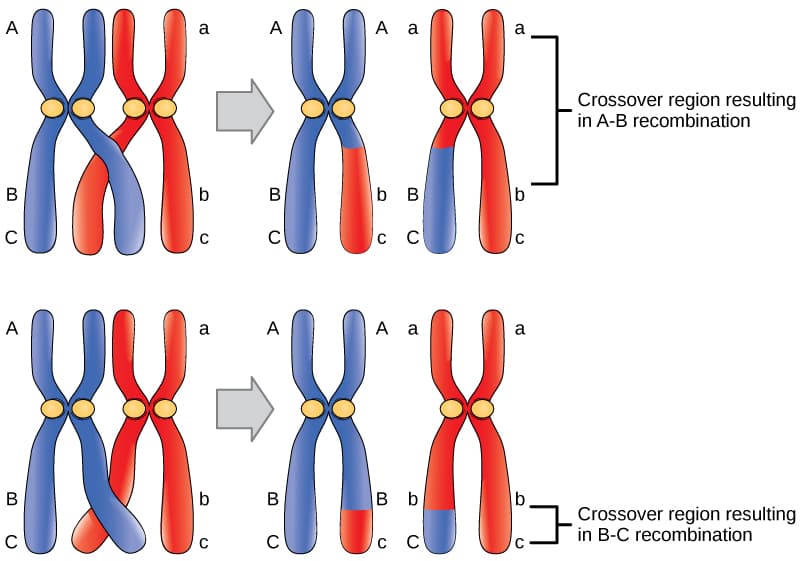
Mapping Genomes | OpenStax Biology 2e View original
Is this image relevant?
Chromosomal Theory and Genetic Linkage · Biology View original
Is this image relevant?
Patterns of Inheritance | Anatomy and Physiology II View original
Is this image relevant?
Mapping Genomes | OpenStax Biology 2e View original
Is this image relevant?
Three-Point Crosses
Concept of Three-Point Crosses
A three-point cross tracks three genes located on the same chromosome simultaneously. The underlying principle is genetic linkage: genes that sit closer together on a chromosome are more likely to be inherited as a unit, while genes farther apart have a higher chance of being separated by recombination during meiosis.
Recombination frequencies between each pair of genes give you map distances, expressed in centiMorgans (cM). One cM equals a 1% recombination frequency. So if two genes recombine 8% of the time, they're 8 cM apart.
The real advantage of a three-point cross over doing three separate two-point crosses is efficiency: you get all three pairwise distances from a single cross, and you can directly identify double crossover classes, which is critical for determining gene order.
Analyzing Offspring to Determine Gene Order
Here's the step-by-step process for working through a three-point cross:
-
Set up the cross. Cross an individual heterozygous for all three linked genes (e.g., ) to a homozygous recessive individual (). This testcross makes it easy to read the gamete genotypes directly from offspring phenotypes.
-
Classify offspring into phenotypic classes. You'll typically see eight classes of offspring. Group them into four pairs based on reciprocal genotypes:
- Parental classes (most frequent): These match the original parental chromosomes and reflect no recombination.
- Single crossover classes (intermediate frequency): Two pairs, each resulting from a crossover in one of the two intervals between adjacent genes.
- Double crossover classes (least frequent): These result from simultaneous crossovers in both intervals. They're always the rarest class.
-
Identify the gene in the middle. Compare the double crossover class to the parental class. The allele that has switched position relative to the parentals tells you which gene is in the middle. This is the key trick for determining gene order.
-
Calculate recombination frequencies for each interval:
For each interval, count all offspring that experienced a crossover in that region. This includes the single crossover classes for that interval plus the double crossover class (since a double crossover involves a crossover in both intervals).
- Convert RF to map distance. The RF percentage equals the map distance in cM. Place the three genes in linear order with the calculated distances between them.

Problem-Solving with Three-Point Crosses
When you're given map distances and asked to predict offspring ratios, work backward:
- Parental types will always appear in the highest proportions. If the total map distance is small, parentals dominate heavily.
- Single crossover types appear at frequencies proportional to the map distance of the relevant interval.
- Double crossover types are the rarest. Their expected frequency equals the product of the two single-crossover frequencies (assuming no interference). For example, if interval 1 is 10 cM and interval 2 is 15 cM, the expected double crossover frequency is , or 1.5%.
Standard Mendelian principles still apply to any unlinked genes in the cross. Linkage only modifies the ratios for genes on the same chromosome.
Impact of Multiple Crossovers
Double crossovers are the main complication in three-point mapping. When two crossovers happen between the outer genes, the middle gene swaps twice and ends up back in its original configuration. This means double crossover offspring look like parentals for the two outer genes, which underestimates the true distance between them.
That's exactly why three-point crosses are better than two-point crosses for the outer genes: you can actually detect the double crossover class and add those individuals back into your recombination count.
Interference describes how one crossover event affects the probability of another crossover nearby:
- Positive interference (most common): One crossover decreases the chance of a second crossover in an adjacent region. The coefficient of coincidence (c.o.c.) will be less than 1.
- Negative interference (rare): One crossover increases the chance of a nearby second crossover. The c.o.c. will be greater than 1.
You calculate interference as:
If interference = 0, crossovers occur independently. If interference = 1, double crossovers never happen in that region.
Gene Order and Genetic Maps

The Concept of Gene Order
Genes are arranged linearly along chromosomes, and their relative positions are consistent within a species. Genetic mapping uses recombination data from crosses to figure out this arrangement.
Knowing gene order matters because it lets you predict how alleles will segregate together during meiosis. If you know genes A, B, and C are in that order with specific distances, you can estimate the probability of any particular combination of alleles appearing in offspring.
Gene order is generally conserved within a species, but chromosomal rearrangements like inversions and translocations can shuffle gene positions between species or even between populations.
Constructing a Genetic Map
Building a genetic map involves combining data from multiple crosses:
-
Two-point crosses establish recombination frequencies between individual gene pairs. They're straightforward but can't resolve gene order when three or more genes are involved.
-
Three-point crosses resolve ambiguities in gene order and simultaneously provide distances for three genes. They also let you detect double crossovers, improving distance estimates.
-
Apply mapping functions to correct for multiple crossovers. Raw recombination frequencies underestimate true distances, especially for genes far apart. The Kosambi mapping function corrects for interference, while simpler models assume no interference.
-
Assemble the map by combining distances from multiple crosses. Arrange genes linearly so that the distances between adjacent genes are additive. The total map length of a chromosome equals the sum of all adjacent gene distances.
Limitations and Challenges
Genetic maps are estimates, not exact physical measurements. Several factors limit their accuracy:
- Recombination frequencies vary. Different crosses, sample sizes, and even environmental conditions can produce slightly different RF values for the same gene pair.
- Double crossovers cause underestimation. Even with three-point crosses, some multiple crossover events go undetected, especially over large distances.
- Recombination isn't uniform across chromosomes. Recombination hotspots and coldspots mean that map distance doesn't scale linearly with physical (base pair) distance. A region with a hotspot will appear "stretched" on a genetic map compared to its actual physical size.
- Sample size matters. Small sample sizes make rare classes (like double crossovers) hard to detect reliably, reducing map accuracy.
- Chromosomal rearrangements complicate things. Inversions suppress recombination in heterozygous individuals, and translocations alter linkage relationships. Both make it harder to compare maps across different individuals or populations.
See Fiveable more often in Google
Mark Fiveable as a preferred source and Google is more likely to show you our guides in Top Stories, with a "preferred" badge in AI Mode and AI Overviews.