16.1 Hardy-Weinberg Equilibrium

👨👩👦👦General Genetics Unit 16 Review
16.1 Hardy-Weinberg Equilibrium
👨👩👦👦 General Genetics
Hardy-Weinberg Equilibrium
The Hardy-Weinberg equilibrium describes a theoretical state where allele and genotype frequencies in a population remain constant from generation to generation. It serves as a null model in population genetics: if a real population deviates from Hardy-Weinberg expectations, something evolutionary must be happening. That makes it the baseline you compare everything else against.
The core equation is . It lets you calculate expected genotype frequencies from allele frequencies and then compare those expectations to what you actually observe in a population. Deviations point toward evolutionary forces like mutation, migration, drift, or natural selection.

Top images from around the web for Assumptions of Hardy-Weinberg equilibrium
Genetic aspects of populations, Hardy-Weinberg equilibrium - WikiLectures View original
Is this image relevant?
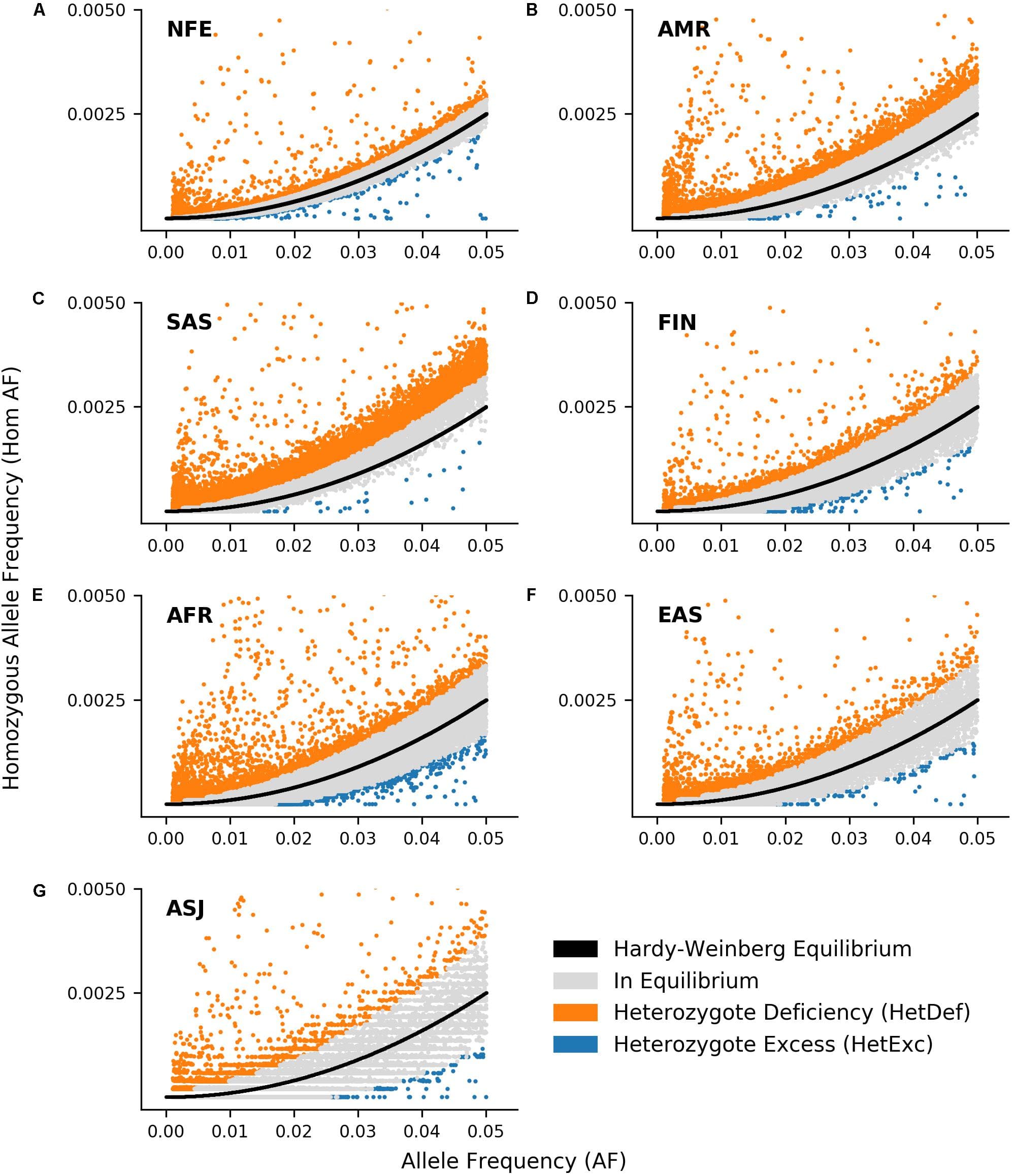
Frontiers | Hardy-Weinberg Equilibrium in the Large Scale Genomic Sequencing Era View original
Is this image relevant?
19.1C: Hardy-Weinberg Principle of Equilibrium - Biology LibreTexts View original
Is this image relevant?
Genetic aspects of populations, Hardy-Weinberg equilibrium - WikiLectures View original
Is this image relevant?
Frontiers | Hardy-Weinberg Equilibrium in the Large Scale Genomic Sequencing Era View original
Is this image relevant?
Assumptions of Hardy-Weinberg Equilibrium
For a population to stay in Hardy-Weinberg equilibrium, five conditions must all hold simultaneously. In reality, no natural population meets every one of these perfectly, which is exactly the point. They define the "no evolution" scenario.
- No mutation — Allele frequencies stay constant because no new alleles are created and no existing alleles are changed or removed.
- No migration (gene flow) — No individuals enter or leave the population, so no alleles are added or lost through movement.
- Large population size — The population must be large enough that genetic drift (random fluctuations in allele frequency due to chance) is negligible. Small populations are far more vulnerable to drift.
- Random mating (panmixia) — Individuals pair up without regard to genotype or phenotype. No one preferentially mates with similar or dissimilar partners.
- No natural selection — All genotypes survive and reproduce equally well. No genotype has a fitness advantage over another.
If even one of these assumptions is violated, allele frequencies can shift across generations, meaning the population is evolving.

Application of the Hardy-Weinberg Equation
The equation relates allele frequencies to genotype frequencies for a locus with two alleles:
where is the frequency of one allele (often called the dominant allele, A) and is the frequency of the other allele (often the recessive allele, a). Squaring the allele-frequency expression gives the genotype frequencies:
- = frequency of homozygous dominant individuals (AA)
- = frequency of heterozygous individuals (Aa)
- = frequency of homozygous recessive individuals (aa)
Worked example: Suppose 1 in 2,500 individuals in a population shows a recessive phenotype (aa).
- Set .
- Solve for : .
- Solve for : .
- Calculate genotype frequencies:
- AA:
- Aa:
- aa:
Notice that heterozygous carriers (about 3.9% of the population) are far more common than affected homozygotes (0.04%). This is a key insight: for rare recessive conditions, most copies of the recessive allele are hidden in carriers.
Calculating allele frequencies from genotype counts: If you know the actual number of each genotype in a population, you can count alleles directly:
This allele-counting method is more accurate than taking the square root of a genotype frequency, because it doesn't assume the population is already in equilibrium.

Determination of Equilibrium Status
To test whether a population is in Hardy-Weinberg equilibrium:
- Count observed genotypes in the population (AA, Aa, aa).
- Calculate observed allele frequencies using the allele-counting method above.
- Calculate expected genotype frequencies by plugging and into the Hardy-Weinberg equation.
- Compare observed vs. expected genotype counts. A chi-square () goodness-of-fit test is the standard statistical tool here. With two alleles, there is 1 degree of freedom (3 genotype classes minus 2 estimated parameters).
- If the value is not significant (p > 0.05), the population is consistent with Hardy-Weinberg equilibrium. A significant result means something is likely driving the population away from equilibrium.
Factors Disrupting Hardy-Weinberg Equilibrium
Each violated assumption corresponds to a specific evolutionary mechanism.
- Mutation introduces new alleles or converts one allele into another, gradually shifting allele frequencies. Mutation rates are typically low per generation, so mutation alone changes frequencies slowly. Example: the sickle cell allele (HbS) arose by a point mutation in the -globin gene.
- Migration (gene flow) occurs when individuals move between populations carrying different allele frequencies. Immigration adds alleles; emigration removes them. This can homogenize allele frequencies between populations over time. (Note: the founder effect is actually a form of genetic drift, not gene flow, because it involves a small group starting a new population with a non-representative sample of alleles.)
- Small population size (genetic drift) causes random, unpredictable changes in allele frequency. Two classic scenarios:
- Bottleneck effect — A sharp reduction in population size (disease, disaster) randomly eliminates alleles, reducing genetic diversity.
- Founder effect — A small group colonizes a new area, carrying only a subset of the original population's alleles.
- Non-random mating changes genotype frequencies without directly changing allele frequencies.
- Assortative mating (preferring similar phenotypes) increases homozygosity.
- Disassortative mating (preferring dissimilar phenotypes) increases heterozygosity.
- Inbreeding is an extreme form of non-random mating that increases homozygosity across the entire genome.
- Natural selection occurs when genotypes differ in fitness (survival and/or reproductive success). Alleles associated with higher fitness increase in frequency over generations. Example: bacteria carrying antibiotic-resistance alleles survive treatment and pass those alleles to the next generation, increasing the resistance allele's frequency.
Quick distinction to remember: Non-random mating alters genotype frequencies but not allele frequencies on its own. The other four forces (mutation, migration, drift, selection) change allele frequencies directly.
See Fiveable more often in Google
Mark Fiveable as a preferred source and Google is more likely to show you our guides in Top Stories, with a "preferred" badge in AI Mode and AI Overviews.