4.2 Mitosis and Meiosis

👨👩👦👦General Genetics Unit 4 Review
4.2 Mitosis and Meiosis
👨👩👦👦 General Genetics
Cell Division and Genetic Diversity
Cell division is the foundation of growth, repair, and reproduction. Mitosis and meiosis serve different purposes: mitosis creates genetically identical cells for maintaining and growing an organism, while meiosis produces genetically diverse gametes for sexual reproduction. Understanding how each process handles chromosomes is central to genetics.

Top images from around the web for Mitosis vs meiosis processes
Biologia: Mitosis y Meiosis: Mitosis y Meiosis View original
Is this image relevant?
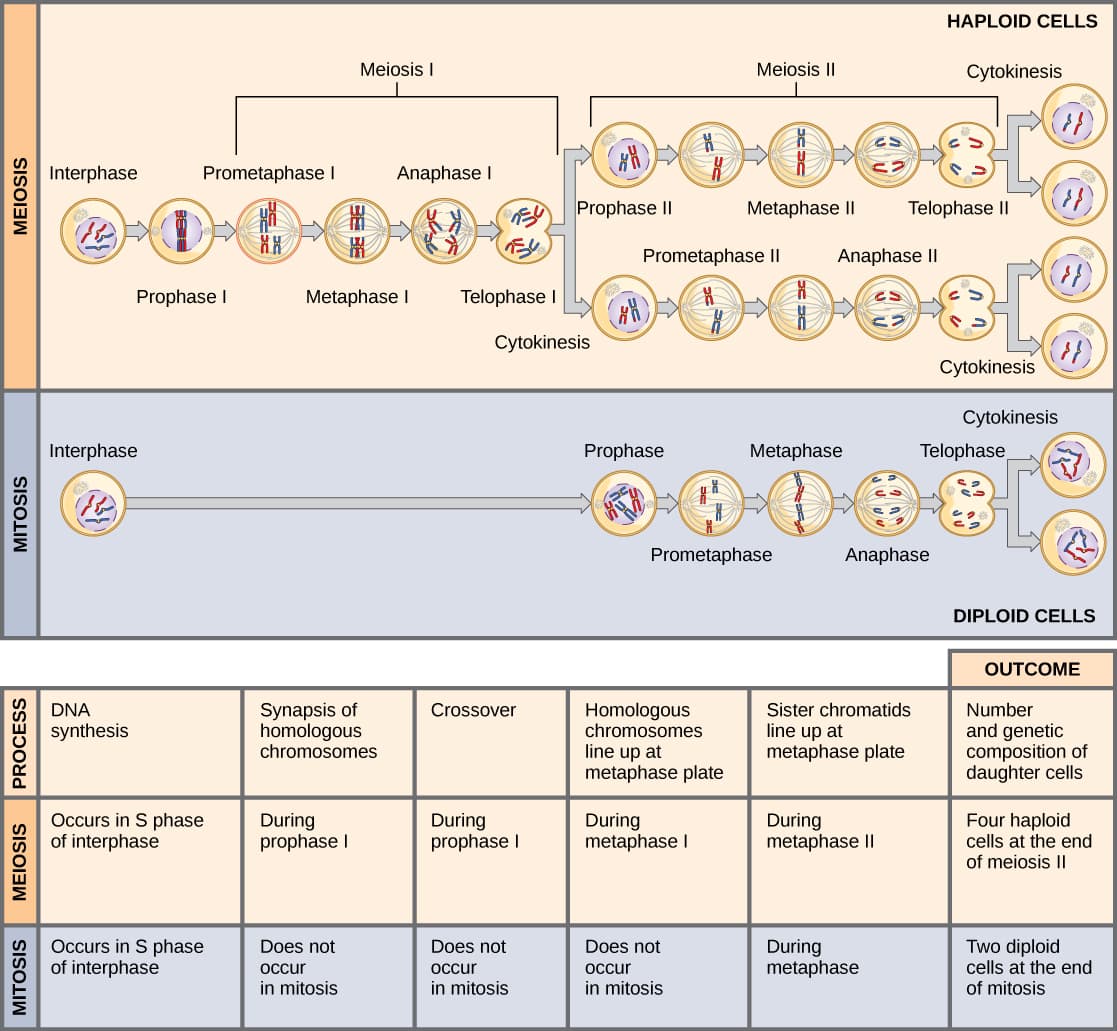
The Process of Meiosis · Biology View original
Is this image relevant?
Cell division and reproduction | It's a natural universe View original
Is this image relevant?
Biologia: Mitosis y Meiosis: Mitosis y Meiosis View original
Is this image relevant?
The Process of Meiosis · Biology View original
Is this image relevant?
Mitosis vs meiosis processes
Mitosis and meiosis both divide cells, but they differ in purpose, mechanism, and outcome.
Mitosis is used for growth, tissue repair, and asexual reproduction (like budding in hydra). It involves a single round of division. The stages follow the PMAT acronym:
- Prophase: Chromosomes condense and become visible. The nuclear envelope breaks down, and spindle fibers begin forming from the centrosomes.
- Metaphase: Individual chromosomes line up along the cell's equatorial plate (also called the metaphase plate). Spindle fibers attach to each chromosome's centromere.
- Anaphase: Sister chromatids are pulled apart at the centromere and move toward opposite poles of the cell.
- Telophase: Nuclear envelopes reform around each set of chromosomes, chromosomes decondense, and cytokinesis divides the cytoplasm.
The result: two genetically identical daughter cells, each with the same chromosome number as the parent cell ().
Meiosis is used to produce gametes (sperm and egg cells) for sexual reproduction. It involves two consecutive rounds of division, often called PMAT I and PMAT II:
- Prophase I: Chromosomes condense. Homologous chromosomes pair up in a process called synapsis, forming tetrads (bivalents). Crossing over occurs here, where homologs exchange segments of DNA at points called chiasmata.
- Metaphase I: Homologous pairs (not individual chromosomes) line up at the equatorial plate. Their orientation is random, which matters for independent assortment.
- Anaphase I: Homologous chromosomes separate and move toward opposite poles. Sister chromatids stay joined.
- Telophase I: Nuclear envelopes may reform, chromosomes may briefly decondense, and cytokinesis produces two haploid cells.
- Prophase II: Chromosomes condense again in each of the two cells. No new DNA replication occurs.
- Metaphase II: Individual chromosomes line up at the equatorial plate (similar to mitotic metaphase).
- Anaphase II: Sister chromatids finally separate and move toward opposite poles.
- Telophase II: Nuclear envelopes reform, chromosomes decondense, and cytokinesis occurs.
The result: four genetically diverse haploid cells (), each with half the chromosome number of the parent cell.
A key distinction: in Anaphase I, homologs separate. In Anaphase II, sister chromatids separate. This two-step reduction is what halves the chromosome number.
Meiosis for genetic diversity
Meiosis generates genetic variation through two main mechanisms, both occurring during meiosis I.
Independent assortment happens during metaphase I. Each homologous pair lines up at the equatorial plate with a random orientation, meaning the maternal and paternal chromosomes sort into gametes in different combinations. For an organism with chromosome pairs, there are possible combinations. In humans (), that's over 8 million combinations from independent assortment alone.
Crossing over happens during prophase I. Homologous chromosomes physically exchange segments of DNA at chiasmata. This recombines alleles that were on the same chromosome, creating new allele combinations that didn't exist on either parent chromosome.
Together, independent assortment and crossing over ensure that virtually every gamete an organism produces is genetically unique. This diversity is the raw material for natural selection and adaptation.

Chromosome segregation importance
Proper chromosome segregation ensures each daughter cell gets the right number of chromosomes. In mitosis, that means each cell gets a full diploid set (). In meiosis, each gamete gets exactly one haploid set ().
When segregation goes wrong, the result is aneuploidy, an abnormal number of chromosomes in the daughter cells. The most common cause is nondisjunction, where chromosomes or chromatids fail to separate properly during anaphase. Nondisjunction can occur during meiosis I (homologs fail to separate) or meiosis II (sister chromatids fail to separate).
Aneuploidy has serious consequences, including developmental abnormalities, intellectual disabilities, and increased miscarriage risk. Two well-known examples:
- Monosomy: A cell is missing one chromosome. Turner syndrome () results from a missing sex chromosome.
- Trisomy: A cell has one extra chromosome. Down syndrome () results from three copies of chromosome 21.
Cell Ploidy and Life Cycles

Haploid vs diploid cells
Haploid cells () contain a single set of chromosomes. They're produced by meiosis. Examples include gametes (egg and sperm) in animals, and the dominant life stage in many fungi and some algae.
Diploid cells () contain two sets of chromosomes, one inherited from each parent. The diploid state is restored when two haploid gametes fuse during fertilization. Most of your body's somatic cells (skin, muscle, etc.) are diploid.
Life cycle types
Different organisms spend different proportions of their life cycle in the haploid vs. diploid state:
- Haplontic life cycle: The organism is predominantly haploid. The diploid stage is brief, limited to the zygote, which immediately undergoes meiosis. Many fungi and some algae follow this pattern.
- Diplontic life cycle: The organism is predominantly diploid. Meiosis produces haploid gametes directly, and those gametes are the only haploid stage. Animals, including humans, follow this pattern.
- Alternation of generations: The organism alternates between a multicellular haploid stage (the gametophyte) and a multicellular diploid stage (the sporophyte). Plants and some algae use this life cycle.
- The gametophyte produces gametes by mitosis (not meiosis, since it's already haploid).
- The sporophyte produces haploid spores by meiosis. Those spores develop into the next gametophyte generation.
In mosses, the gametophyte is the dominant, visible stage. In flowering plants and conifers, the sporophyte dominates, and the gametophyte is reduced (pollen grains and embryo sacs).
See Fiveable more often in Google
Mark Fiveable as a preferred source and Google is more likely to show you our guides in Top Stories, with a "preferred" badge in AI Mode and AI Overviews.