13.4 The Supreme Court

🎟️Intro to American Government Unit 13 Review
13.4 The Supreme Court
🎟️ Intro to American Government
The Supreme Court
The Supreme Court is the highest court in the United States, and its rulings are the final word on what the Constitution means. With the power to strike down laws passed by Congress or actions taken by the President, it plays a central role in the balance of power across all three branches of government.
Composition and Functions of the Supreme Court
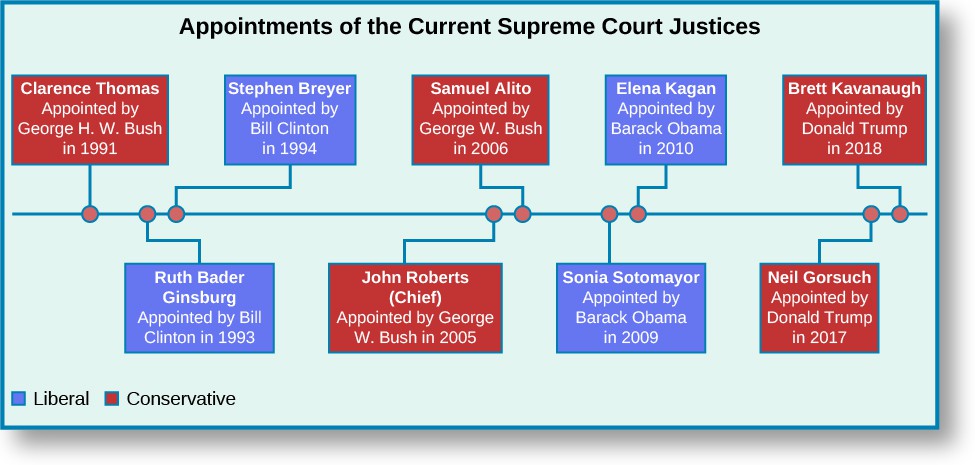
Nine justices sit on the Supreme Court: one Chief Justice and eight Associate Justices. The President nominates justices, and the Senate confirms them through a hearing and vote. Once confirmed, justices serve lifetime appointments (technically "during good behavior"), which insulates them from political pressure since they don't need to worry about reelection or reappointment.
The Court's core functions include:
- Serving as the final court of appeals in the federal judiciary
- Exercising judicial review, the power to strike down laws and executive actions that violate the Constitution. This power was established in Marbury v. Madison (1803), not written explicitly in the Constitution itself.
- Interpreting the meaning of the Constitution and federal laws as applied to specific disputes
- Resolving legal conflicts between states (boundary disputes, water rights, etc.)
- Hearing appeals from lower federal courts and state supreme courts when cases involve federal or constitutional questions
Supreme Court Case Selection Process
The Court receives thousands of petitions each year but only hears roughly 70–80 cases. Most cases arrive through a petition for a writ of certiorari, which is a formal request asking the Court to review a lower court's decision.
Justices use the "Rule of Four": at least four of the nine justices must agree to hear a case before certiorari is granted. When deciding whether to take a case, justices look at factors like:
- Circuit splits: lower courts in different regions have reached conflicting conclusions on the same legal issue
- The significance and broad impact of the legal question
- Whether the constitutionality of a law or government action is being challenged
Once the Court accepts a case, the decision-making process unfolds in stages:
- Oral arguments: Attorneys for each side present their case and answer questions from the justices. Outside groups with a stake in the outcome may submit amicus curiae ("friend of the court") briefs to offer additional perspectives or arguments.
- Conference: The justices meet privately to discuss the case and take a preliminary vote.
- Opinion writing: If the Chief Justice is in the majority, they assign who writes the majority opinion. If not, the most senior justice in the majority assigns it.
- The majority opinion announces the Court's ruling and lays out the legal reasoning behind it. This becomes binding law.
- A concurring opinion is written by a justice who agrees with the outcome but for different reasons.
- A dissenting opinion is written by justices who disagree with the majority. Dissents aren't law, but they can influence future cases and signal where the law might shift.

Impact of Supreme Court Decisions
Several landmark cases show how the Court has reshaped American law and daily life:
- Brown v. Board of Education (1954) struck down racial segregation in public schools, overturning the "separate but equal" doctrine from Plessy v. Ferguson.
- Roe v. Wade (1973) recognized a constitutional right to privacy that included the right to abortion. (This ruling was later overturned by Dobbs v. Jackson Women's Health Organization in 2022.)
- Obergefell v. Hodges (2015) legalized same-sex marriage nationwide under the Fourteenth Amendment's equal protection and due process clauses.
Beyond individual cases, the Court shapes American governance in broader ways. It protects individual rights like freedom of speech and due process, and it adapts constitutional principles to changing social and political conditions. Its rulings also provide guidance to lower courts, promoting more consistent application of the law across the country.
That said, the Court is not without controversy. Justices' personal ideologies can influence decisions, which raises ongoing questions about judicial objectivity. There's also a persistent debate over judicial activism (judges actively shaping policy through broad interpretations) versus judicial restraint (judges deferring to elected branches and interpreting the Constitution more narrowly). Court decisions can be overturned by constitutional amendments or by future Courts reversing precedent, so the law is never entirely settled.
Legal Principles and Interpretation
A few key legal concepts come up repeatedly when studying the Supreme Court:
- Jurisdiction: The Court's authority to hear a case. It has original jurisdiction in a narrow set of cases (such as disputes between states) and appellate jurisdiction over cases appealed from lower courts.
- Precedent: Earlier court decisions that guide how similar issues are decided in the future.
- Stare decisis: Latin for "to stand by things decided." This principle says courts should generally follow precedent, which promotes consistency and predictability in the law. The Court can overturn its own precedent, but doing so is relatively rare and usually controversial.
- Constitutional interpretation: The process of determining what the Constitution means as applied to a specific case. Different justices approach this differently, with some favoring originalism (interpreting the text as it was understood when written) and others favoring a living Constitution approach (interpreting the text in light of contemporary values and conditions).
See Fiveable more often in Google
Mark Fiveable as a preferred source and Google is more likely to show you our guides in Top Stories, with a "preferred" badge in AI Mode and AI Overviews.