7.1 Context: America in the World

🇺🇸AP US History Unit 7 Review
7.1 Context: America in the World
🇺🇸 AP US History
7.1
Context: America in the World
7.2
Imperialism: Debates
7.3
The Spanish-American War
7.4
The Progressives
7.5
World War I: Military and Diplomacy
7.6
World War I: Home Front
7.7
1920s: Innovations
7.8
1920s: Cultural and Political Controversies
7.9
The Great Depression
7.10
The New Deal
7.11
Interwar Foreign Policy
7.12
World War II: Mobilization
7.13
World War II: Military
7.14
Postwar Diplomacy
7.15
Comparison in Period 7
By the late 19th and early 20th centuries, the United States expanded its role in world affairs through industrial growth, overseas markets, naval power, and territorial acquisitions. This context helps explain debates over imperialism, war, diplomacy, and America's global identity.
Explain the context in which America grew into its role as a world power
What to Know About Context
- The US shifted from a rural, agricultural economy to an urban, industrial one, driven partly by large corporations, new technology, transportation, and immigrant labor.
- The Great Depression prompted new economic policies, and Roosevelt's New Deal added welfare programs, public works, reforms, and a larger federal role in the economy.
- New technology helped create a consumer culture, international migration brought new cultures to the US, and migration westward and southward affected transportation and industry.
- Economic interests and strategic goals drove US territorial expansion in the Western Hemisphere and Pacific, prompting debate over America's role abroad and fears of foreign conflicts.
- The US entered World War I in 1917 and helped defeat the Central Powers, and the war and its aftermath intensified debates over the nation's world role and how best to secure national security and advance American interests.
- World War II mobilization ended the Great Depression, and victory over the Axis powers made the US a superpower. Its wartime atomic weapons gave it leverage in the Cold War.
The Progressive Era
In the early 20th century, Progressives responded to economic instability, social problems, and political corruption by calling for government to take a larger role. Expansion had widened opportunity for many, but instability led reformers to seek changes to both American society and the nation's economic system. They pushed for reforms such as regulating big business, protecting workers and consumers, cleaning up city and state politics, and expanding democracy through measures like the direct election of senators and women's suffrage.
Economy
The United States experienced a significant economic transformation in the late 19th and early 20th centuries, as it transitioned from a largely rural, agricultural economy to an urban, industrial economy. The US economy grew into a major world importer and exporter, eventually becoming the world’s biggest economy (as measured by Gross Domestic Product, or GDP) by the 1920s.
This transformation was driven by several factors, including the growth of large corporations, advances in technology and transportation, and an influx of immigrants who provided a large and growing labor force. The growth of large companies, known as trusts, and the increasing concentration of wealth and power in the hands of a few large corporations, led to the rise of industrial capitalism, which shaped the economy of the United States during the 20th century.
On the other hand, the Great Depression challenged US politicians to come up with new solutions to increasing economic instability. Policymakers and politicians in the United States implemented a number of policies aimed at addressing the economic and social problems caused by the depression.
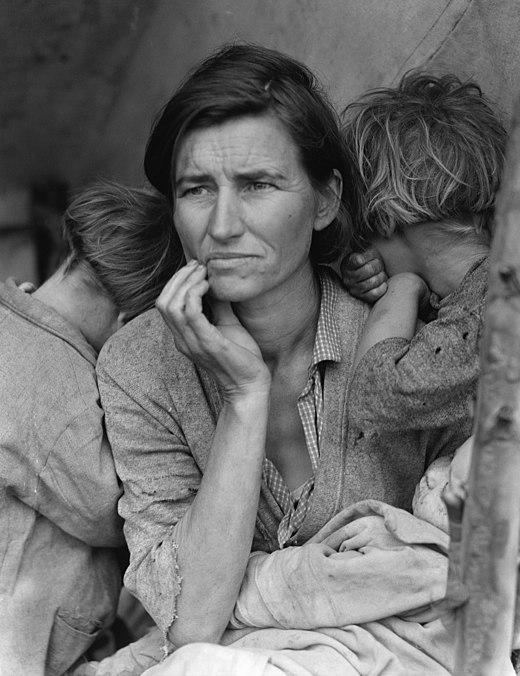
Image Courtesy of Wikipedia
President Franklin D. Roosevelt's New Deal was the most significant of these policies. It introduced a number of social welfare programs and government-funded public works projects, as well as financial and agricultural reforms. The New Deal also expanded the role of the federal government in the economy, and established new regulatory agencies to oversee key sectors of the economy.
These policies and programs, a response to the mass unemployment and social upheaval of the Great Depression in the 1930s, turned the US into a limited welfare state. They laid the foundation for the modern American welfare state and helped to redefine the goals and ideas of American liberalism, which had traditionally emphasized individualism and laissez-faire economics.
Technology & Migration
Thanks to new technologies that spread faster than ever, the US changed into a consumer culture, with fewer goods being made inside the home and more and more goods being “imported” from stores. Automobiles and radio made it possible for large numbers of people to access information, entertainment, and advertising on a scale that was previously unimaginable. As a result, popular culture became more influential in American life, and Americans debated its effects on morals, public values, and national identity.
The economic and political changes in the world, such as World War I, the Russian Revolution, and the Mexican Revolution, led to large-scale international migration, as people moved in search of better economic opportunities, political freedom, or to escape persecution. These migrations brought new cultures and diversity to the US.
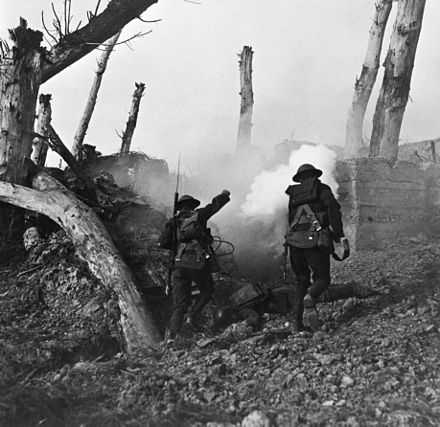
Image Courtesy of Wikipedia
People also migrated within the US. Suburbanization and migration westward and southward had a massive impact on transportation and industry.
Foreign Policy
The US grew into a dominant position militarily and politically through this time period. At the start of the period, the US was generally uninvolved in overseas events other than through trade.
In the late 19th century and early 20th century, the United States began to assert its territorial ambitions and acquisitions in the Western Hemisphere and the Pacific. This expansion was driven by a number of factors, including economic interests, political considerations, and a desire for strategic advantage. The U.S. annexed Hawaii in 1898 and acquired Puerto Rico, Guam and Philippines from Spain, the U.S. also acquired the Panama Canal Zone, which was a significant strategic acquisition.
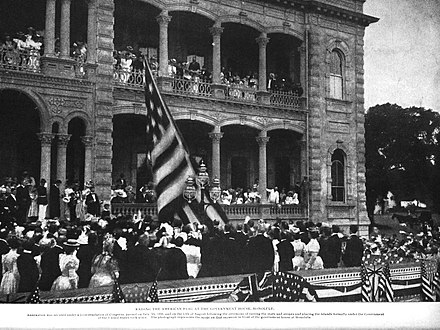
Image Courtesy of Wikipedia
These territorial acquisitions and expansion led to heightened public debates over America's role in the world. Some Americans viewed expansion as a means of fulfilling the nation's Manifest Destiny and spreading American values and institutions to other parts of the world. Others opposed expansion, arguing that it would lead to entanglement in foreign conflicts and the erosion of American values and traditions.
The U.S. entered World War I in 1917, and its participation played a key role in the eventual defeat of the Central Powers. Despite being a huge provider of loans and military equipment, the US promptly returned to isolationism under new presidential administrations.
U.S. participation in World War II, which lasted from 1939 to 1945, had a profound impact on American society and economy. The war effort required the mobilization of the American economy, which led to the end of the Great Depression and the country's transformation into the "arsenal of democracy." Millions of Americans were drafted or volunteered to fight, and the war effort required the involvement of millions of Americans on the home front as well, including women and minorities, who participated in the war effort in unprecedented numbers.
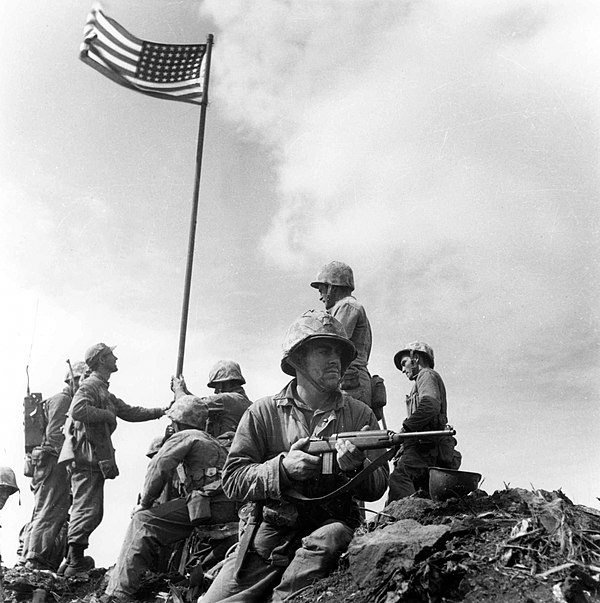
Image Courtesy of Wikipedia
The victory of the United States and its allies over the Axis powers in World War II led to the emergence of the United States as a superpower. The U.S. played a key role in the formation of the United Nations and the establishment of the Bretton Woods system, which helped to rebuild the post-war international economy. Additionally, the U.S. had developed atomic weapons during the war and it was the only country in possession of those weapons. This gave the country a powerful leverage in the Cold War that followed.
The U.S. emerged from World War II as the world's leading economic and military power, and its leadership role in the post-war period set the stage for American dominance in international affairs during the second half of the 20th century and beyond.
🎥 Watch: AP US History -
Practice Questions for 7.1
1 of 10
The late-19th-century shift from a rural agricultural to an urban industrial economy most directly enabled which U.S. foreign-policy development?
A.
Adoption of mercantilist policies restricting foreign trade and commerce
B.
Territorial expansion into the Western Hemisphere and Pacific to secure markets
C.
A turn toward isolationism that rejected overseas trade and security commitments
D.
Greater dependence on European capital and foreign investment flows
Vocabulary
The following words are mentioned explicitly in the AP® course framework for this topic.Term | Definition |
|---|---|
American interests | The political, economic, and strategic goals and objectives pursued by the United States in domestic and foreign policy. |
American liberalism | A political ideology emphasizing government intervention in the economy and society to promote social welfare and individual rights. |
Axis powers | The alliance of Nazi Germany, Imperial Japan, and Fascist Italy defeated by the United States and its allies in World War II. |
economic instability | Periods of economic uncertainty characterized by fluctuating markets, unemployment, and unpredictable business conditions. |
global leadership | A position of international influence and authority in political, military, and economic affairs. |
Great Depression | A severe economic crisis in the 1930s characterized by widespread unemployment, falling prices, and reduced consumer spending that had profound effects on the U.S. economy and society. |
internal migration | The movement of people within the United States from one region or area to another. |
international migration | The movement of people from one country to another, often in search of economic opportunity or to escape difficult conditions. |
limited welfare state | A government system that provides social and economic assistance to citizens while maintaining a mixed economy, developed during the New Deal era. |
mass culture | Standardized cultural products and values produced for and consumed by large populations, particularly through media and entertainment. |
mass unemployment | Widespread joblessness affecting a large portion of the working population. |
national security | The protection of a nation's interests, territory, and citizens from external threats. |
Pacific | The Pacific Ocean region where the United States acquired territories and pursued imperial expansion in the late 19th and early 20th centuries. |
political corruption | Dishonest or unethical conduct by government officials and politicians. |
Progressive Era | The early 20th century period of American history characterized by reform movements addressing political corruption, economic inequality, and social problems. |
Progressives | Early 20th century reformers who advocated for greater government action to address political corruption, economic instability, and social concerns. |
rural, agricultural economy | An economy based primarily on farming and natural resource extraction, characteristic of pre-industrial America. |
territorial ambitions | American desires to acquire and control territory beyond its continental borders in the late 19th and early 20th centuries. |
urban, industrial economy | An economy centered on manufacturing and city-based production, led by large corporations and factories. |
Western Hemisphere | The half of Earth containing North and South America, which became a focus of U.S. foreign policy and influence. |
world power | A nation with significant global political, military, and economic influence capable of affecting international affairs. |
World War I | The global conflict (1914-1918) that intensified American debates about the nation's international role and security interests. |
World War II | The global conflict (1939-1945) in which U.S. participation transformed American society and established the nation as a global superpower. |
See Fiveable more often in Google
Mark Fiveable as a preferred source and Google is more likely to show you our guides in Top Stories, with a "preferred" badge in AI Mode and AI Overviews.