2.6 Real vs Nominal GDP

💶AP Macroeconomics Unit 2 Review
2.6 Real vs Nominal GDP
💶 AP Macroeconomics
Nominal GDP measures output using current year prices, so it goes up when prices rise, when production rises, or both. Real GDP uses constant base year prices to strip out price changes, which is why it's the better measure for comparing how much an economy actually produces over time.
How to Calculate Real GDP AP Macro
To calculate real GDP in AP Macro, use base-year prices instead of current-year prices. Multiply each good's current-year quantity by its base-year price, then add the values together. That removes price-level changes so you can compare actual output across years.
If the problem gives you nominal GDP and the GDP deflator, use: Real GDP = Nominal GDP / (GDP deflator / 100). For example, if nominal GDP is 800 and the deflator is 125, real GDP is 800 / 1.25 = 640.
Why This Matters for the AP Macroeconomics Exam
This topic builds a skill the AP Macroeconomics exam expects from you: turning given price and quantity data into real values and price-level measures. Multiple-choice questions often hand you nominal GDP and a deflator and ask for real GDP, or give you output data across two years and ask whether the economy truly grew. Free-response prompts can ask you to calculate real GDP or the GDP deflator and then explain what the result tells you about output versus prices.
Getting comfortable with the difference between "how much is spent" and "how much is produced" also sets you up for later units. Once you can separate price changes from output changes, you'll read AD-AS graphs, growth, and inflation problems much more accurately.
Key Takeaways
- Nominal GDP uses current-year prices and measures how much is spent on output, so it changes with prices, output, or both.
- Real GDP uses constant base-year prices and measures how much is produced, removing the effect of price level changes.
- Use real GDP, not nominal GDP, to compare output across different years.
- GDP deflator = (Nominal GDP / Real GDP) x 100, and it equals 100 in the base year.
- Convert with Real GDP = Nominal GDP / (GDP deflator / 100) and Nominal GDP = Real GDP x (GDP deflator / 100).
- Weighting output by a fixed base year is the simple AP method, but it can overstate real GDP growth, so statistical agencies use updated methods in practice.
Nominal GDP vs. Real GDP
Nominal GDP is the dollar value of final goods and services produced in a country, measured using current-year prices. Because it uses current prices, nominal GDP measures spending on output and can change because of changes in prices, changes in output, or both.
Here's the problem with relying on nominal GDP alone. Say GDP was $100 one year and $200 the next. That could mean production doubled, or it could mean prices doubled while output stayed flat. If prices doubled, the economy didn't actually produce more, the numbers just got bigger. Because nominal GDP can't tell those two situations apart, it's a poor tool for comparing output over time when the price level changes.
Real GDP fixes this. Real GDP is the dollar value of final goods and services produced in a country, measured using base-year (constant) prices. Because it holds prices constant, real GDP measures the quantity of output produced and removes the effect of changes in the overall price level. That lets you compare economic performance across years and see whether the country actually produced more.
The short version: nominal GDP measures how much is spent on output, and real GDP measures how much is produced.
How to Calculate Nominal and Real GDP
The basic method comes down to which prices you multiply quantities by.
- Nominal GDP: Multiply the quantity of each good produced in a year by that good's price in that same year.
- Real GDP: Multiply the quantity of each good produced by the base-year prices.
Using base-year prices is the standard way to calculate real GDP for this course. Keep in mind that a fixed base year can overstate real GDP growth over time, which is why statistical agencies use updated methods in practice. For the AP exam, the base-year approach is what you'll usually apply.
Worked Example 1


Using United States GDP data for 2018 and 2019, with 2018 as the base year:
2018 Nominal GDP = Steel ($4,000,000) + Wheat ($600,000) + Corn ($600,000) + Sugar ($100,000) = $5,300,000
2019 Nominal GDP = Steel ($5,500,000) + Wheat ($900,000) + Corn ($1,200,000) + Sugar ($400,000) = $8,000,000
2019 Real GDP = Steel (550,000 x $8) + Wheat (300,000 x $3) + Corn (400,000 x $2) + Sugar (200,000 x $1) = $6,300,000
Notice that 2019 real GDP ($6,300,000) is lower than 2019 nominal GDP ($8,000,000). The gap comes from price increases between 2018 and 2019. Real GDP shows the true growth in output.
Worked Example 2


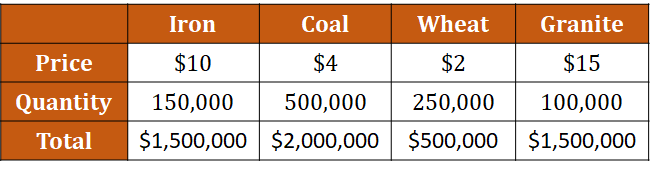
Using Germany GDP data for 2017 and 2018, with 2017 as the base year:
2017 Nominal GDP = Iron ($1,500,000) + Coal ($2,000,000) + Wheat ($500,000) + Granite ($1,500,000) = $5,500,000
2018 Nominal GDP = Iron ($1,500,000) + Coal ($3,500,000) + Wheat ($900,000) + Granite ($2,000,000) = $7,900,000
2018 Real GDP = Iron (100,000 x $10) + Coal (500,000 x $4) + Wheat (300,000 x $2) + Granite (100,000 x $15) = $5,100,000
Again, 2018 real GDP ($5,100,000) is well below nominal GDP ($7,900,000), showing how much of the apparent increase was price-driven rather than output-driven.
Using the GDP Deflator
The GDP deflator is a price index that captures the effect of inflation across all the goods and services in GDP. Instead of comparing market baskets like CPI does, it compares the nominal and real GDP of a country in a given year. When nominal GDP equals real GDP (zero inflation since the base year), the GDP deflator is 100. It's called a "deflator" because it's used to deflate a nominal GDP figure that's inflated by higher prices.
The formula is:
GDP Deflator = (Nominal GDP / Real GDP) x 100
You can rearrange it to solve for either GDP measure:
Nominal GDP = Real GDP x (GDP Deflator / 100)
Real GDP = Nominal GDP / (GDP Deflator / 100)
Quick conversion: If nominal GDP is $800 and the GDP deflator is 125, then Real GDP = 800 / 1.25 = $640. Going the other way, if real GDP is $640 and the deflator is 125, then Nominal GDP = 640 x 1.25 = $800.
Worked Example 1
Great Britain GDP data, with 2017 as the base year:
- 2017 Nominal GDP = $11,000,000
- Because 2017 is the base year, nominal GDP and real GDP are equal, so the GDP deflator for 2017 is 100. (The base-year deflator is always 100.)
For 2018:
- 2018 Nominal GDP = $20,000,000
- 2018 Real GDP = $11,000,000
- GDP Deflator for 2018 = (20,000,000 / 11,000,000) x 100 = 181.818..., which rounds to 182
Worked Example 2
Italy GDP data, with 2017 as the base year:
- 2017 Nominal GDP = $9,000,000
- Since 2017 is the base year, nominal and real GDP are equal, so the GDP deflator for 2017 is 100.
For 2018:
- 2018 Nominal GDP = $13,000,000
- 2018 Real GDP = $9,000,000
- GDP Deflator for 2018 = (13,000,000 / 9,000,000) x 100 = 144.444..., which rounds to 144.4 (or 144 if rounding to a whole number)
How to Use This on the AP Macroeconomics Exam
Problem Solving
- When you're given quantities and prices for multiple years, calculate nominal GDP with each year's own prices and real GDP with base-year prices. Don't mix them up.
- The base year always has nominal GDP equal to real GDP and a GDP deflator of 100. Use this as a quick check on your work.
- If a problem gives you two of the three values (nominal GDP, real GDP, GDP deflator), use the deflator formula to solve for the missing one.
- Watch your decimal placement when dividing by the deflator. Dividing by 125 means dividing by 1.25, not 125.
Common Trap
- Don't read a rising nominal GDP as proof the economy produced more. Until you remove price changes with real GDP, you can't separate growth from inflation.
Common Misconceptions
- Misconception: A higher nominal GDP means the economy grew.Actually: Not necessarily. Nominal GDP rises with higher prices too, so you need real GDP to know if output actually increased.
- Misconception: Real GDP and nominal GDP are always different numbers.Actually: In the base year they're equal, which is exactly why the base-year deflator is 100.
- Misconception: The GDP deflator and CPI are the same thing.Actually: Both track price changes, but the GDP deflator compares nominal and real GDP across all goods and services in output, while CPI tracks the cost of a fixed basket of consumer goods.
- Misconception: The GDP deflator is measured in dollars.Actually: It's an index number, not a dollar amount. A deflator of 182 means prices are 82 percent higher than in the base year.
- Misconception: Using a fixed base year gives a perfect measure of growth.Actually: It's the standard classroom method, but a fixed base year can overstate real GDP growth, which is why statistical agencies use updated methods in practice.
Related AP Macroeconomics Guides
Practice Questions for 2.6
1 of 10
| Year | Nominal GDP | Real GDP |
|---|---|---|
| Year 1 | \$500 billion | \$500 billion |
| Year 2 | \$600 billion | \$550 billion |
| Year 3 | \$650 billion | \$600 billion |
The table above displays nominal and real GDP data for a hypothetical economy.
Based on the calculations from the table, what happened to the GDP deflator between Year 2 and Year 3?
A.
The GDP deflator remained constant because nominal and real GDP both increased by $50 billion.
B.
The GDP deflator increased, indicating that prices have risen relative to the base year.
C.
The GDP deflator decreased, indicating that the overall price level fell.
D.
The GDP deflator increased, indicating that the overall price level rose.
E.
The GDP deflator cannot be determined without knowing the prices of individual goods.
Vocabulary
The following words are mentioned explicitly in the AP® course framework for this topic.Term | Definition |
|---|---|
aggregate output | The total quantity of goods and services produced in an economy, typically measured as real GDP. |
base year | A reference year used to standardize prices when calculating real GDP, allowing for comparison of economic output across different time periods. |
constant prices | Prices from a fixed base year used to measure output across different time periods while removing the effect of inflation. |
current prices | The market prices of goods and services in the time period being measured. |
final goods and services | Products and services produced for end consumers rather than for further processing or resale in the production chain. |
GDP deflator | A price index that measures the ratio of nominal GDP to real GDP, used to convert nominal GDP to real GDP by adjusting for inflation. |
nominal GDP | The total monetary value of all final goods and services produced in an economy during a specific period, measured using current prices without adjustment for inflation. |
price level | The average of all prices of goods and services produced in an economy, typically measured by price indices like the CPI. |
real GDP | The total monetary value of all final goods and services produced by an economy, adjusted for inflation to reflect actual changes in production. |
Frequently Asked Questions
How do you calculate real GDP in AP Macro?
To calculate real GDP, multiply current-year quantities by base-year prices and add the values together. If you have nominal GDP and the GDP deflator, use real GDP = nominal GDP divided by (GDP deflator / 100).
What is the difference between nominal GDP and real GDP?
Nominal GDP uses current-year prices, so it changes with prices and output. Real GDP uses constant base-year prices, so it removes price-level changes and better measures output growth.
What is the nominal GDP formula in AP Macro?
Nominal GDP equals the sum of each current-year quantity multiplied by its current-year price. It measures spending on final goods and services using current prices.
How do you use the GDP deflator to find real GDP?
Divide nominal GDP by the GDP deflator expressed as a decimal. For example, a deflator of 125 becomes 1.25, so real GDP equals nominal GDP divided by 1.25.
Why is real GDP better for comparing output over time?
Real GDP holds prices constant, so changes in real GDP show changes in production rather than changes in the price level. That makes it better for comparing economic growth across years.
How does Topic 2.6 show up on the AP Macroeconomics exam?
Questions may ask you to calculate nominal GDP, calculate real GDP with base-year prices, use the GDP deflator, or explain whether a GDP increase reflects output growth or inflation.
See Fiveable more often in Google
Mark Fiveable as a preferred source and Google is more likely to show you our guides in Top Stories, with a "preferred" badge in AI Mode and AI Overviews.