5.2 The Phillips Curve

💶AP Macroeconomics Unit 5 Review
5.2 The Phillips Curve
💶 AP Macroeconomics
The Phillips curve shows the relationship between inflation and unemployment. In the short run, the downward-sloping short-run Phillips curve (SRPC) shows a trade-off: lower unemployment usually comes with higher inflation.
Phillips Curve AP Macro Definition
The Phillips curve model represents the relationship between inflation and unemployment. The SRPC shows the short-run trade-off between inflation and unemployment, while the LRPC is vertical at the natural rate of unemployment. Demand shocks move the economy along the SRPC, supply shocks shift the SRPC, and changes in the natural rate of unemployment shift the LRPC.
Why This Matters for the AP Macroeconomics Exam
The Phillips curve is one of the models you are expected to draw, label, and analyze in AP Macroeconomics, and it is a frequent challenge area on the exam. It directly mirrors the AD-AS model, so getting comfortable with it strengthens your ability to explain cause and effect across both models.
You will be expected to:
- Draw and label the SRPC and the vertical LRPC correctly.
- Tell the difference between movement along the SRPC and a shift of the SRPC.
- Connect demand shocks and supply shocks to the right changes on the graph.
- Explain short-run versus long-run outcomes for inflation and unemployment.
Because the exam rewards full cause-and-effect chains, you should be able to explain not just what moves, but why it moves.
Key Takeaways
- The SRPC slopes downward and shows the short-run trade-off between inflation and unemployment. The economy is always operating somewhere on it.
- The LRPC is vertical at the natural rate of unemployment, meaning there is no permanent trade-off in the long run.
- Long-run equilibrium is where the SRPC and LRPC intersect, at the natural rate of unemployment.
- Points left of long-run equilibrium (unemployment below natural rate) show an inflationary gap. Points right of it (unemployment above natural rate) show a recessionary gap.
- Demand shocks cause movement along the SRPC. Supply shocks shift the SRPC.
- Changes in the natural rate of unemployment shift the LRPC.
The Phillips Curve Model
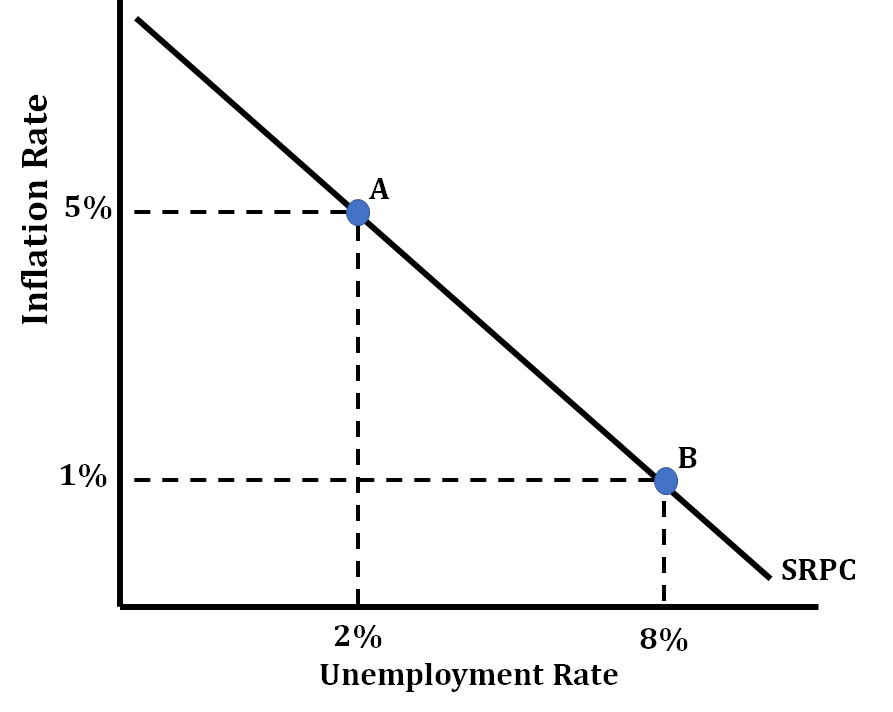
The Phillips curve graphs the relationship between the inflation rate and the unemployment rate. It is closely tied to the AD-AS model, so the same events you analyze there show up here in a different form.
The horizontal axis measures the unemployment rate, and the vertical axis measures the inflation rate. There are two curves to know:
- The short-run Phillips curve (SRPC) slopes downward, showing the short-run trade-off between inflation and unemployment.
- The long-run Phillips curve (LRPC) is vertical at the natural rate of unemployment.
The economy is always operating at some point on the SRPC. Long-run equilibrium is where the SRPC crosses the vertical LRPC, which sits at the natural rate of unemployment (the same level of employment shown by the LRAS curve in the AD-AS model).
Inflationary and Recessionary Gaps
Where you are relative to long-run equilibrium tells you about output gaps:
- A point to the left of long-run equilibrium means unemployment is below the natural rate. This corresponds to an inflationary gap.
- A point to the right of long-run equilibrium means unemployment is above the natural rate. This corresponds to a recessionary gap.
Demand Shocks: Movement Along the SRPC

Demand shocks cause the economy to move along the existing SRPC. This is the short-run trade-off in action.
- When aggregate demand increases, inflation rises and unemployment falls. On the graph, you move up and to the left along the SRPC.
- When aggregate demand decreases, inflation falls and unemployment rises. On the graph, you move down and to the right along the SRPC.
This mirrors the AD-AS model. An increase in AD raises the price level and real GDP, which means higher inflation and lower unemployment. A decrease in AD lowers the price level and real GDP, which means lower inflation and higher unemployment. The point that moves from A to B in the AD-AS model corresponds to a movement from A to B along the SRPC.
In the long run, wages and expectations adjust, so unemployment returns to the natural rate and the economy settles back on the LRPC. That is why there is no permanent trade-off between inflation and unemployment.
Supply Shocks: Shifts of the SRPC
Supply shocks shift the entire SRPC instead of causing movement along it. A useful rule: when the SRAS curve shifts one direction, the SRPC shifts the opposite direction.
- A favorable supply shock shifts SRAS right, which shifts the SRPC left. Inflation and unemployment both fall.
- An adverse supply shock shifts SRAS left, which shifts the SRPC right. Inflation and unemployment both rise.
When inflation and unemployment rise at the same time, the economy is in stagflation. In this model, stagflation comes from an adverse supply shock that shifts the SRPC right. The oil price shocks of the 1970s are a common real-world example of an adverse supply shock, though that historical case is an application rather than required content.
In the long run, unemployment stays anchored at the natural rate shown by the LRPC unless the natural rate itself changes.
The Long-Run Phillips Curve

The LRPC is vertical at the natural rate of unemployment, which lines up with full employment and the LRAS curve. Because it is vertical, it shows there is no long-run trade-off between inflation and unemployment. Policies that try to push unemployment below the natural rate end up only changing the inflation rate in the long run, not the unemployment rate.
Factors that change the natural rate of unemployment shift the LRPC:
- If the natural rate rises, the LRPC shifts right.
- If the natural rate falls, the LRPC shifts left.
Things that can change the natural rate include shifts in labor market institutions, how efficiently workers and jobs match, demographics, and government labor-market policies.
How to Use This on the AP Macroeconomics Exam
Free Response
When a free-response question describes an event, decide first whether it is a demand shock or a supply shock. That choice tells you whether to show movement along the SRPC or a shift of the SRPC. Then walk through the full chain: name the cause, show the graph change, and state what happens to both inflation and unemployment.
Label everything: both axes, the SRPC, the vertical LRPC, the natural rate of unemployment, and your starting and ending points. Unlabeled graphs lose easy points.
MCQ
Multiple-choice questions often test whether you can tell movement from a shift. If the prompt is about a change in aggregate demand, expect movement along the SRPC. If it is about a supply shock, expect a shift of the SRPC. Questions may also ask you to connect a point on the Phillips curve to an inflationary or recessionary gap.
Common Trap
Remember the inverse direction rule for supply shocks. A rightward shift of SRAS goes with a leftward shift of the SRPC, and a leftward shift of SRAS goes with a rightward shift of the SRPC. Mixing this up is one of the most common errors on this topic.
Common Misconceptions
- Misconception: The short-run trade-off is permanent.Actually: The short-run trade-off is not permanent. In the long run, unemployment returns to the natural rate, so the LRPC is vertical and there is no lasting trade-off.
- Misconception: Demand shocks shift the SRPC.Actually: Demand shocks do not shift the SRPC. They cause movement along it. Only supply shocks shift the SRPC.
- Misconception: A point on the LRPC means zero unemployment.Actually: A point on the LRPC does not mean zero unemployment. It means unemployment is at the natural rate, which still includes frictional and structural unemployment.
- Misconception: Stagflation is caused by a demand shock.Actually: Stagflation is not caused by a demand shock. It comes from an adverse supply shock that raises both inflation and unemployment.
- Misconception: Left of long-run equilibrium is a recessionary gap.Actually: Left of long-run equilibrium is not a recessionary gap. Unemployment below the natural rate is an inflationary gap. Unemployment above the natural rate (to the right) is a recessionary gap.
- Misconception: The SRAS and SRPC shift the same direction.Actually: The SRAS and SRPC do not shift the same direction. They move in opposite directions.
Related AP Macroeconomics Guides
Practice Questions for 5.2
1 of 10
The graph above shows the Phillips curve model for an economy currently operating at point K.
Based on the quantitative data shown, what can be concluded about the current state of the economy?
A.
The economy is at full employment and is experiencing deflation.
B.
The economy is in a recessionary gap and is experiencing deflation.
C.
The economy is in an inflationary gap and is experiencing disinflation.
D.
The economy is at full employment and is experiencing inflation.
E.
The economy is in a recessionary gap and is experiencing stagflation.
Vocabulary
The following words are mentioned explicitly in the AP® course framework for this topic.Term | Definition |
|---|---|
demand shocks | Unexpected changes in aggregate demand that cause movement along the short-run Phillips curve. |
employment | The state of having a paid job or being engaged in work for compensation. |
inflation | A sustained increase in the general price level of goods and services in an economy over time. |
inflationary gap | An economic condition represented by points to the left of long-run equilibrium, where actual output exceeds potential output and inflation pressures exist. |
long run | A time period in macroeconomics where all factors of production are variable and prices fully adjust to changes in supply and demand. |
long-run equilibrium | The point where the short-run Phillips curve intersects the long-run Phillips curve, representing a stable economic state. |
long-run Phillips curve | A vertical curve at the natural rate of unemployment that illustrates the long-run relationship between inflation and unemployment. |
natural rate of unemployment | The unemployment rate that exists when the economy produces full-employment real output, equal to the sum of frictional and structural unemployment. |
Phillips curve model | An economic model showing the relationship between the rate of inflation and the rate of unemployment in an economy. |
recessionary gap | An economic condition represented by points to the right of long-run equilibrium, where actual output falls short of potential output and unemployment is elevated. |
short run | A time period in macroeconomics where at least one factor of production is fixed and prices may not fully adjust to changes in demand. |
short-run equilibrium | The point where aggregate demand and short-run aggregate supply intersect, determining the current price level and output in the Phillips curve model. |
short-run Phillips curve | A downward-sloping curve that illustrates the short-run trade-off between inflation and unemployment in an economy. |
supply shocks | Unexpected changes in aggregate supply that cause the short-run Phillips curve to shift. |
Frequently Asked Questions
What is the Phillips curve in AP Macro?
The Phillips curve is a graph that shows the relationship between inflation and unemployment. AP Macro uses it to compare short-run trade-offs with long-run outcomes.
What is the difference between SRPC and LRPC?
The SRPC slopes downward and shows the short-run trade-off between inflation and unemployment. The LRPC is vertical at the natural rate of unemployment, showing no permanent long-run trade-off.
Why is the long-run Phillips curve vertical?
The LRPC is vertical because unemployment returns to the natural rate in the long run after wages and expectations adjust. Long-run changes affect inflation, not the natural rate itself.
What causes movement along the SRPC?
Demand shocks cause movement along the SRPC. An increase in aggregate demand moves the economy up and left, while a decrease in aggregate demand moves it down and right.
What causes the SRPC to shift?
Supply shocks shift the SRPC. A favorable supply shock shifts it left, and an adverse supply shock shifts it right.
How do I identify inflationary and recessionary gaps on a Phillips curve?
A point left of the LRPC means unemployment is below the natural rate, which is an inflationary gap. A point right of the LRPC means unemployment is above the natural rate, which is a recessionary gap.
See Fiveable more often in Google
Mark Fiveable as a preferred source and Google is more likely to show you our guides in Top Stories, with a "preferred" badge in AI Mode and AI Overviews.