6.6 Group Decision-Making

👥Organizational Behavior Unit 6 Review
6.6 Group Decision-Making
👥 Organizational Behavior
Group Decision-Making in Organizations
Group decision-making harnesses the knowledge and perspectives of multiple people to tackle organizational problems. Understanding when it works well and when it breaks down is central to managerial decision-making, because most significant organizational decisions happen in teams, committees, or boards rather than in isolation.
Advantages vs. Disadvantages of Group Decisions
Group decisions tend to be higher quality than individual ones, but they come with real tradeoffs. Knowing both sides helps you decide when a group process is worth the extra time and effort.
Advantages:
- Diverse perspectives and expertise. Different members bring different knowledge bases, so the group can spot problems or opportunities that any single person would miss.
- Greater creativity. The exchange of ideas during brainstorming can spark solutions no one member would have reached alone.
- Better decision quality. Multiple viewpoints mean more thorough critique of alternatives before a final choice is made.
- Stronger buy-in. People who participate in making a decision are more likely to support its implementation, which matters enormously for execution.
- Shared responsibility. The weight of a risky or high-stakes decision doesn't fall on one person's shoulders.
Disadvantages:
- Slower process. Discussion, debate, and consensus-building all take time. When speed matters, group decisions can be a liability.
- Groupthink risk. Members may conform to the majority opinion rather than voice concerns. The Bay of Pigs invasion is a classic example of groupthink leading to a catastrophic policy decision.
- Domination by vocal members. One or two influential personalities can steer the group, effectively turning a "group" decision into an individual one with extra steps.
- Difficulty reaching consensus. The more diverse the opinions, the harder it can be to converge on a single course of action, especially in large committees.
- Diffused accountability. When everyone is responsible, no one feels fully responsible. This can reduce the sense of ownership over outcomes.

Techniques for Improving Group Decisions
Poor group decisions usually aren't caused by having the wrong people in the room. They're caused by a flawed process. These techniques address the most common process failures.
Encourage open communication and active participation. Build psychological safety, which means members trust they won't be punished or embarrassed for speaking up. Without it, quieter members self-censor and the group loses valuable input. Practically, this means the leader should invite input from everyone, not just wait for volunteers.
Assign clear roles and responsibilities. A facilitator keeps the discussion on track and manages time. A devil's advocate is specifically tasked with challenging assumptions and poking holes in the emerging consensus. The devil's advocate role is one of the most effective defenses against groupthink because it makes dissent part of the job rather than an act of social risk.
Use a structured decision-making process. Without structure, groups tend to jump to solutions before fully understanding the problem. A solid process looks like this:
- Clearly define the problem and the objectives.
- Generate alternative solutions (keep idea generation separate from evaluation).
- Systematically evaluate alternatives using tools like decision matrices, cost-benefit analyses, or a Pugh matrix.
- Select the best alternative based on agreed-upon criteria.
- Plan implementation and assign follow-up accountability.
Foster constructive conflict. Respectful disagreement actually improves decisions. Actively seek out dissenting opinions and treat them as contributions, not disruptions. Research on minority influence shows that even a single dissenter can push the group toward more careful, creative thinking.
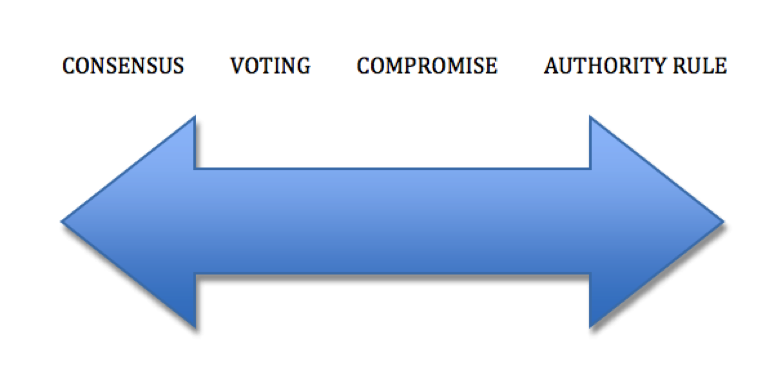
Establish group norms and ground rules. Set expectations upfront for how members will communicate, how conflicts will be handled, and how final decisions will be made (e.g., majority vote vs. consensus). Having a protocol for managing disagreements prevents conflict from becoming personal.
Advanced Group Decision-Making Techniques
These structured methods go beyond general best practices. Each one is designed to solve a specific problem that arises in group settings.
- Nominal Group Technique (NGT). Members first generate ideas individually and silently, then share them with the group one at a time. Ideas are discussed and ranked through a structured voting process. NGT prevents dominant personalities from controlling the conversation and ensures every member's ideas get equal airtime.
- Delphi Technique. Experts respond to a series of anonymous questionnaires across multiple rounds. After each round, a summary of responses is shared, and participants can revise their answers. Because responses are anonymous, status and social pressure don't distort the results. This technique is especially useful for forecasting or when experts are geographically dispersed.
- Decision Trees. A visual tool that maps out possible choices, their likely outcomes, and the probabilities associated with each path. Decision trees force the group to think systematically about consequences rather than relying on gut feeling.
- Stakeholder Analysis. Before making a decision, the group identifies all individuals or groups who will be affected by it and assesses their interests and influence. This ensures the group doesn't overlook perspectives that could derail implementation later.
Pitfalls in Group Decision-Making
Even well-intentioned groups fall into predictable traps. Recognizing these pitfalls is the first step toward avoiding them.
Groupthink is the most heavily studied pitfall. It occurs when the desire for harmony and conformity overrides realistic evaluation of alternatives. Irving Janis identified several symptoms:
- Illusion of invulnerability: The group feels it can't fail, leading to excessive risk-taking.
- Belief in the group's inherent morality: Members assume their decisions are ethically sound without scrutiny.
- Stereotyping of outgroups: Outsiders or critics are dismissed as uninformed or hostile.
- Self-censorship and pressure on dissenters: Members who disagree stay quiet, and those who do speak up face social pressure to fall in line.
The Challenger space shuttle disaster is a frequently cited example: engineers who had concerns about launching in cold temperatures were overridden by group pressure and organizational norms favoring the launch schedule.
Suppression of dissent is closely related to groupthink but can occur even without full-blown groupthink dynamics. It happens when members feel pressure to conform due to fear of retaliation, a desire to maintain cohesion, or simply a lack of psychological safety. The result is the same: the group loses access to alternative perspectives that could have improved the decision.
Other common pitfalls include:
- Anchoring bias: The group fixates on the first piece of information introduced (such as an initial cost estimate) and adjusts insufficiently from that anchor, even when better data is available.
- Confirmation bias: Members selectively seek or emphasize information that supports what they already believe, creating an echo chamber effect.
- Sunk cost fallacy: The group continues investing in a failing course of action because of resources already spent, rather than evaluating the decision based on future costs and benefits alone.
- Escalation of commitment: A more extreme version of the sunk cost fallacy, where the group doubles down on a losing strategy. The U.S. involvement in the Vietnam War is often cited as an example of escalation of commitment at the policy level.
The common thread across all these pitfalls is that they substitute social or cognitive shortcuts for careful analysis. Structured processes, assigned dissent roles, and awareness of these biases are your best defenses.
See Fiveable more often in Google
Mark Fiveable as a preferred source and Google is more likely to show you our guides in Top Stories, with a "preferred" badge in AI Mode and AI Overviews.