19.5 Design Thinking

👥Organizational Behavior Unit 19 Review
19.5 Design Thinking
👥 Organizational Behavior
Design Thinking for Entrepreneurship
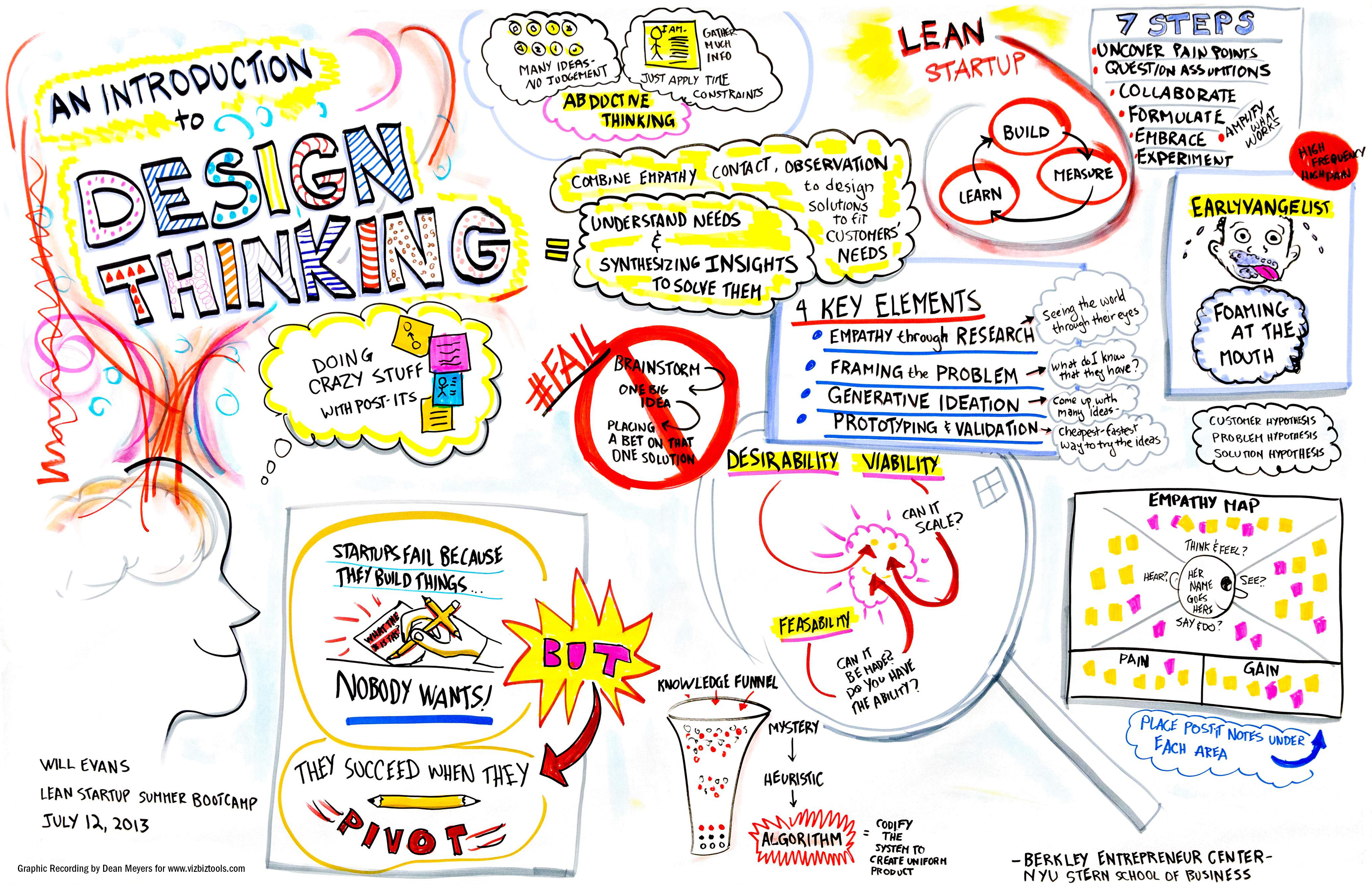
Design thinking gives entrepreneurs a structured way to understand customer needs before committing resources to a solution. Instead of building something and hoping people want it, you start by learning what problems actually exist, generate a wide range of possible solutions, then test and refine the best ones. This dramatically lowers the risk of building something nobody needs.
The process moves through three phases: inspiration, ideation, and implementation. It also relies on two complementary modes of thinking: divergent thinking (generating lots of ideas) and convergent thinking (narrowing down to the best ones). Together, these create a cycle of exploration and refinement that keeps the customer at the center.
Design Thinking for Entrepreneurial Opportunities
Design thinking shifts the starting point of entrepreneurship from "what can we build?" to "what do people actually need?" This matters because most startups fail not from bad execution, but from solving the wrong problem.
Here's how design thinking supports entrepreneurs at each stage:
- Empathize with potential customers to uncover unmet needs and pain points. This might involve ethnographic research, interviews, or simply observing how people struggle with existing solutions (long wait times, confusing interfaces).
- Reframe problems in a customer-centric way. Rather than defining the problem from the business's perspective, you define it from the user's. This often reveals unique opportunities like personalized recommendations or streamlined processes that competitors have missed.
- Rapidly prototype and test solutions to validate assumptions before investing heavily. Early prototypes can be as simple as 3D-printed models, landing pages, or paper mockups.
- Iterate based on real feedback. User testing, A/B testing, and other feedback loops let you continuously improve the product or service rather than guessing what works.
- Reduce the risk of failure by validating concepts early and often. Tools like minimum viable products (MVPs) and crowdfunding campaigns let you gauge demand before full-scale development.
The end result is solutions grounded in real user needs, which naturally differentiate your venture from competitors through unique features or a superior user experience.

Phases of the Design Thinking Process
The three phases don't always happen in a strict sequence. Teams often loop back to earlier phases as they learn more. But the general flow moves from understanding the problem to generating solutions to testing them.
1. Inspiration
This phase is about building a deep understanding of the people you're designing for.
- Empathize with users by studying their needs, behaviors, and motivations. Methods include shadowing users in their environment, conducting interviews, and running surveys.
- Define the problem based on what you've learned. Tools like personas (fictional profiles representing key user types) and journey maps (visual timelines of a user's experience) help synthesize research into clear insights.
- Frame the challenge in a way that opens up creative possibilities. Teams often write "How Might We" (HMW) statements, such as "How might we reduce wait times for patients checking in at a clinic?" A well-framed HMW statement is specific enough to be useful but broad enough to allow many possible solutions.
2. Ideation
This is where you generate as many ideas as possible without filtering for quality yet.
- Brainstorm widely using techniques like mind mapping, sketching, or "Crazy 8s" (sketching eight ideas in eight minutes).
- Push beyond obvious solutions. Techniques like reverse thinking (asking "how could we make this problem worse?") help break conventional assumptions.
- Combine and build on ideas. Storyboarding or "idea mash-ups" (merging two different concepts) often produce the most novel solutions.
3. Implementation
Now you take the most promising ideas and make them tangible.
- Create low-fidelity prototypes to test ideas quickly and cheaply. Paper prototypes, wireframes, and simple mockups all work at this stage.
- Gather user feedback through usability testing, focus groups, or pilot programs. The goal is to validate your assumptions and identify what needs to change.
- Refine and develop the solution into a viable product or service that meets both customer needs and business goals. This is where you move toward market launch and scaling.
Each phase builds on the last: inspiration grounds you in real needs, ideation expands your options, and implementation pressure-tests your best ideas against reality.
Convergent vs. Divergent Thinking Applications
Design thinking alternates between two modes of thinking, and knowing when to use each is critical.
Divergent thinking is about expanding possibilities. You use it primarily during the ideation phase.
- The goal is to generate a large quantity of ideas without judging quality or feasibility. A good ideation session might produce 100+ ideas.
- Techniques include brainstorming, mind mapping, and lateral thinking exercises like "blue sky thinking" (imagining solutions with no constraints).
- The key rule: defer judgment. Evaluating ideas too early kills creativity.
Convergent thinking is about narrowing down. You use it during the inspiration and implementation phases.
- During inspiration, convergent thinking helps you analyze user research data, identify the most important insights, and define a clear problem statement that will guide ideation.
- During implementation, convergent thinking helps you assess which ideas are feasible (can we build it?), viable (can we sustain it as a business?), and desirable (do users actually want it?). You then decide which ideas to prototype, test, and refine.
By alternating between these two modes, entrepreneurs can generate a diverse range of creative ideas, narrow to the top 3-5 most promising concepts, and develop solutions that are both innovative and practical.
Collaborative Design Approaches
Design thinking works best as a team activity, not a solo exercise. Several structured approaches help teams collaborate effectively:
- Design sprints are intensive, time-boxed sessions (typically five days) where a team moves from problem definition to tested prototype. Google Ventures popularized this format, and it's especially useful when a team needs to make progress on a complex problem quickly.
- Co-creation involves users and stakeholders directly in the design process. Rather than designing for people, you design with them, which surfaces needs and preferences that research alone might miss.
- Cross-functional teams bring together people with different expertise (engineering, marketing, design, customer support) to tackle challenges from multiple angles. This diversity of perspective is what makes design thinking solutions more holistic than those developed within a single department.
See Fiveable more often in Google
Mark Fiveable as a preferred source and Google is more likely to show you our guides in Top Stories, with a "preferred" badge in AI Mode and AI Overviews.