11.3 Factors Affecting Communications and the Roles of Managers

👥Organizational Behavior Unit 11 Review
11.3 Factors Affecting Communications and the Roles of Managers
👥 Organizational Behavior
Factors Affecting Organizational Communication
Communication inside organizations doesn't happen in a vacuum. It's shaped by who holds power, how the company is structured, and the interpersonal skills of the people involved. Understanding these factors helps explain why the same message can land completely differently depending on context.
Managers sit at the center of most organizational communication. Their roles go well beyond just passing along information. They gather intelligence, build relationships, make decisions, and represent the organization to the outside world.
Factors Affecting Organizational Communication
Power and Status
Power dynamics shape nearly every conversation in an organization. People with more power (executives, senior managers) tend to communicate more assertively, set the agenda in meetings, and speak with confidence that their ideas will be heard. People with less power (entry-level employees, new hires) often hold back opinions, avoid disagreeing with superiors, or soften their language to avoid conflict.
Status works similarly but isn't always tied to formal authority. A subject matter expert or senior leader carries status that makes others listen more attentively, even outside their direct chain of command. Junior staff and newcomers tend to defer in conversations, which means their ideas may go unheard unless the culture actively encourages participation.
The takeaway: power and status create invisible filters on communication. Managers who recognize this can deliberately create space for lower-status voices.

Interpersonal Skills
Even in a perfectly flat organization, communication quality depends on individual skills:
- Active listening builds trust and ensures messages are actually understood, not just heard
- Empathy helps people interpret what others really mean and respond to underlying concerns, not just surface-level words
- Conflict resolution keeps disagreements productive rather than destructive
- Nonverbal communication (body language, facial expressions, tone of voice) often carries more weight than the words themselves. A manager who says "great idea" while looking at their phone sends a very different message than one who makes eye contact and leans in.
Organizational Factors
Beyond individual skills, the organization itself creates conditions that help or hinder communication:
- Communication channels determine how information travels. Formal channels (official memos, scheduled meetings, company-wide emails) provide structure and documentation but can be slow. Informal channels (hallway conversations, group chats, social networks) move faster but are harder to control and can spread inaccurate information.
- Organizational culture sets the unspoken rules. In open cultures, people feel safe sharing ideas and raising concerns freely. In rigid, hierarchical cultures, communication flows mostly top-down, and employees may avoid speaking up.
- Feedback loops allow senders to check whether their message was received and understood correctly. Without feedback, miscommunication goes uncorrected and compounds over time.
- Information overload is a growing problem. When people receive more data, emails, and messages than they can reasonably process, important information gets lost in the noise.
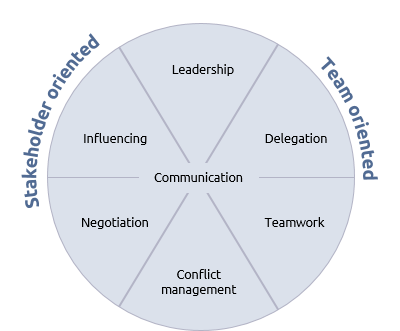
Managerial Roles in Organizations
Key Roles of Managers
Henry Mintzberg's classic framework groups managerial roles into three categories. Each one involves distinct communication demands.
Interpersonal Roles focus on managing relationships:
- Figurehead: Representing the organization in ceremonial or symbolic activities (attending events, signing official documents). The communication here is largely symbolic, but it signals legitimacy and authority.
- Leader: Motivating, guiding, and evaluating employees. This is where day-to-day communication matters most: setting objectives, giving feedback, coaching performance.
- Liaison: Building and maintaining relationships with people outside the manager's direct team (customers, suppliers, partners, peers in other departments). Liaison work keeps information flowing across organizational boundaries.
Informational Roles center on handling information:
- Monitor: Scanning internal and external environments for useful information (reading reports, attending meetings, tracking industry trends). Monitors are essentially the organization's sensors.
- Disseminator: Sharing relevant information with employees and team members to keep everyone informed and aligned. This might look like forwarding a key report, holding a team briefing, or translating executive strategy into actionable updates.
- Spokesperson: Communicating the organization's position to external audiences (media, investors, regulators, the public).
Decisional Roles involve using information to make choices:
- Entrepreneur: Initiating change and innovation, such as launching new products or streamlining processes
- Disturbance handler: Responding to unexpected problems, conflicts, or crises that threaten stability
- Resource allocator: Deciding how to distribute budget, personnel, and equipment among competing priorities
- Negotiator: Representing the organization in negotiations over contracts, partnerships, or disputes
Information Processing by Leaders
A manager's communication effectiveness depends on how well they handle three stages of information processing.
1. Gathering information. Managers need a steady flow of reliable input to make good decisions. This means monitoring both internal signals (employee feedback, performance data) and external ones (market trends, competitor moves, customer needs). Effective managers don't rely on a single source. They seek diverse perspectives through surveys, focus groups, one-on-one conversations, and formal research.
2. Processing information. Raw data isn't useful until it's evaluated and interpreted. Managers need to assess whether information is reliable and relevant, then synthesize inputs from multiple sources into a coherent picture. This is where pattern recognition matters: spotting trends in customer behavior, identifying recurring operational problems, or connecting financial data to strategic opportunities.
3. Disseminating information. Processed information only creates value when it reaches the right people in a form they can act on. Effective dissemination involves several considerations:
- Choosing the right channel for the message (a quick Slack message vs. a formal presentation)
- Tailoring content and tone to the audience (technical detail for engineers, high-level summaries for executives)
- Ensuring timeliness so information arrives when it's still actionable
- Providing enough context that recipients understand not just what the information is, but why it matters
The best managers treat information processing as a continuous cycle, not a one-time event. They gather, interpret, share, collect feedback, and adjust, keeping communication flowing in all directions.
See Fiveable more often in Google
Mark Fiveable as a preferred source and Google is more likely to show you our guides in Top Stories, with a "preferred" badge in AI Mode and AI Overviews.