6.5 Improving the Quality of Decision-Making

👥Organizational Behavior Unit 6 Review
6.5 Improving the Quality of Decision-Making
👥 Organizational Behavior
Techniques for Improved Decision-Making
Not every decision requires the same approach. Sometimes a quick mental shortcut works fine; other times you need a structured, step-by-step process. The key is knowing which tool fits the situation and where each one can go wrong.
Heuristics
Heuristics are mental shortcuts that simplify decision-making. They're fast and often useful, but they can also introduce systematic errors.
- Availability heuristic: You judge how likely something is based on how easily you can recall similar events. If a workplace accident happened recently, you might overestimate the risk of another one, even if the data says otherwise.
- Representativeness heuristic: You judge something based on how closely it matches a stereotype or prototype. A manager might assume a candidate with an engineering degree will be analytical and detail-oriented, without looking at the individual's actual track record.
- Anchoring and adjustment: You latch onto an initial piece of information (the "anchor") and then adjust from there, but usually not enough. If a past project cost $500K, you might estimate a new, very different project at $550K simply because that anchor is in your head.
Heuristics are efficient under time pressure, but they can lead to cognitive biases and poor decisions when they cause you to oversimplify complex situations.
Satisficing
Satisficing means choosing the first option that meets a minimum acceptable threshold, rather than searching for the perfect solution. Herbert A. Simon introduced this concept as part of bounded rationality, which recognizes that decision-makers have limited time, information, and cognitive capacity.
Satisficing makes sense when the cost of continued searching outweighs the benefit. For example, a purchasing manager might select the first vendor that meets quality, price, and delivery requirements rather than evaluating every vendor on the market. When "good enough" truly is good enough, satisficing is a rational strategy.
The Rational Decision-Making Model
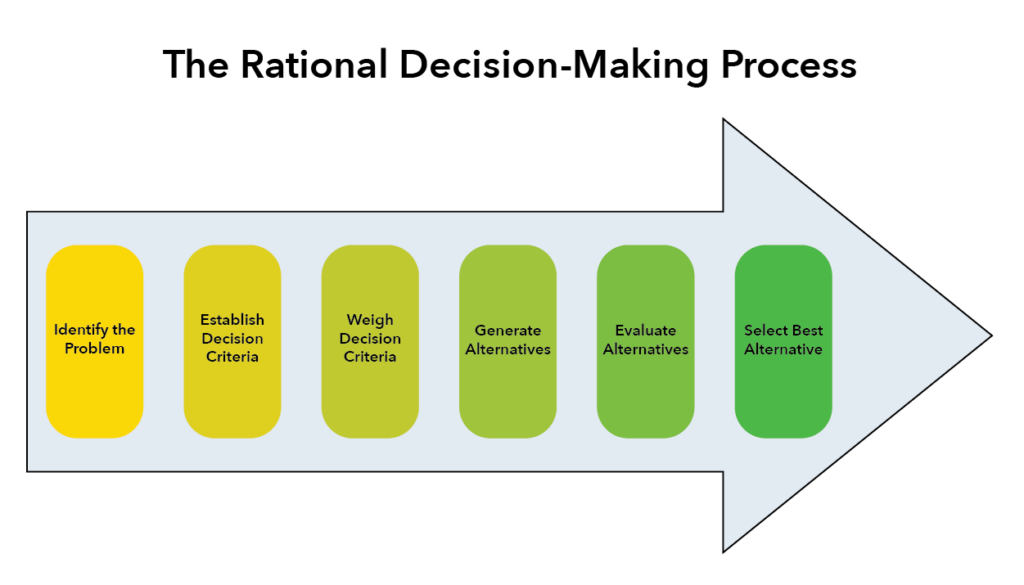
For high-stakes or complex decisions, a systematic process helps you avoid rushing to judgment or overlooking key factors. The rational decision-making model follows these steps:
- Define the problem or opportunity clearly
- Identify decision criteria that matter (cost, quality, timeline, etc.)
- Weight each criterion by its relative importance
- Generate a range of alternatives
- Rate each alternative against every criterion
- Compute the optimal choice by selecting the alternative with the highest weighted score
This model enforces logical, thorough analysis. NASA uses structured decision-making processes like this for space missions, where overlooking a single factor can have catastrophic consequences. The tradeoff is that it's time-intensive and requires good data.
Generation of Decision Alternatives
Better decisions start with better options. If you only consider one or two alternatives, you're likely settling for a mediocre choice. These techniques help you generate a wider range of possibilities.
Creative Methods
- Brainstorming encourages participants to freely share ideas, build on each other's suggestions, and defer criticism until later. The goal is volume and divergent thinking. Google's "10x thinking" sessions, where teams aim for solutions ten times better than the current state, are a well-known example.
- Lateral thinking approaches problems indirectly by challenging assumptions. Specific techniques include provocation (making deliberately outrageous statements to spark new ideas), random entry (using a random word or image to generate unexpected associations), and reversal (considering the exact opposite of the current approach).
- Dialectical inquiry deliberately pits opposing viewpoints against each other. Decision-makers critique each position and try to synthesize the best elements of both. Organizations use "red teams" this way, assigning a group to challenge a proposed strategy and expose its weaknesses.
- Synectics uses analogies and metaphors from unrelated domains to spark creative connections. Velcro, for instance, was inspired by the way burrs cling to fabric, an example of biomimicry that came from looking outside the problem's original domain.
Analytical Tools for Evaluating Alternatives
Once you have a set of options, you need to assess them rigorously:
- Feasibility analysis asks whether each alternative is practical given your resources, constraints, and organizational capabilities.
- Cost-benefit analysis weighs expected costs against anticipated benefits, including both tangible outcomes (revenue, savings) and intangible ones (employee morale, brand reputation), to estimate the net value of each option.
- Scenario planning explores how each alternative might perform under different future conditions. Shell has famously used scenario planning since the 1970s to prepare for vastly different energy futures.
- Decision trees visually map out possible outcomes and their probabilities for each alternative, making it easier to assess risk and calculate expected values.
Cognitive Biases and Decision Traps
Even with good techniques, biases can quietly undermine your decisions. Recognizing them is the first step toward counteracting them.
- Confirmation bias: You seek out information that supports what you already believe and discount evidence that contradicts it. A manager convinced a project will succeed might ignore early warning signs of failure.
- Framing effect: The way information is presented changes how you respond to it. Describing a surgery as having a "90% survival rate" feels very different from a "10% mortality rate," even though they're identical.
- Groupthink: In highly cohesive teams, pressure to agree can suppress dissenting views and lead to poor decisions. The 1986 Challenger disaster is a classic organizational example.
- Decision fatigue: The quality of your decisions deteriorates after making many in a row. This is why scheduling your most important decisions earlier in the day, or after a break, can meaningfully improve outcomes.
Strategies for Decision Implementation
A good decision means nothing if it's poorly executed. Implementation requires planning, resources, people management, and follow-through.

Action Planning
Develop a detailed roadmap that identifies specific tasks, timelines, responsibilities, and milestones. Tools like Gantt charts and PERT diagrams help you visualize the sequence and ensure coordination and accountability.
Resource Allocation
Secure and deploy the resources needed to carry out the decision. This includes budgeting, assigning personnel, and procuring materials or technology. Effective allocation aligns with strategic priorities so resources go where they'll have the most impact.
Stakeholder Management
Identify the people affected by the decision, assess their interests and influence, and tailor your communication accordingly. A power-interest grid helps you map stakeholders by how much power they have and how much they care about the outcome. Proactive engagement builds buy-in, surfaces valuable input, and reduces resistance before it becomes a problem.
Change Management
Decisions that require significant behavioral or organizational shifts need deliberate change management. Kotter's 8-step change model is one widely used framework, emphasizing strategies like clear communication, training, quick wins, and incentives to help people adapt. Without attention to the human side, even well-analyzed decisions can fail during implementation.
Evaluating Decision Effectiveness
After implementation, you need to assess whether the decision actually worked. This is where learning and continuous improvement happen.
- Establish clear metrics and KPIs tied to the original decision objectives
- Collect relevant data through surveys, interviews, or system analytics
- Compare actual results against expected outcomes
- Conduct post-implementation reviews to capture lessons learned
- Make data-driven adjustments as needed, using approaches like A/B testing or agile iteration
Skipping this step means you'll keep repeating the same mistakes. Building evaluation into your process turns every decision into an opportunity to improve the next one.
See Fiveable more often in Google
Mark Fiveable as a preferred source and Google is more likely to show you our guides in Top Stories, with a "preferred" badge in AI Mode and AI Overviews.