6.6 Real Interest Rates and International Capital Flows

💶AP Macroeconomics Unit 6 Review
6.6 Real Interest Rates and International Capital Flows
💶 AP Macroeconomics
How do real interest rates affect international capital flows in AP Macro?
When real interest rates differ across countries, financial capital flows toward the country with the higher real interest rate. That capital movement shows up in three connected markets: the foreign exchange market (the receiving country's currency appreciates), the loanable funds market (the receiving country's supply of loanable funds increases), and the financial account through net capital inflows. Central banks can shift these flows in the short run by changing the domestic interest rate.
Why This Matters for the AP Macroeconomics Exam
This topic is where the financial sector from Unit 4 and the open economy tools from Unit 6 come together. You need to trace a single cause, a difference in real interest rates, through three different graphs and explain the chain of effects clearly. Expect to interpret model changes, predict the direction of currency appreciation or depreciation, and explain how capital inflows or outflows shift the loanable funds market. Open economy questions like this often ask you to connect monetary policy, interest rates, and exchange rates in one explanation, so getting comfortable with the cause and effect chain pays off across the whole unit.
Key Takeaways
- Financial capital flows toward the country with the relatively higher real interest rate, because investors want the higher return.
- A higher real interest rate increases demand for that country's currency in the foreign exchange market, causing it to appreciate.
- The country receiving capital sees its supply of loanable funds increase; the country losing capital sees its supply of loanable funds decrease.
- Capital flowing in is an inbound flow (a financial capital inflow); capital flowing out is an outbound flow (a financial capital outflow).
- Central banks can influence the domestic interest rate in the short run, which then changes net capital inflows.
- Watch the chain: interest rate difference, then capital flow direction, then currency value, then loanable funds shifts.
Real Interest Rates and Asset Value
Differences in real interest rates across countries change the relative values of domestic and foreign assets. A higher real interest rate in one country makes assets denominated in that country's currency more attractive to investors, because those assets offer a higher return. Investors respond by shifting funds toward the country with the higher rate, which is the core idea behind international capital flows.
Capital flow is the movement of money for the purpose of investment, trade, or business production. There are two directions to track:
Inbound capital flow is funds entering a domestic economy when foreign investors buy domestic assets. For example, a Japanese investor might purchase U.S. assets because they pay a higher interest rate than similar assets in Japan. These assets include stocks, bonds, or other interest-bearing accounts. Higher domestic real interest rates tend to generate inbound capital flow, because foreign investors chase the higher return.
Outbound capital flow is funds leaving a domestic economy when domestic investors buy foreign assets. For example, an American might buy assets in Germany because they yield a higher interest rate there. When domestic real interest rates fall relative to other countries, outbound capital flow tends to rise, because domestic investors look abroad for the higher return.
Impacts on the Foreign Exchange and Loanable Funds Markets
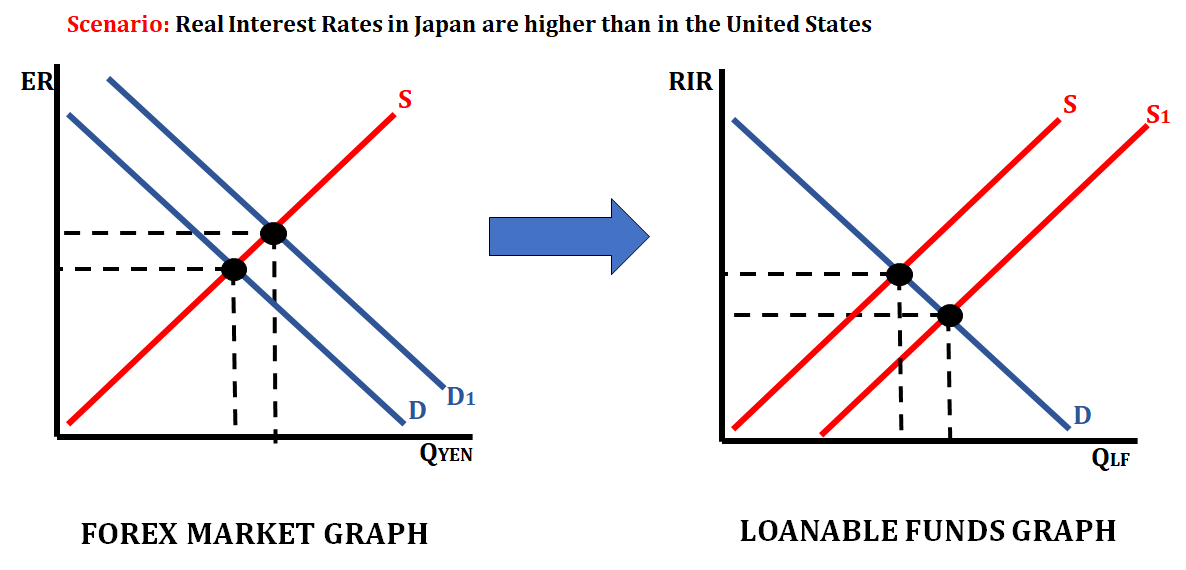
The inflow or outflow of capital affects both the foreign exchange market and the loanable funds market. Consider a case where interest rates are higher in Japan than in the United States, so U.S. investors want to buy Japanese interest-bearing assets.
Tracing the effects step by step:
- In the foreign exchange market for yen, demand for yen shifts right, because Americans must exchange dollars for yen to purchase Japanese assets. The yen appreciates.
- In Japan's loanable funds market, the supply of loanable funds shifts right, because financial capital flows into Japan. This tends to lower Japan's interest rate from its initial high level.
- In the United States, the supply of loanable funds shifts left, because financial capital flows out. This tends to raise the U.S. interest rate from its initial low level.
These shifts show the self-correcting logic of supply and demand. The country receiving capital sees downward pressure on its interest rate, and the country losing capital sees upward pressure on its rate, moving the two economies toward a new balance.
Impacts on Net Exports
An appreciation caused by capital inflows can also make a country's exports relatively more expensive and its imports relatively cheaper, which would tend to lower net exports. This is a useful connection to Topic 6.5, but the main focus here is how real interest rate differences move financial capital across the foreign exchange and loanable funds markets.
Central Banks and Domestic Interest Rates
The key institution that influences domestic interest rates in the short run is the central bank, not ordinary commercial banks acting on their own. Using monetary policy tools, the central bank can raise or lower the short-run domestic interest rate.
- If the central bank raises interest rates, domestic financial assets become more attractive relative to foreign assets, which increases net capital inflows.
- If the central bank lowers interest rates, domestic financial assets become less attractive, which decreases net capital inflows or causes net capital outflows.
Central banks use monetary policy tools such as open market operations, the discount rate, and reserve requirements to influence interest rates.
How do changes in domestic interest rates affect net capital inflows? A higher domestic interest rate makes a country's assets more attractive to foreign investors, so they buy more domestic financial assets, producing net capital inflows. A lower domestic interest rate pushes investors to move funds abroad, producing smaller net capital inflows or net capital outflows. A higher domestic interest rate also tends to increase demand for the domestic currency, causing it to appreciate in the foreign exchange market.
How to Use This on the AP Macroeconomics Exam
Free Response
When a question gives you an interest rate difference or a monetary policy change, work through the markets in order so you do not skip a link in the chain:
- Identify which country has the higher real interest rate.
- State the direction of the capital flow (toward the higher rate).
- Show the foreign exchange effect (demand for the receiving country's currency rises, so it appreciates).
- Show the loanable funds effect (supply of loanable funds rises in the receiving country, falls in the other).
Label your graphs fully. On the foreign exchange graph, the vertical axis is the exchange rate expressed in terms of one unit of the domestic currency, and the curves are demand and supply of that currency. On the loanable funds graph, label the real interest rate and the quantity of loanable funds, and show whether supply shifts left or right.
Problem Solving
Practice connecting a monetary policy action to capital flows. For example, if a central bank raises its policy rate, trace it to more attractive domestic assets, then to net capital inflows, then to currency appreciation. Make the cause and effect explicit rather than just naming the end result.
Common Trap
A frequent error is shifting the demand curve in the loanable funds market when capital flows change. In this topic, capital inflows and outflows shift the supply of loanable funds, since they change the amount of funds available for borrowing in each country.
Common Misconceptions
- Capital flows toward higher rates, not away from them. Investors want the higher return, so money moves to the country with the relatively higher real interest rate.
- Real rates, not just nominal rates, drive these flows. The real interest rate accounts for inflation, which is what determines the actual return on an asset.
- Capital inflows shift the supply of loanable funds, not the demand. More funds entering a country increase the supply available to borrowers there.
- A capital inflow causes the receiving country's currency to appreciate, not depreciate, because investors must buy that currency to purchase its assets.
- Commercial banks do not set the short-run domestic interest rate on their own. The central bank influences it through monetary policy tools.
- Higher domestic interest rates do not raise the supply of loanable funds at home through the capital channel. Inflows raise supply in the country receiving the capital, while the country sending capital sees its supply fall.
Related AP Macroeconomics Guides
Frequently Asked Questions
How do real interest rates affect international capital flows?
Financial capital flows toward the country with the relatively higher real interest rate because investors want the higher real return. That flow affects the financial account, the foreign exchange market, and the loanable funds market.
What happens when a country has a higher real interest rate?
A higher real interest rate makes that country's financial assets more attractive. Foreign investors demand more of its currency to buy those assets, so the currency appreciates and the country receives net capital inflows.
Do capital inflows shift demand or supply in the loanable funds market?
Capital inflows shift the supply of loanable funds to the right because more funds are available for borrowers in the receiving country. Capital outflows shift the supply of loanable funds to the left in the country sending capital abroad.
What is the link between interest rates and exchange rates in AP Macro?
Higher real interest rates increase demand for domestic assets, which increases demand for the domestic currency. In a flexible exchange market, that higher currency demand causes appreciation.
How can a central bank affect capital flows?
A central bank can influence domestic interest rates in the short run through monetary policy. Higher domestic rates tend to increase net capital inflows, while lower domestic rates tend to reduce inflows or encourage outflows.
What is the common AP Macro mistake in this topic?
A common mistake is skipping one link in the chain. On FRQs, identify the higher real interest rate, state the capital flow direction, explain the currency effect, and then show the loanable funds supply shift.