9.3 Direct and indirect speech acts

🔠Intro to Semantics and Pragmatics Unit 9 Review
9.3 Direct and indirect speech acts
🔠 Intro to Semantics and Pragmatics
Types of Speech Acts
Speech acts don't just convey information. They do things: request, promise, warn, apologize. A direct speech act performs its function transparently, while an indirect speech act uses one surface form to accomplish a different communicative goal. Telling these apart is a core skill in pragmatics.
Direct vs. indirect speech acts
A direct speech act is one where the sentence type (declarative, interrogative, imperative) matches the intended illocutionary force. What you say is what you mean.
- "Close the door." — imperative form, functions as a command. Form and force align.
- "I promise to return the book tomorrow." — declarative form performing a promise (a performative utterance).
- "Is it raining outside?" — interrogative form, genuinely asking a question.
An indirect speech act is one where the literal sentence type does not match the intended illocutionary force. The speaker means something beyond (or different from) the surface meaning.
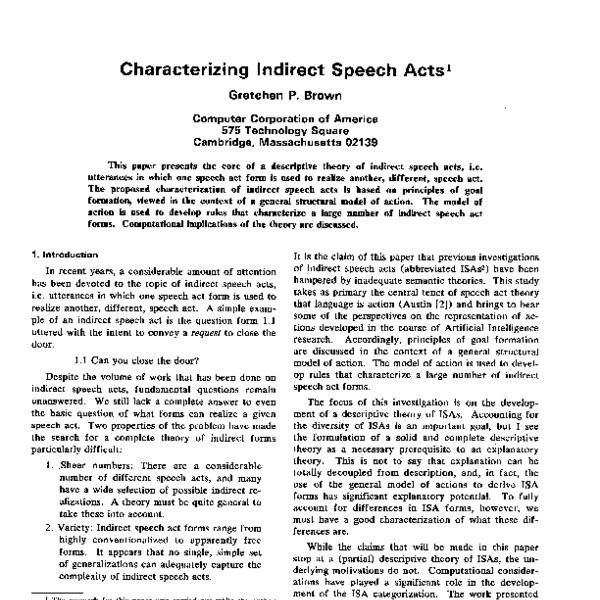
- "Can you pass the salt?" — interrogative form, but it functions as a request. Nobody actually wants to know whether you possess the physical ability to move a salt shaker.
- "It's getting cold in here." — declarative form, but in context it often functions as a request to close a window or turn up the heat.
- "I wouldn't do that if I were you." — declarative form, but it functions as a warning or piece of advice.
The key distinction: with direct speech acts, you can take the utterance at face value. With indirect speech acts, the hearer has to infer the real illocutionary force from context.
Context and implicature in interpretation
How do listeners figure out that "Can you pass the salt?" is a request and not a question? Two main tools: context and implicature.
Context includes shared knowledge between speaker and hearer, the physical setting, social norms, and the relationship between participants. "It's cold in here" said by your roommate sitting next to an open window means something different from the same sentence in a weather report.
Implicature is the additional meaning a speaker conveys beyond what's literally said. Grice's cooperative principle and its four maxims (quantity, quality, relation, and manner) help explain how this works. When someone asks "Can you tell me the time?" the literal answer would be "Yes, I can." But that response violates the maxim of relation — it's technically responsive but unhelpful. Listeners assume the speaker is being cooperative, so they interpret the utterance as a request for the actual time.
Structure and Interpretation
Sentence structure and illocutionary force
There's a conventional mapping between sentence types and illocutionary forces:
- Declarative sentences (subject-verb structure) typically perform assertions — The sky is blue.
- Interrogative sentences (question syntax) typically perform questions — What time is it?
- Imperative sentences (verb-first, no overt subject) typically perform directives (commands, requests) — Pass the salt.
Indirect speech acts break this default mapping. That's exactly what makes them indirect: the sentence structure points toward one type of force, but the speaker intends a different one. "Can you pass the salt?" has interrogative structure but directive force.
This mismatch is systematic, not random. Certain indirect forms are so common they've become conventionalized. Most English speakers instantly recognize "Can you...?" and "Would you mind...?" as polite request forms, not genuine ability questions. These are sometimes called conventionalized indirect speech acts because their indirect meaning is almost as predictable as a direct one.
Strategies for interpreting indirect speech acts
When you encounter a potential indirect speech act, here's how to work through it:
- Identify the literal sentence type and the illocutionary force it would normally carry.
- Check whether the literal interpretation makes sense in context. If someone at dinner says "Can you pass the salt?" a literal yes/no answer about ability would be odd.
- Use context and implicature to infer the intended force. The setting (dinner), the object mentioned (salt), and conversational norms all point toward a request.
- Respond to the intended meaning, not the literal one. Pass the salt rather than saying "Yes, I can."
- If genuinely uncertain, ask for clarification. Saying "Are you asking me to close the window?" is a perfectly reasonable move.
One more thing worth noting: cultures differ in how much they rely on indirect speech acts. Japanese communication, for example, tends to use more indirect expressions than American English does. This means the same literal utterance can carry different pragmatic weight depending on the cultural context, and misreading indirectness across cultures is a common source of miscommunication.
See Fiveable more often in Google
Mark Fiveable as a preferred source and Google is more likely to show you our guides in Top Stories, with a "preferred" badge in AI Mode and AI Overviews.