10.1 Types of deixis: person, time, place, and discourse

🔠Intro to Semantics and Pragmatics Unit 10 Review
10.1 Types of deixis: person, time, place, and discourse
🔠 Intro to Semantics and Pragmatics
Types of Deixis: Person, Time, Place, and Discourse
Deixis is how we "point" with words. When you say "I'll meet you here tomorrow," every key word in that sentence depends on who is speaking, where they are, and when they say it. Without that context, the sentence is almost meaningless. Deixis is what anchors language to the real-world situation of the speaker.
There are four main types: person, time, place, and discourse. Each one ties a different dimension of context to the words we use.

Top images from around the web for Types and examples of deixis
Frontiers | Fictive Deixis, Direct Discourse, and Viewpoint Networks | Communication View original
Is this image relevant?
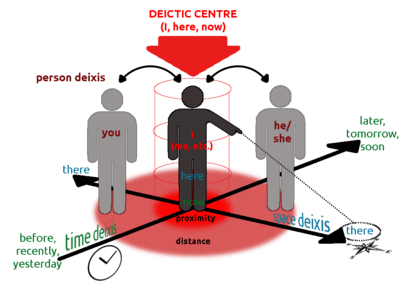
Deixis - Wikipedia View original
Is this image relevant?
Frontiers | Fictive Deixis, Direct Discourse, and Viewpoint Networks | Communication View original
Is this image relevant?
Frontiers | Fictive Deixis, Direct Discourse, and Viewpoint Networks | Communication View original
Is this image relevant?
Deixis - Wikipedia View original
Is this image relevant?
Types of Deixis
Person Deixis
Person deixis encodes the roles of participants in a speech event, primarily through pronouns.
- First person refers to the speaker or speakers: I, me, we, us
- Second person refers to the addressee or addressees: you
- Third person refers to anyone else not directly participating in the conversation: he, she, it, they, them
The critical thing to notice is that these pronouns shift reference depending on who's talking. If you say "I'm tired," I refers to you. When your friend replies "I understand," that same word I now refers to them. The form stays the same, but the referent changes with each speaker. That shifting quality is what makes something deictic rather than just referential.

Time Deixis
Time deixis encodes temporal points and spans relative to the moment of speaking.
- Adverbs of time locate events relative to the speech event: now, then, yesterday, today, tomorrow
- Tense markers on verbs signal whether the action is past, present, or future
Consider the word "yesterday." On Monday, it means Sunday. On Friday, it means Thursday. The word has no fixed date attached to it; you need to know when the utterance was made to interpret it. The same goes for "now," "last week," or "in two hours." All of these are temporally deictic because their meaning is calculated from the time of utterance, sometimes called the coding time.
Place Deixis
Place deixis encodes spatial locations relative to where the participants are.
- Demonstratives indicate proximity to the speaker: this/these (near the speaker) vs. that/those (farther from the speaker)
- Adverbs of place specify location relative to the speaker: here (near) vs. there (far)
"Put it here" only makes sense if you can identify where the speaker is. English has a two-way distinction (here/there, this/that), but some languages have three-way systems that distinguish near the speaker, near the addressee, and far from both. Regardless of the language, the speaker's location serves as the reference point, often called the deictic center.

Discourse Deixis
Discourse deixis refers to parts of the surrounding text or conversation itself, rather than to people, places, or times.
- Anaphoric expressions point backward to something already mentioned: "The committee voted. That was unexpected." Here, that refers back to the act of voting.
- Cataphoric expressions point forward to something coming up: "Consider the following argument..." Here, the following directs the reader ahead.
Discourse deixis is what keeps a conversation or text connected. Words like this, that, the former, and the latter can all function as discourse deictics when they refer to chunks of language rather than to objects in the physical world.
How Deixis Shapes Interpretation
Each type of deixis contributes a different layer of context that listeners need to interpret an utterance:
- Person deixis tells you who is involved: who's speaking, who's being addressed, and who's being talked about.
- Time deixis tells you when: it provides the temporal framework for understanding described events.
- Place deixis tells you where: it establishes spatial relationships between participants and referents.
- Discourse deixis tells you what part of the conversation is relevant: it connects the current utterance to what came before or what comes next.
All four types share one fundamental property: they are context-dependent. A deictic expression cannot be fully interpreted without knowing the situational context of the utterance. Strip away the context, and words like I, here, now, and this become empty shells.
The Role of Deixis in Communication
Deixis makes communication far more efficient. Instead of saying "Sarah Johnson will meet David Park at 42 Oak Street on October 15th," you can say "I'll meet you there tomorrow." That single sentence does the same work, as long as both participants share the context.
This efficiency depends on a shared deictic center between speaker and listener. Both parties need to coordinate around who is speaking, where they are, and when the conversation is happening. When that coordination breaks down (think of a note found with no date or signature), deictic expressions become ambiguous or uninterpretable.
Deictic expressions also guide the listener's attention, directing it to the right person, time, place, or stretch of discourse needed to make sense of what's being said. In this way, deixis doesn't just reflect context; it actively organizes how participants engage with it.
See Fiveable more often in Google
Mark Fiveable as a preferred source and Google is more likely to show you our guides in Top Stories, with a "preferred" badge in AI Mode and AI Overviews.