1.4 Relationship between semantics, pragmatics, and other linguistic fields

🔠Intro to Semantics and Pragmatics Unit 1 Review
1.4 Relationship between semantics, pragmatics, and other linguistic fields
🔠 Intro to Semantics and Pragmatics
Relationship between Semantics, Pragmatics, and Other Linguistic Fields
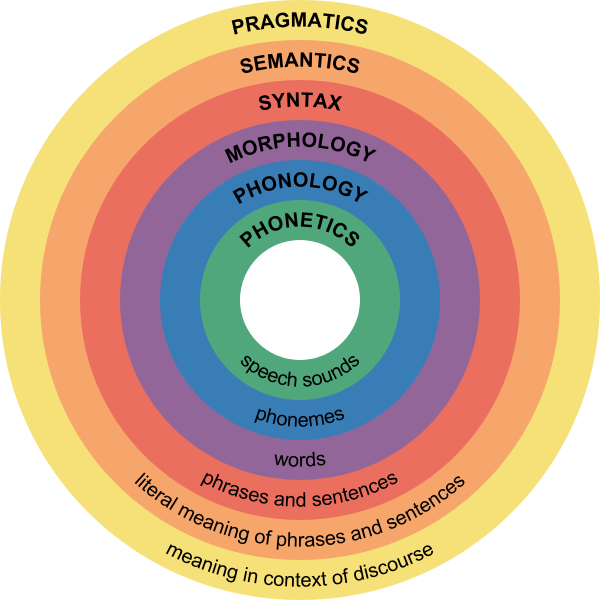
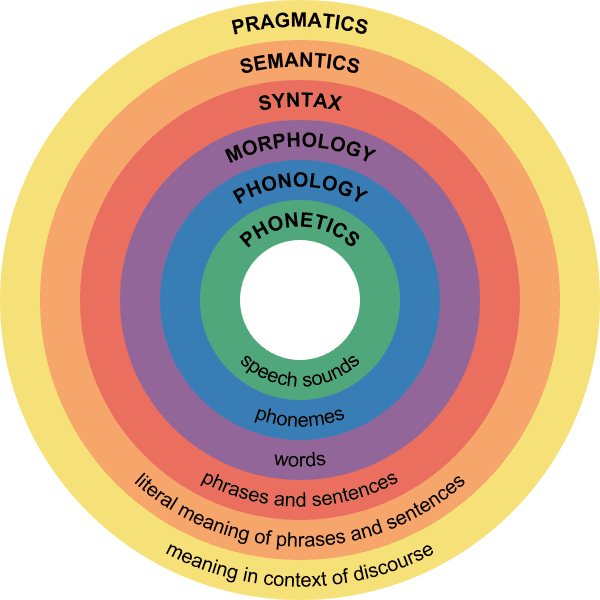
Semantics and pragmatics don't operate in isolation. They depend on and interact with other areas of linguistics to produce the full meaning of any utterance. At the same time, they connect to disciplines outside linguistics, like philosophy, psychology, and cognitive science, each of which sheds light on how meaning works from a different angle.
Top images from around the web for Semantics and linguistic fields
Frontiers | Syntax in language and music: what is the right level of comparison? | Psychology View original
Is this image relevant?
Introduction to Language | Boundless Psychology View original
Is this image relevant?
Frontiers | Transition From Sublexical to Lexico-Semantic Stimulus Processing View original
Is this image relevant?
Frontiers | Syntax in language and music: what is the right level of comparison? | Psychology View original
Is this image relevant?
Introduction to Language | Boundless Psychology View original
Is this image relevant?
Semantics and Other Linguistic Fields
Semantics is concerned with the meaning of linguistic expressions. But meaning doesn't emerge from semantics alone. It's shaped by how words sound, how they're built, and how they're arranged in sentences.
- Phonology studies the sound system of a language. Sound distinctions can change meaning directly. For instance, stress placement on "record" determines whether it's a noun (REcord) or a verb (reCORD).
- Morphology deals with the internal structure of words. The meaning of "unhappy" comes from combining the prefix "un-" (meaning not) with "happy." You can't fully interpret a word's meaning without understanding its parts.
- Syntax governs how words combine into phrases and sentences. Word order matters for meaning: "The dog bit the man" and "The man bit the dog" contain the same words but describe very different events.
The takeaway here is that semantics draws on all these levels. The meaning of an utterance is the product of its sounds, word structure, and sentence organization working together.

Pragmatics in Linguistic Context
Pragmatics picks up where semantics leaves off. It studies how context and speaker intentions contribute to meaning beyond what the words literally say.
Pragmatics also interacts with the other linguistic fields:
- Phonology: Intonation and prosody carry pragmatic information. A flat or exaggerated tone on "Great job" can flip its meaning from genuine praise to sarcasm.
- Morphology: Morphological choices can reflect pragmatic goals. In many languages, diminutive suffixes (like Spanish -ito) signal affection or politeness, not just small size.
- Syntax: Syntactic structures can serve pragmatic functions. Moving a phrase to the front of a sentence (topicalization) shifts emphasis, as in "The pizza, John ate," where the unusual word order highlights the pizza as the focus.
Pragmatic concepts like implicature (what a speaker implies without saying directly) and presupposition (what a speaker takes for granted) rely on the interaction between semantic content and these other linguistic levels. Grice's conversational maxims, for example, explain how listeners use expectations about informativeness, truthfulness, and relevance to infer meanings that go beyond the literal words.

Interdisciplinary Connections and Examples
Connections Beyond Linguistics
Semantics and pragmatics have deep ties to several fields outside linguistics:
- Philosophy of language provides foundational theories about meaning, reference, and truth conditions. Philosophers like Frege and Russell developed frameworks for how words refer to things in the world and how sentence meaning relates to truth, and these ideas remain central to formal semantics.
- Psychology and psycholinguistics investigate how people process and acquire meaning. Research on the mental lexicon (your internal "dictionary" of word meanings) and language development in children reveals how meaning is stored and retrieved in real time.
- Cognitive science examines the mental representations behind language. Work in cognitive linguistics on conceptual metaphors (e.g., understanding time in terms of space, as in "the weeks ahead") and embodied cognition (the idea that meaning is grounded in bodily experience) shows how meaning connects to broader cognition.
These interdisciplinary connections give us a richer picture of meaning than any single field could provide on its own.
Examples of Linguistic Fields Working Together
These examples show how semantics, pragmatics, and other fields converge on a single expression:
Example 1: "I'm fine"
- Semantics: The literal meaning is that the speaker is in good condition.
- Phonology: A flat or falling intonation might sound sincere, while an exaggerated or rising intonation can signal sarcasm.
- Pragmatics: If someone asks "How are you?" after something clearly went wrong, and the speaker says "I'm fine" with a sharp tone, the context and delivery suggest they are actually not fine.
Example 2: "Unlockable"
- Semantics: This word has two possible meanings: "able to be unlocked" or "not able to be locked."
- Morphology: The ambiguity comes from how you parse the prefix "un-." It can attach to "lock" first (un-lock-able = able to be unlocked) or to "lockable" (un-lockable = not lockable). Two different morphological structures produce two different meanings.
- Pragmatics: Context resolves the ambiguity. If you're talking about a door, you probably mean "able to be unlocked." If you're talking about a game feature, you might mean "able to be unlocked" in a different sense (made available).
Example 3: "The pizza, John ate"
- Semantics: The basic meaning is that John ate the pizza.
- Syntax: The object "the pizza" has been moved to the front of the sentence, departing from typical subject-verb-object order. This is called topicalization.
- Pragmatics: The reason for this reordering is emphasis. The speaker is highlighting the pizza specifically, perhaps to contrast it with something else ("The pizza, John ate; the salad, nobody touched").
See Fiveable more often in Google
Mark Fiveable as a preferred source and Google is more likely to show you our guides in Top Stories, with a "preferred" badge in AI Mode and AI Overviews.