8.4 Presupposition projection and accommodation

🔠Intro to Semantics and Pragmatics Unit 8 Review
8.4 Presupposition projection and accommodation
🔠 Intro to Semantics and Pragmatics
Presupposition Projection and Accommodation
Presupposition projection and accommodation explain two related puzzles: how presupposed information survives inside complex sentences, and how listeners handle presuppositions they didn't already know about. Together, these concepts reveal a lot about how speakers pack meaning into utterances efficiently and how listeners keep up.
Presupposition Projection
A presupposition is information that a sentence takes for granted rather than directly asserting. Presupposition projection is the phenomenon where presuppositions triggered inside an embedded clause carry up to become presuppositions of the whole complex sentence.
This matters because many operators in language change or cancel the main assertion of a clause. Negation flips it, conditionals make it hypothetical, modals weaken it. Yet presuppositions typically pass through these operators unaffected. The presupposed content remains part of what the sentence conveys, regardless of what happens to the main assertion's truth value.
Consider negation: "John didn't stop smoking" negates the claim that John stopped, but it still presupposes that John used to smoke. The presupposition projects past the negation. Similarly, "If Mary's cat is hungry, she'll feed it" is a conditional, but it still presupposes that Mary has a cat. The conditional doesn't touch that background assumption.
Projection Across Linguistic Environments
Different sentence types interact with presuppositions in slightly different ways:
- Negation: Presuppositions almost always survive. "John hasn't stopped smoking" still presupposes John used to smoke, even though the stopping is denied.
- Conditionals: Presuppositions from the consequent (the "then" clause) generally project to the whole sentence, but presuppositions from the antecedent (the "if" clause) don't necessarily project. Compare: "If John has a sister, then his sister is a doctor." The consequent presupposes John has a sister, but the antecedent already introduces that possibility, so the whole conditional doesn't commit to John having a sister. This is called filtering: the antecedent satisfies the presupposition locally, preventing it from projecting.
- Questions: Presuppositions typically project. "When did you quit your job?" presupposes you had a job and that you quit it, no matter how the question is answered.
- Modals: Presuppositions usually pass through modal operators like may, might, and must. "Mary must have stopped playing piano" presupposes Mary used to play piano. The modal affects the certainty of the stopping, not the background assumption.
The key pattern: presuppositions are remarkably resilient. Most embedding operators leave them intact. The main exception is when another part of the same sentence already entails or introduces the presupposed content (as in the conditional filtering case above).
Presupposition Accommodation
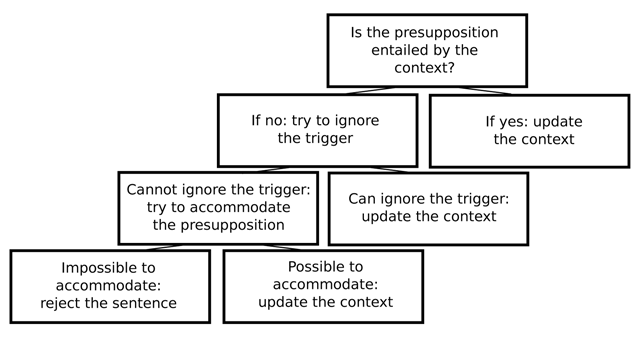
Sometimes a speaker uses a presupposition that the listener didn't previously know about. Accommodation is the process by which the listener silently updates their mental model of the conversation to include that presupposed information, treating it as if it had been established all along.
For example, if someone says "I'm sorry I'm late; I had to take my dog to the vet," the phrase "my dog" presupposes the speaker has a dog. Even if you didn't know that, you'll typically just add it to your understanding of the context without asking "Wait, you have a dog?" That's accommodation in action.
Accommodation works because listeners are generally cooperative. Rather than interrupting to challenge every unfamiliar presupposition, they fold the new information into the common ground and move on. This lets speakers introduce background information efficiently without spelling everything out.
The term comes from Lewis (1979), who described it as a rule of conversational dynamics: if a sentence requires something to be in the common ground and it isn't there yet, then (all else being equal) the common ground is adjusted to include it.
When Accommodation Succeeds and When It Doesn't
Accommodation isn't automatic. A few factors affect whether it goes smoothly:
- Plausibility: Listeners accommodate easily when the presupposed information is unremarkable. "I had to take my dog to the vet" is easy to accept. "I had to return my spaceship to the hangar" is not.
- Stakes: If the presupposed information is controversial or consequential, listeners are more likely to push back. "Did you enjoy the concert last night?" presupposes there was a concert and you attended. If neither is true, you'll probably correct the speaker rather than accommodate.
- Strategic use: Speakers can exploit accommodation to slip information into a conversation without asserting it directly. "When did you stop cheating on the exam?" presupposes you were cheating. This is the classic loaded question. Because presuppositions aren't part of the main assertion, they can be harder to challenge directly.
Real-World Applications
-
"I can't believe I forgot my wallet at the restaurant." This presupposes the speaker was at a restaurant and had their wallet there. A listener who didn't know any of this will typically accommodate both presuppositions at once to make sense of the complaint.
-
"Have you stopped exercising?" This presupposes you used to exercise. A yes or no answer both accept that presupposition. If it's false, you need to reject the presupposition itself before answering, which is socially awkward. This is exactly why loaded questions are effective rhetorical tools.
These examples highlight a broader point: presupposition and accommodation are not just theoretical curiosities. They shape how information flows in real conversations. Speakers rely on projection to keep background assumptions stable across complex sentences, and they rely on accommodation to introduce new information without derailing the discourse. Mismatches between what a speaker presupposes and what a listener actually knows can cause confusion, and deliberate manipulation of presuppositions can steer conversations in ways that are hard to resist.
See Fiveable more often in Google
Mark Fiveable as a preferred source and Google is more likely to show you our guides in Top Stories, with a "preferred" badge in AI Mode and AI Overviews.