12.3 Dynamic semantics and context change potentials

🔠Intro to Semantics and Pragmatics Unit 12 Review
12.3 Dynamic semantics and context change potentials
🔠 Intro to Semantics and Pragmatics
Dynamic Semantics and Context Change Potentials
Dynamic semantics shifts the core question of meaning from "Under what conditions is this sentence true?" to "How does this sentence change what we know?" Where static approaches like Montague Grammar assign truth conditions to sentences in isolation, dynamic semantics treats the meaning of a sentence as its ability to update the ongoing discourse context. This matters because real conversations build on themselves: each sentence adds information, introduces new things to talk about, and shapes how we interpret what comes next.

Top images from around the web for Limitations of static semantics
Bacovcin | To accommodate or to ignore?: The presuppositions of again and continue across ... View original
Is this image relevant?
Bacovcin | To accommodate or to ignore?: The presuppositions of again and continue across ... View original
Is this image relevant?
Bacovcin | To accommodate or to ignore?: The presuppositions of again and continue across ... View original
Is this image relevant?
Bacovcin | To accommodate or to ignore?: The presuppositions of again and continue across ... View original
Is this image relevant?
Bacovcin | To accommodate or to ignore?: The presuppositions of again and continue across ... View original
Is this image relevant?
Limitations of Static Semantics
Static semantics works well for analyzing individual sentences, but it runs into trouble once you look at how sentences interact in discourse. Here are the main gaps:
- Cross-sentential anaphora. In a sequence like "A farmer owns a donkey. He beats it," the pronouns he and it refer back to a farmer and a donkey from the previous sentence. Static semantics evaluates each sentence on its own, so it has no mechanism for linking pronouns to referents introduced in earlier sentences.
- Presupposition projection. A sentence like "The king of France is bald" presupposes that there is a king of France. Static semantics doesn't have a clear way to model how presuppositions carry forward through discourse or how they interact with connectives like if...then and and.
- Information update. Conversations are cumulative. Each utterance changes what participants take for granted. Static truth conditions don't capture this progression; they just tell you whether a sentence is true or false relative to a model.
Context Change Potential
The context change potential (CCP) of a sentence is the core idea in dynamic semantics. Instead of assigning a sentence a set of truth conditions, you assign it a function that maps an input context to an output context.
Think of it this way: before someone speaks, the conversation is in a certain state (the context). After they speak, the context has been updated. The CCP is that update function.
A CCP can do several things at once:
- Introduce new discourse referents. Saying "A woman walked in" adds a new entity to the context that later sentences can refer to (e.g., with she).
- Constrain interpretations. Once a referent is in the context, anaphoric expressions like pronouns or definite descriptions can pick it up. The CCP determines which referents are available.
- Impose presuppositional requirements. Some CCPs require the input context to already contain certain information. For example, "She left" requires that a salient female referent already exists in the context.
The key shift: meaning is no longer a static object (a proposition or truth value). Meaning is the change.
Anaphora and Presupposition Interpretation
Anaphora resolution works naturally in dynamic semantics because the framework keeps a running inventory of discourse referents. When you encounter a pronoun like he or it, you look at the current context to find an appropriate antecedent. This solves the donkey sentence problem: "A farmer owns a donkey" introduces two referents into the context, and the next sentence can access them directly.
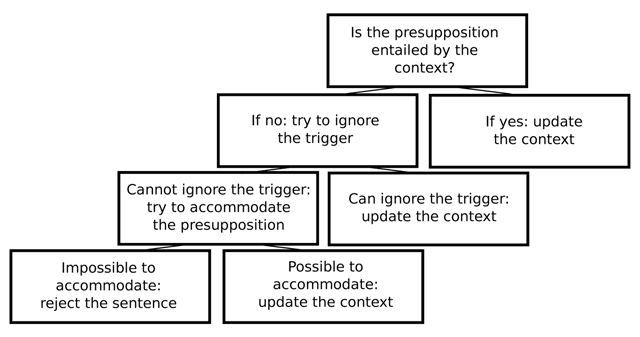
Presupposition handling treats presuppositions as conditions on the input context. An utterance is felicitous (appropriate) only if the current context already satisfies its presuppositions. For instance, "John stopped smoking" presupposes that John used to smoke. If the context already includes that information, the utterance goes through smoothly.
When a presupposition isn't already in the context, listeners often accommodate it: they silently update the context to include the presupposed information. So if someone says "John stopped smoking" out of the blue, you'll typically just add "John used to smoke" to your mental model of the conversation rather than objecting.
Dynamic vs. Static Semantic Theories
| Static (e.g., Montague Grammar) | Dynamic Semantics | |
|---|---|---|
| Unit of analysis | Individual sentences | Sentences in discourse context |
| Meaning is... | Truth conditions | Context change potential |
| Anaphora | Handled within single sentences only | Tracked across sentence boundaries |
| Presupposition | Not directly modeled in the semantics | Treated as requirements on input contexts |
| Compositionality | Central principle | Preserved, but extended to discourse |
These two approaches aren't entirely opposed. Both use formal, logical tools to represent meaning, and dynamic semantics often builds directly on the compositional machinery that Montague developed. The difference is that dynamic semantics extends that machinery to handle discourse-level phenomena that static truth conditions alone can't capture.
See Fiveable more often in Google
Mark Fiveable as a preferred source and Google is more likely to show you our guides in Top Stories, with a "preferred" badge in AI Mode and AI Overviews.