6.5 Heat exchangers

🦫Intro to Chemical Engineering Unit 6 Review
6.5 Heat exchangers
🦫 Intro to Chemical Engineering
Heat exchanger types and applications
Heat exchangers transfer thermal energy between two or more fluids without mixing them. They show up everywhere in chemical engineering: distillation columns, reactors, power plants, and refineries. Choosing the right type for a given application depends on factors like operating pressure, temperature, fluid properties, and how easy the unit needs to be to clean.

Top images from around the web for Classification and main types of heat exchangers
A "MEDIA TO GET" ALL DATAS IN ELECTRICAL SCIENCE...!!: HEAT EXCHANGERS View original
Is this image relevant?
Shell and tube heat exchanger - Wikipedia View original
Is this image relevant?
Intercambiador de calor - Wikipedia, la enciclopedia libre View original
Is this image relevant?
A "MEDIA TO GET" ALL DATAS IN ELECTRICAL SCIENCE...!!: HEAT EXCHANGERS View original
Is this image relevant?
Shell and tube heat exchanger - Wikipedia View original
Is this image relevant?
Classification and main types of heat exchangers
Heat exchangers can be classified into four main categories:
- Shell and tube — the workhorse of the chemical process industry
- Plate — compact units with stacked corrugated plates
- Extended surface — fins added to increase heat transfer area
- Regenerative — periodic flow switching for heat recovery
Each type has trade-offs in cost, size, pressure rating, and ease of maintenance.
Shell and tube heat exchangers
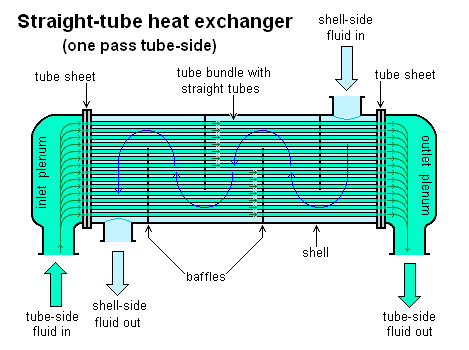
A shell and tube exchanger has a bundle of tubes inside a cylindrical shell. One fluid flows through the tubes (the "tube side") while the other flows over and around the tubes inside the shell (the "shell side"). Baffles inside the shell direct the shell-side fluid across the tube bundle, improving heat transfer.
These are the most common heat exchangers in chemical processing, power generation, and oil refining. Their popularity comes from their ability to handle high pressures (often above 30 bar), high temperatures, and large flow rates. They're also relatively straightforward to design for a wide range of duties.
Plate and extended surface heat exchangers
Plate heat exchangers use a series of thin, corrugated metal plates clamped together. The corrugations create narrow channels, and the two fluids alternate between plates. Because the plates are thin and the channels are narrow, these units achieve high heat transfer coefficients in a compact footprint. They're easy to disassemble for cleaning, which makes them popular in food processing and pharmaceutical applications where hygiene matters.
Extended surface heat exchangers (fin-tube or plate-fin designs) add fins to the heat transfer surface. The fins increase the effective surface area, which is especially useful when one fluid has a low heat transfer coefficient (like a gas). You'll find these in air conditioning systems, refrigeration units, and gas processing plants where you need high heat transfer rates in a small space.
Regenerative heat exchangers
Regenerative heat exchangers work differently from the types above. Instead of transferring heat through a shared wall simultaneously, they use a solid matrix that alternately absorbs heat from the hot fluid and releases it to the cold fluid. This can happen through a rotating wheel (rotary type) or by periodically switching the flow direction through a fixed matrix.
These are used in high-temperature applications like glass manufacturing and steel production, where recovering waste heat significantly improves energy efficiency.
LMTD calculations for heat exchangers
The Log Mean Temperature Difference (LMTD) method is the standard approach for sizing a heat exchanger when you know (or can determine) the inlet and outlet temperatures of both fluids.

Log mean temperature difference (LMTD) method
The temperature difference between the hot and cold fluids isn't constant along the length of a heat exchanger. It changes from one end to the other. A simple arithmetic average of the two end temperature differences would overestimate the driving force for heat transfer. The LMTD accounts for this by using a logarithmic average:
where and are the temperature differences between the hot and cold fluids at each end of the exchanger.
For a counter-flow arrangement (fluids flowing in opposite directions):
For a parallel-flow arrangement (fluids flowing in the same direction):
Counter-flow always gives a higher LMTD than parallel-flow for the same terminal temperatures, which is why counter-flow is generally preferred.
Heat transfer rate calculation
Once you have the LMTD, the heat transfer rate is:
where is the overall heat transfer coefficient (W/m²·K) and is the heat transfer area (m²). This equation is the foundation of heat exchanger design: if you know and , you can solve for the required product.
LMTD correction factor for multi-pass and cross-flow heat exchangers
The LMTD formula above assumes pure counter-flow or pure parallel-flow. Real heat exchangers often have multiple tube passes or cross-flow arrangements, which don't achieve the full temperature driving force of true counter-flow. To handle this, a correction factor is applied:
The value of ranges from 0 to 1, where 1 corresponds to true counter-flow. You calculate the LMTD as if the exchanger were counter-flow, then multiply by to correct for the actual geometry.
is found from published charts (or correlations) based on two dimensionless temperature ratios, and , which depend on the four terminal temperatures. As a rule of thumb, if drops below about 0.75, the design is inefficient and you should consider a different configuration.
Overall heat transfer coefficient
The overall heat transfer coefficient captures all the resistances to heat flow between the two fluids. Think of it like electrical resistances in series: each layer the heat must pass through adds resistance.
Definition and calculation
For a clean heat exchanger (no fouling), the overall resistance is:
where:
- = heat transfer coefficient on the hot-fluid side (W/m²·K)
- = heat transfer coefficient on the cold-fluid side (W/m²·K)
- = thermal resistance of the tube wall (m²·K/W), calculated as for a flat wall (thickness , thermal conductivity )
The smallest value dominates . If one side has a much lower heat transfer coefficient (e.g., a gas), that side is the bottleneck, and adding fins on that side can help.

Individual heat transfer coefficients
The individual coefficients depend on fluid properties, flow velocity, and geometry. For turbulent flow inside tubes, two widely used correlations are:
Dittus-Boelter equation:
where for heating and for cooling. This is valid for and .
Sieder-Tate equation:
The Sieder-Tate equation includes a viscosity correction term that accounts for the difference in fluid viscosity at the bulk temperature versus at the wall temperature. This makes it more accurate when there's a large temperature difference between the fluid and the wall.
In both cases, , so once you calculate , you solve for .
Fouling factors
Over time, deposits build up on heat transfer surfaces: scale, biological growth, corrosion products, or sediment. This fouling adds extra thermal resistance and reduces performance. To account for it during design, fouling resistances are added:
where and are the fouling factors for the hot and cold sides. Typical fouling factors are published in references like the TEMA standards. For example, clean river water might have m²·K/W, while heavy fuel oil could be m²·K/W.
Designing with fouling factors means the exchanger is oversized when new, but it will still meet its duty as fouling develops over time.
Heat exchanger effectiveness vs efficiency
NTU-effectiveness method
The LMTD method works well when you know all four terminal temperatures. But what if you only know the inlet temperatures and want to predict what the exchanger will do? That's where the NTU-effectiveness method comes in.
NTU (Number of Transfer Units) is a dimensionless measure of the heat exchanger's "size" relative to the flow:
where is the smaller of the two heat capacity rates. The heat capacity rate for each fluid is (mass flow rate times specific heat, in W/K).
A higher NTU means a larger or more effective exchanger. The capacity rate ratio is defined as:
This ratio ranges from 0 (one fluid undergoes a phase change, like in a condenser) to 1 (both fluids have equal capacity rates).
Effectiveness calculation
Effectiveness is the ratio of actual heat transfer to the maximum possible heat transfer:
The maximum possible heat transfer occurs if one fluid undergoes the full temperature change from to :
The relationship between , , and depends on the flow arrangement. For a counter-flow exchanger:
For a parallel-flow exchanger:
Different formulas exist for cross-flow and shell-and-tube configurations, and they're typically provided on exams or in reference tables.
Efficiency determination
Once you know , finding the actual heat transfer is straightforward:
Note that effectiveness and efficiency are the same quantity here: both equal . The term "efficiency" in this context simply means how close the exchanger gets to the thermodynamic maximum. An effectiveness of 0.85 means the exchanger transfers 85% of the maximum possible energy.
Application in heat exchanger design and analysis
The NTU-effectiveness method is especially useful in two scenarios:
- Rating problems — You have an existing exchanger (known ) and want to predict outlet temperatures for given inlet conditions. Calculate , find , then compute .
- Sizing problems — You need a certain effectiveness. Determine the required from the effectiveness relation, then solve for the needed (since can be estimated).
This method also makes it easy to compare configurations. For the same and , counter-flow always gives the highest effectiveness, which is another reason it's the preferred arrangement when possible.
See Fiveable more often in Google
Mark Fiveable as a preferred source and Google is more likely to show you our guides in Top Stories, with a "preferred" badge in AI Mode and AI Overviews.