6.3 Convection

🦫Intro to Chemical Engineering Unit 6 Review
6.3 Convection
🦫 Intro to Chemical Engineering
Natural vs Forced Convection

Top images from around the web for Mechanisms Driving Fluid Motion
Buoyancy – TikZ.net View original
Is this image relevant?
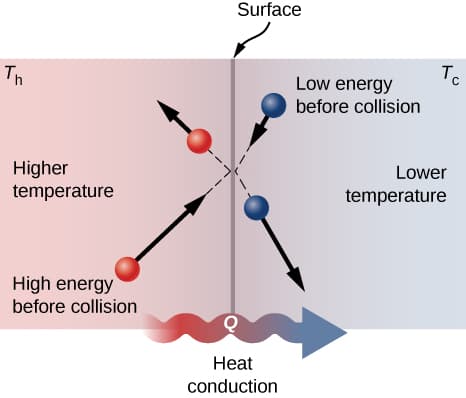
1.6 Mechanisms of Heat Transfer – University Physics Volume 2 View original
Is this image relevant?
1.6 Mechanisms of Heat Transfer – University Physics Volume 2 View original
Is this image relevant?
5.11 Convection – Douglas College Physics 1207 View original
Is this image relevant?
Buoyancy – TikZ.net View original
Is this image relevant?
Buoyancy – TikZ.net View original
Is this image relevant?
1.6 Mechanisms of Heat Transfer – University Physics Volume 2 View original
Is this image relevant?
Mechanisms Driving Fluid Motion
Convection transfers heat through the bulk movement of fluid. The two types differ in what causes that movement.
Natural convection happens when fluid moves on its own due to buoyancy. When a fluid near a hot surface heats up, it becomes less dense and rises, while cooler, denser fluid sinks to take its place. This creates a circulation pattern driven entirely by temperature-induced density differences.
Forced convection happens when something external (a pump, fan, or blower) pushes the fluid across a surface. The fluid doesn't need a temperature gradient to move; it's mechanically driven.
The key distinction: natural convection relies on buoyancy forces, while forced convection relies on external forces.
Heat Transfer Rates and Examples
Natural convection generally produces lower heat transfer rates because the fluid velocities are much smaller than what a pump or fan can achieve.
- Natural convection examples:
- Heat rising off a hot pipe into still air
- Water circulating in a pot heated from below
- Warm air rising near a radiator in a room
- Forced convection examples:
- Coolant pumped through a shell-and-tube heat exchanger
- A fan blowing air over electronic components
- Air pushed through a car radiator by a fan
In practice, many chemical engineering systems use forced convection because the higher fluid velocities lead to much better heat transfer performance.
Newton's Law of Cooling
Convective Heat Transfer Rate Equation
Newton's Law of Cooling says the rate of convective heat transfer is proportional to the temperature difference between a surface and the surrounding fluid:
where:
- = rate of heat transfer (W)
- = convective heat transfer coefficient (W/m²·K)
- = surface area available for heat transfer (m²)
- = surface temperature (K or °C)
- = bulk fluid temperature (K or °C)
The temperature difference is the driving force. Heat always flows from the hotter side to the cooler side. A larger temperature difference, a larger surface area, or a higher value all increase the heat transfer rate.
Assumptions and Factors Affecting Convective Heat Transfer
This equation assumes that and the fluid properties stay roughly constant during the process. In reality, is not a simple material property; it depends on several things at once:
- Fluid velocity: Higher velocities thin the boundary layer and increase .
- Fluid properties: Thermal conductivity, viscosity, and specific heat capacity all influence how effectively the fluid carries heat.
- Surface geometry: The shape and roughness of the surface change how the fluid flows near it.
- Flow regime: Turbulent flow produces significantly higher values than laminar flow because of the increased mixing.
The challenge in convection problems is usually figuring out , since everything else in the equation is straightforward to measure or look up.
Convective Heat Transfer Coefficients

Dimensionless Numbers and Empirical Correlations
Because depends on so many variables, engineers use dimensionless numbers to organize the physics and empirical correlations to calculate for specific situations.
Nusselt number () represents the ratio of convective to conductive heat transfer:
where is a characteristic length (pipe diameter, plate length, etc.) and is the fluid's thermal conductivity. A higher means convection is doing much more than conduction alone would.
Reynolds number () represents the ratio of inertial forces to viscous forces:
where is fluid density, is velocity, and is dynamic viscosity. tells you whether the flow is laminar or turbulent, which directly affects heat transfer.
Prandtl number () represents the ratio of momentum diffusivity to thermal diffusivity:
where is specific heat capacity. is a fluid property that describes how quickly momentum spreads relative to heat. For most gases, . For water at room temperature, . For viscous oils, can be in the hundreds.
The general idea: correlations express as a function of and , and then you solve for from the definition.
Flow Configurations and Correlations
Different geometries require different correlations. The most common one you'll encounter is the Dittus-Boelter correlation for fully developed turbulent flow inside pipes:
- Use when the fluid is being heated
- Use when the fluid is being cooled
This correlation is valid for (turbulent flow), , and (fully developed flow).
Other correlations you should be aware of:
- Sieder-Tate: Laminar flow in pipes (accounts for viscosity variation with temperature)
- Pohlhausen / Colburn: Flow over a flat plate (laminar and turbulent, respectively)
- Zukauskas: Flow across a bank of tubes (common in shell-and-tube heat exchangers)
Each correlation has its own validity range, so always check that your , , and geometry match before applying one.
Fluid Properties & Convection
Impact of Fluid Properties on Heat Transfer
The fluid you're working with has a big effect on how well convection performs.
- Thermal conductivity (): Higher means the fluid conducts heat more readily, improving overall heat transfer. Liquid metals have very high values; gases have low ones.
- Specific heat capacity (): A higher means the fluid can absorb more energy per degree of temperature change, making it a better heat carrier. Water's high is one reason it's so widely used as a coolant.
- Viscosity (): Higher viscosity dampens fluid motion and creates a thicker boundary layer, which resists heat transfer. Viscous oils transfer heat much less effectively than water at the same velocity.
- Density (): Density differences caused by temperature gradients are what drive natural convection. In forced convection, density affects the Reynolds number and thus the flow regime.
Flow Characteristics and Heat Transfer
Beyond fluid properties, how the fluid moves matters just as much.
Velocity is one of the most direct ways to improve convective heat transfer. Higher velocity thins the thermal boundary layer and increases , both of which raise .
Turbulent vs. laminar flow makes a major difference. Turbulent flow constantly mixes fluid from the bulk into the boundary layer, disrupting the insulating layer of slow-moving fluid near the surface. This is why turbulent flow gives much higher values than laminar flow.
Boundary layer development affects local heat transfer along a surface:
- Near the leading edge, the boundary layer is thin and heat transfer coefficients are high.
- Further downstream, the boundary layer thickens and local decreases.
Surface roughness can enhance heat transfer by tripping the flow into turbulence earlier, but this comes at the cost of increased pressure drop. In engineering design, you're always balancing better heat transfer against the extra pumping power required.
See Fiveable more often in Google
Mark Fiveable as a preferred source and Google is more likely to show you our guides in Top Stories, with a "preferred" badge in AI Mode and AI Overviews.