6.2 Conduction

🦫Intro to Chemical Engineering Unit 6 Review
6.2 Conduction
🦫 Intro to Chemical Engineering
Heat conduction describes how thermal energy moves through materials due to temperature differences. Understanding it is essential for designing anything that involves heating, cooling, or insulation, from reactor walls to heat exchangers.
This section covers thermal conductivity as a material property, Fourier's Law for calculating heat transfer rates, how geometry changes the math, and how to handle composite (layered) systems using thermal resistance.
Thermal Conductivity and Heat Conduction

Top images from around the web for Definition and Properties of Thermal Conductivity
Finite Difference Approximation for Solving Transient Heat Conduction Equation of Copper View original
Is this image relevant?
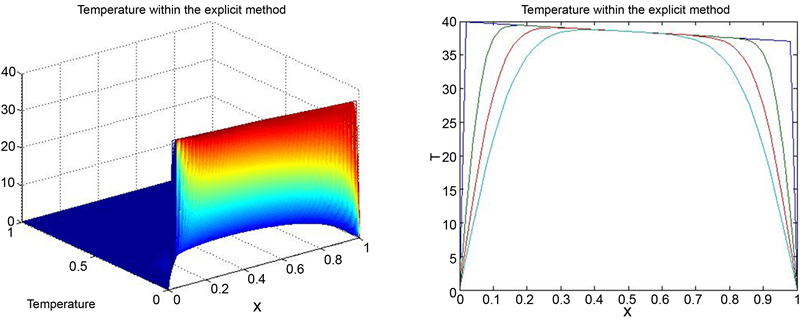
Finite Difference Approximation for Solving Transient Heat Conduction Equation of Copper View original
Is this image relevant?
Definition and Properties of Thermal Conductivity
Thermal conductivity () measures how easily a material conducts heat, with units of W/(m·K). A high means heat passes through readily; a low means the material resists heat flow.
To get a sense of scale: copper has a thermal conductivity around 400 W/(m·K), while wood sits near 0.1–0.2 W/(m·K). That's why a metal spoon in hot soup burns your hand but a wooden one doesn't.
Three factors control a material's thermal conductivity:
- Composition: Pure metals generally conduct heat much better than alloys or non-metals, because free electrons carry thermal energy efficiently.
- Microstructure: Crystalline materials tend to have higher than amorphous (glassy) materials, since ordered lattice structures transmit vibrations more effectively.
- Temperature: Depending on the material, can increase or decrease with temperature. For most metals, decreases slightly as temperature rises. For many insulators, it increases.
Role of Thermal Conductivity in Heat Conduction
When a temperature gradient exists across a material, directly determines how fast heat flows through it. Higher produces faster heat transfer and a more uniform temperature profile. Lower produces slower heat transfer and steeper temperature gradients.
This is why material selection matters so much in engineering. You pick high- materials (metals) for heat exchangers where you want rapid heat transfer, and low- materials (foams, fiberglass) for insulation where you want to block it.
Fourier's Law for Heat Transfer
One-Dimensional Steady-State Heat Conduction
Fourier's Law is the fundamental equation for conduction. It states that the heat transfer rate through a material is proportional to the negative temperature gradient and the cross-sectional area perpendicular to heat flow:
where:
- = heat transfer rate (W)
- = thermal conductivity (W/(m·K))
- = cross-sectional area perpendicular to heat flow (m²)
- = temperature gradient in the direction of heat flow (K/m)
The negative sign is there because heat flows from hot to cold. Temperature decreases in the direction of heat flow, making negative, so the negative sign ensures comes out positive in the direction heat actually moves.
Under steady-state conditions (temperatures not changing with time), the temperature profile through a flat slab is linear, meaning is constant. This simplifies the equation to:
where is the material thickness and .
Applying Fourier's Law
Here's a step-by-step approach:
- Identify the geometry and confirm steady-state conditions.
- Determine , , the thickness , and the boundary temperatures.
- Calculate the temperature gradient: .
- Plug into Fourier's Law and solve for .
Example: Find the heat transfer rate through a wall that is 2 m × 1 m, 0.2 m thick, with W/(m·K) and a temperature difference of 20 K across it.
- m², m, W/(m·K), K
- W
The magnitude is 100 W. (If you use the full form and define from hot to cold, the gradient is negative and the two negatives cancel, giving a positive result in the direction of heat flow.)
Conduction in Different Geometries
Planar (Cartesian) Geometry
Planar geometry covers heat conduction through flat surfaces like walls, windows, and plates. The temperature gradient is perpendicular to the surface, and you use the standard form of Fourier's Law.
Example: A 3 m × 2 m window is 0.01 m thick with W/(m·K). Inside temperature is 20°C, outside is 5°C. Find the heat transfer rate.
- m², m, K
- W
That's 7.2 kW lost through a single window, which illustrates why thin, high-conductivity materials make terrible insulators.
Cylindrical and Spherical Geometries
For pipes and tubes, heat flows radially through the wall. The cross-sectional area changes with radius (it increases as you move outward), so you can't just use the flat-wall equation. Integrating Fourier's Law in cylindrical coordinates gives:
where and are the inner and outer radii, is the pipe length, and and are the inner and outer surface temperatures.
For a hollow sphere, the integrated result is:
Notice that both of these reduce to the flat-wall form when the curvature becomes negligible (i.e., when the wall is very thin compared to the radius).
Example: A cylindrical pipe has m, m, m, W/(m·K), with inner surface at 100°C and outer surface at 80°C.
- K
- W
Note how different this is from the original guide's value of ~3.14 MW. That earlier calculation incorrectly used the flat-wall gradient formula () directly in the differential form of Fourier's Law for a cylinder. For cylindrical geometry, you must use the integrated equation with the term, because the area through which heat flows changes with radius.
Thermal Resistance in Composite Systems
Definition and Calculation of Thermal Resistance
Thermal resistance quantifies how much a material resists heat flow, analogous to electrical resistance in a circuit. For a flat slab:
where is thickness, is thermal conductivity, and is the cross-sectional area. Units are K/W.
For composite systems (multiple layers in series), the total thermal resistance is simply the sum of individual resistances:
This is the thermal equivalent of resistors in series. The overall heat transfer rate is then:
This approach is powerful because it lets you handle complex layered walls without solving Fourier's Law separately for each layer.
Effect of Thermal Resistance on Heat Transfer
Adding a high-resistance layer (like insulation) dramatically reduces heat transfer, even if it's thin. The layer with the highest thermal resistance dominates the total, just like the largest resistor dominates in a series circuit.
Step-by-step method for composite walls:
- Calculate each layer's thermal resistance:
- Sum to get
- Apply
Example: A composite wall has a 0.1 m concrete layer ( W/(m·K)) and a 0.05 m insulation layer ( W/(m·K)). The wall area is 10 m² and the temperature difference across it is 30 K.
- K/W
- K/W
- K/W
- W
Look at those resistance values: the insulation layer is only half as thick as the concrete, yet its thermal resistance is about 17.5 times larger. That thin insulation layer controls almost all of the heat flow through this wall. This is exactly why engineers add insulation rather than thicker structural materials when they want to reduce heat loss.
See Fiveable more often in Google
Mark Fiveable as a preferred source and Google is more likely to show you our guides in Top Stories, with a "preferred" badge in AI Mode and AI Overviews.