18.1 Retirement and Role Transitions

👶Developmental Psychology Unit 18 Review
18.1 Retirement and Role Transitions
👶 Developmental Psychology
Retirement Theories

Top images from around the web for Disengagement and Activity Theories
Frontiers | Time for a Systems Biological Approach to Cognitive Aging?—A Critical Review View original
Is this image relevant?
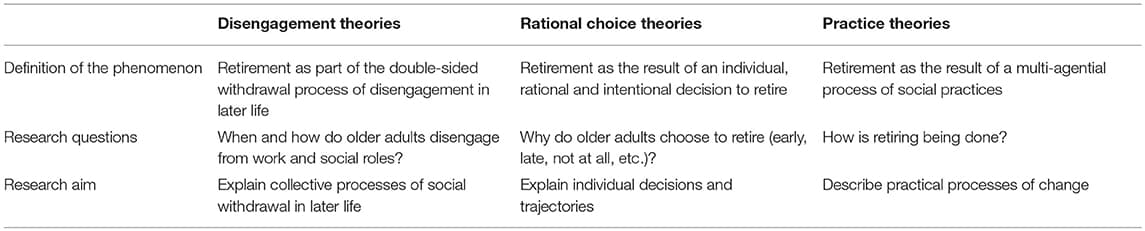
Frontiers | Change Ahead—Emerging Life-Course Transitions as Practical Accomplishments of ... View original
Is this image relevant?
Mindful Sustainable Aging: Advancing a Comprehensive Approach to the Challenges and ... View original
Is this image relevant?
Frontiers | Time for a Systems Biological Approach to Cognitive Aging?—A Critical Review View original
Is this image relevant?
Frontiers | Change Ahead—Emerging Life-Course Transitions as Practical Accomplishments of ... View original
Is this image relevant?
Disengagement and Activity Theories
Disengagement theory proposes that older adults naturally withdraw from social roles and responsibilities as they age. The theory frames this as a mutual process: the individual steps back while society simultaneously makes room for younger generations to fill those roles. When it was introduced by Cumming and Henry in 1961, it was one of the first formal theories of aging.
Activity theory takes the opposite stance. It argues that staying socially and physically engaged is the key to life satisfaction in later life. From this perspective, successful aging means maintaining hobbies, social interactions, and a sense of purpose rather than pulling away from them.
These two theories sit at opposite ends of a spectrum. Disengagement frames withdrawal as natural and even healthy, while activity theory treats continued engagement as the path to well-being. Most contemporary researchers find activity theory better supported by evidence, though disengagement theory helped spark important debates about what "good aging" actually looks like.
Continuity Theory
Continuity theory offers a middle ground. It argues that people tend to maintain similar patterns of behavior, relationships, and activities as they age. Rather than dramatically withdrawing or ramping up activity, most people adapt by making choices that preserve their existing routines and self-concept.
This plays out on two levels:
- Internal continuity means holding onto your beliefs, values, and personality traits. A lifelong introvert, for example, will likely continue to prefer solitary activities in retirement rather than suddenly joining a dozen social clubs.
- External continuity means preserving familiar roles, relationships, and environments. Someone who volunteered at a local organization for years will probably keep doing so rather than seeking out something entirely new.
The core idea is that stability and consistency matter for well-being. People don't become different people when they retire; they carry forward who they've always been.

Post-Retirement Activities
Bridge Employment
Bridge employment refers to paid work taken on after retiring from a full-time career but before completely leaving the labor force. It creates a gradual off-ramp rather than an abrupt stop.
This can take several forms: part-time work, consulting, freelancing, or self-employment in a field related or unrelated to the previous career. A retired teacher who tutors students a few hours a week is a classic example.
Bridge employment serves multiple functions at once. It provides supplemental income, preserves social connections, and maintains a sense of purpose during a period that can otherwise feel disorienting. From a continuity theory perspective, it eases the psychological adjustment by letting retirees hold onto parts of their professional identity while gradually building a new daily structure.

Leisure and Volunteer Activities
Leisure activities give retirees a way to stay active, socialize, and explore interests they may not have had time for during their working years. Hobbies like gardening, reading, traveling, and crafting provide enjoyment and mental stimulation. Joining a book club or taking an art class, for instance, combines learning with regular social contact. Physical activities like golf, hiking, or group exercise classes support both health and friendships.
Volunteer work plays a particularly important role in retirement adjustment. It allows retirees to contribute their skills and experience to causes they care about, whether that's mentoring young people, assisting at a food bank, or serving on a nonprofit board. In Erikson's framework, this connects directly to generativity, the drive to give back and support future generations that remains relevant well into late adulthood.
Both leisure and volunteering help retirees maintain social engagement, support psychological well-being, and preserve the kind of continuity that smooths the transition out of full-time work.
Retirement Adjustments
Role Transitions and Identity Shifts
For many people, their career is deeply tied to their sense of self. Retirement disrupts that connection. Losing the role of employee or professional can trigger feelings of loss, lowered self-esteem, and uncertainty about purpose, especially for those whose identity was closely linked to their job title or workplace community.
Adjusting means taking on and embracing new roles: full-time grandparent, volunteer, hobbyist, mentor, community member. Developing a positive retirement identity doesn't happen automatically. It involves actively exploring new interests, building or deepening relationships, and finding fresh sources of meaning.
What helps most with this transition is a combination of flexibility, self-reflection, and social support. Retirees who can reframe retirement as a new chapter rather than an ending tend to navigate identity shifts more successfully.
Financial Planning Considerations
Financial security has a direct impact on retirement satisfaction. Retirees typically draw from multiple income sources, including pensions, personal savings, investments, and Social Security benefits, and managing these effectively matters for long-term stability.
Budgeting becomes especially important because expenses shift in retirement. Healthcare costs tend to rise, daily work-related expenses drop, and spending on leisure and travel may increase. Planning for these changes in advance reduces the financial stress that can undermine an otherwise positive retirement experience.
Consulting with financial advisors can help retirees make informed decisions about investment strategies, tax implications, and estate planning. The broader point for developmental psychology is straightforward: adequate financial resources don't guarantee a satisfying retirement, but financial insecurity makes every other adjustment harder.
See Fiveable more often in Google
Mark Fiveable as a preferred source and Google is more likely to show you our guides in Top Stories, with a "preferred" badge in AI Mode and AI Overviews.