7.2 Solving recurrence relations using characteristic equations
Updated July 2024Fiveable Content Team

🧮Combinatorics Unit 7 Review
7.2 Solving recurrence relations using characteristic equations
Solving recurrence relations using characteristic equations is a powerful technique in combinatorics. It transforms complex sequences into manageable polynomial equations, making it easier to find general solutions and analyze long-term behavior.
This method connects various mathematical concepts, from linear algebra to complex analysis. By mastering it, you'll gain valuable tools for tackling a wide range of problems in discrete mathematics and beyond.
Characteristic Equation for Recurrence Relations
Fundamentals of Linear Recurrence Relations
- Linear recurrence relations define each term of a sequence as a linear combination of previous terms
- Characteristic equation transforms the recurrence relation into a polynomial equation
- Set up characteristic equation by replacing each term with , where r represents a variable and n denotes the index
- Degree of characteristic equation matches the order of the recurrence relation
- Coefficients in characteristic equation directly correspond to those in the recurrence relation
- Homogeneous linear recurrence relations produce characteristic equations without constant terms
- Non-homogeneous relations include a constant term in the characteristic equation
Transformation Process and Examples
- Setting up characteristic equation shifts problem from sequence domain to polynomial domain
- Example: For recurrence relation , characteristic equation becomes
- Higher-order recurrence relation yields characteristic equation
- Non-homogeneous example: transforms to
General Solutions of Recurrence Relations
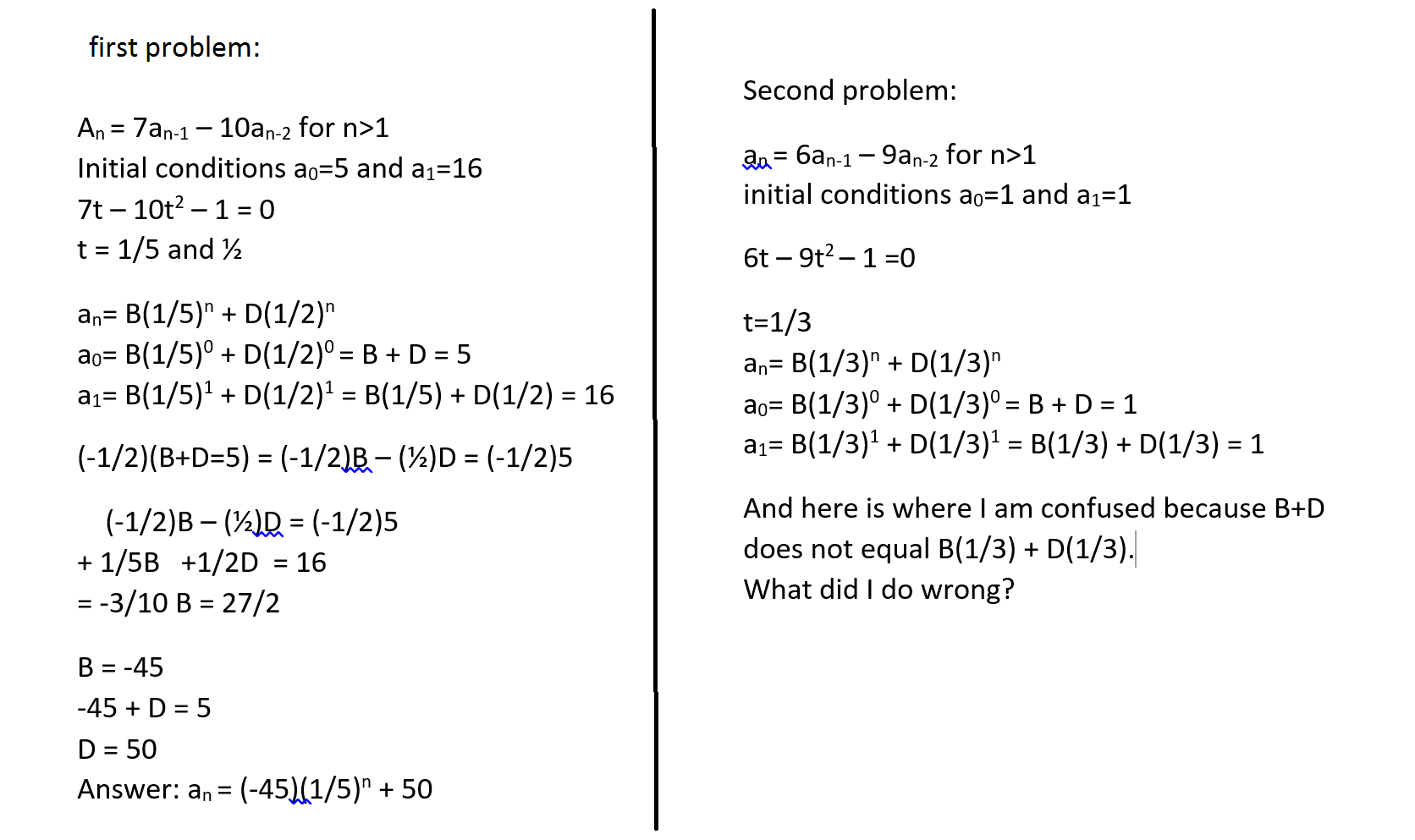
Root Analysis and Solution Forms
- Roots of characteristic equation determine the form of general solution
- Distinct real roots contribute terms to general solution
- Complex conjugate roots yield terms with sine and cosine functions
- Repeated roots of multiplicity m add terms
- Number of terms in general solution equals characteristic equation degree
- Example: For with roots 2 and 3, general solution
Solving Techniques and Examples
- Solving methods include factoring, quadratic formula, and numerical approaches for higher-degree polynomials
- General solution combines fundamental solutions derived from characteristic equation roots
- Example: Characteristic equation with repeated root 3 gives solution
- Complex roots case: with roots and yields solution
Particular Solutions from Initial Conditions

Applying Initial Conditions
- Particular solution obtained by using given initial conditions with general solution
- Number of required initial conditions equals recurrence relation order
- Initial conditions create system of linear equations when substituted into general solution
- Solving equation system determines constants in general solution
- Non-homogeneous recurrence relations require both homogeneous and non-homogeneous solution parts
- Method of undetermined coefficients finds form of non-homogeneous solution part
- Verify particular solution satisfies both recurrence relation and initial conditions
Solution Process and Examples
- Example: For with and , solve system:
- Solution yields and , giving particular solution
- Non-homogeneous example: with Homogeneous solution: Particular solution: Combine: Apply initial condition: , so Final solution:
Sequence Behavior vs Characteristic Roots
Long-term Behavior Analysis
- Dominant root (largest absolute value) determines long-term sequence behavior
- Real positive dominant root > 1 causes exponential growth, < 1 leads to decay
- Negative dominant root creates alternating sequence, may grow or decay in magnitude
- Complex roots produce oscillatory behavior in sequence
- Multiple roots of same magnitude can result in polynomial growth factors
- Apply ratio test to confirm growth or decay rate predicted by characteristic roots
- Example: Sequence with characteristic roots 2 and -1 grows exponentially due to dominant root 2
Stability Analysis and Examples
- Examine magnitude of all characteristic roots relative to unit circle for stability analysis
- Roots inside unit circle lead to convergent sequence
- Roots outside unit circle result in divergent sequence
- Roots on unit circle may produce bounded oscillations
- Example: Recurrence with roots 1 and 0.5 grows linearly due to root on unit circle
- Complex roots example: with roots and produces growing oscillations
See Fiveable more often in Google
Mark Fiveable as a preferred source and Google is more likely to show you our guides in Top Stories, with a "preferred" badge in AI Mode and AI Overviews.