Building Strong Evidence and Commentary for the Argument Essay

✍🏽AP English Language Review
Building Strong Evidence and Commentary for the Argument Essay
✍🏽 AP English Language
Overview
Evidence and commentary are worth up to 4 of the 6 points on the AP Lang argument essay, making Row B the single biggest scoring opportunity on FRQ 3. The thesis and sophistication points are worth 1 each; this row carries the rest. Evidence means the specific examples you bring to the argument (personal experience, history, current events, reading, logical reasoning), and commentary is the explanation of how each piece of evidence proves your claim. Graders consistently say the same thing: most essays have decent evidence but thin commentary, so commentary is where points get lost.
This guide goes deep on that one skill. For the full picture of FRQ 3 (the prompt format, timing, and all three rubric rows), start with the hub guide to the AP Lang Argument Essay. The short version: you get a short quotation or idea, and you write an essay arguing your position with about 40 minutes recommended. The argument essay unit page collects every guide in this series.
How Evidence and Commentary Are Scored on the AP Lang Rubric
Row B of the argument essay rubric awards 0 to 4 points based on how specific your evidence is and how consistently your commentary connects it to a line of reasoning. Here is what each score level requires, in plain language:
| Points | Evidence | Commentary |
|---|---|---|
| 0 | Restates the thesis, repeats the prompt, or offers irrelevant information | None, or just opinion |
| 1 | Mostly general (vague references, no specifics) | Summarizes the evidence without explaining how it supports the argument |
| 2 | Some specific, relevant evidence mixed with broad generalities | Explains how some evidence relates to the argument, but no clear line of reasoning emerges (or the reasoning is faulty) |
| 3 | Specific evidence supporting all claims in a line of reasoning | Explains how some of the evidence supports the line of reasoning, with occasional gaps |
| 4 | Specific evidence supporting all claims in a line of reasoning | Consistently explains how every piece of evidence supports the line of reasoning |
Two details from the rubric matter a lot in practice. First, the jump from 2 to 3 points is about the line of reasoning. A line of reasoning means your essay is organized as multiple supporting claims that build toward your thesis, not a pile of disconnected examples. Essays stuck at 2 often make one point well but never connect their claims to each other. Second, an essay with grammar and mechanics errors that interfere with communication cannot earn the fourth point, no matter how good the ideas are. Leave two minutes to proofread.
What Counts as Evidence on the Argument Essay
Anything specific and relevant counts. Unlike the synthesis essay, FRQ 3 gives you no sources, so your evidence comes from your own knowledge:
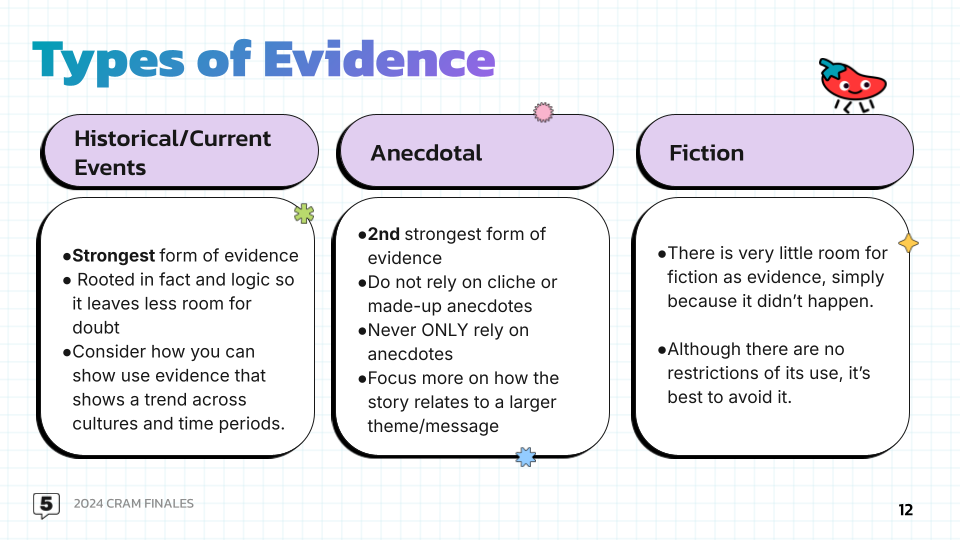
- Personal experiences and observations
- Historical examples
- Current events
- Books, articles, films, and things you've studied in other classes
- Hypothetical scenarios
- Logical reasoning and common knowledge
There is no hierarchy here. A vivid, specific personal experience can score just as well as a historical example. What separates strong evidence from weak evidence is specificity. "Some students are shy" is general. "A talented student who wrote brilliant lab reports nearly failed Biology because participation was 30% of the grade" is specific. The rubric language is explicit about this: 1-point essays provide evidence that is "mostly general," while 3- and 4-point essays "focus on the importance of specific details."
One strategy note: graders read hundreds of essays citing the same handful of examples (Rosa Parks, the American Revolution, social media in general). Those examples can work, but an unexpected, well-explained example from your own life or reading usually produces fresher commentary because you actually understand it.
How to Build Evidence and Commentary, Step by Step
The reliable formula is claim, evidence, commentary, in that order, in every body paragraph, with commentary getting the most sentences. Here is how to execute it inside your roughly 40 minutes for this essay.
Step 1: Brainstorm before you outline (3-4 minutes)
Once you have a defensible position (see the guide on crafting an effective thesis), dump every possible example onto your scratch paper: personal, historical, current events, things from class. Then pick the two or three you can explain in the most detail. Detail you can actually write beats an impressive-sounding example you only half remember.
Step 2: Arrange your claims into a line of reasoning (2 minutes)
Before writing, decide what each body paragraph argues and how the paragraphs connect. Each paragraph should make a distinct supporting claim, and the claims together should add up to your thesis. A quick test: could you write one sentence explaining why paragraph 2 follows paragraph 1? If not, you have a list of examples, not a line of reasoning, and the rubric caps lists at 2 points.
Step 3: Open each paragraph with a claim, not an example
Start with the point the paragraph proves ("Mandatory participation grades penalize students whose strengths are written, not verbal"), then introduce the evidence. If a paragraph opens with "For example," the claim is missing.
Step 4: Write commentary that answers "so what?" (most of your writing time)
After each piece of evidence, write at least two or three sentences explaining how it supports the claim. Three moves keep commentary from collapsing into summary:
- Name the connection explicitly. "This demonstrates that..." or "What this reveals is..." forces you to interpret rather than retell.
- Explain why it matters to your thesis, not just to the paragraph. Trace the evidence back to your central position.
- Push on implications. Ask what would follow if your claim is true, or what the counterargument misses. This is also where Row B work starts feeding the sophistication point.
A useful self-check while drafting: if a sentence could appear in a neutral summary of your example, it is summary. Commentary is the sentence only someone arguing your position would write.
Step 5: Proofread (2 minutes)
The fourth point in Row B is off the table if errors interfere with communication. Fix dropped words, sentence fragments, and confusing pronouns.
Worked Example: Commentary at Every Score Level
Watching the same prompt climb from 1 point to 4 points shows exactly what graders mean by "consistently explains." These are editorial examples, not official samples, written for this prompt:
Write an essay that argues your position on whether classroom participation should be a required component of course grades.
1 point (general evidence, summary commentary):
"Some students are shy. This shows why participation grades are unfair."
The evidence is vague (which students? what happened?) and the commentary just restates the thesis. Nothing is explained.
2 points (specific evidence, partial commentary):
"In my Advanced Physics class, several bright international students rarely speak up during discussions, but they consistently score highest on exams. This demonstrates how participation grades might penalize knowledgeable students who come from cultures where speaking up in class is considered disrespectful."
Now the evidence is specific and the commentary draws a real connection. But if the whole essay is paragraphs like this that never connect to each other, no line of reasoning emerges, and the score stalls at 2.
3 points (line of reasoning, counterargument engaged):
"While proponents argue that participation grades prepare students for professional environments, this assumes all professional success requires verbal assertiveness. In fields like software development or research, many professionals contribute through written communication, detailed analysis, or individual problem-solving. Forcing students to develop one specific communication style actually limits their professional preparation rather than enhancing it."
This paragraph does Row B work at a high level: it engages the opposing view, supplies specific evidence, and explains the logic step by step. An essay full of paragraphs like this earns 3, and slips to 3 instead of 4 only when commentary occasionally lapses or one claim goes underexplained.
4 points (specific evidence, consistent commentary, claims that build):
"The very students who most need support in our educational system, including English language learners, students with anxiety disorders, and those from cultures that value listening over speaking, are often the ones most harmed by mandatory participation grades. At my school, a talented Vietnamese student who wrote brilliant lab reports and scored perfectly on tests nearly failed Biology because participation was 30% of the grade. This common grading policy doesn't just disadvantage certain students; it actively undermines education's role as an equalizing force in society. While developing communication skills is crucial, we must question whether our current approach to participation actually develops these skills or simply rewards students who already possess them while punishing those who need different types of support."
Notice the ratio: one sentence of evidence, several sentences of commentary. The example is concrete, the explanation links it to a larger claim about equity, and the final sentence complicates the issue rather than dismissing the other side. That kind of consistent, layered explanation across the whole essay is what earns all 4 points, and it is also the natural path to the sophistication point covered in the next guide.
Common Mistakes
- The list problem. Stacking three examples in a paragraph with no analysis between them. Fix: cut to your one or two best examples and spend the saved space explaining each one in two or three sentences.
- Summary disguised as commentary. Retelling what happened in your example instead of arguing what it proves. Fix: after every piece of evidence, write a sentence starting with "This demonstrates..." or "This matters because..." and finish it with your claim, not more plot.
- The logic gap. Assuming the connection between evidence and thesis is obvious. It never is to a grader reading at speed. Fix: state the connection explicitly every time, even when it feels redundant to you.
- No line of reasoning. Body paragraphs that could be shuffled into any order without changing the essay. This caps you at 2 points. Fix: make each paragraph a distinct claim and use transitions that show how claim 2 builds on claim 1.
- Irrelevant or stretched evidence. Forcing in a prepared example (a memorized historical event, a favorite book) that doesn't actually fit the prompt. Fix: brainstorm fresh for each prompt and choose evidence for fit, not impressiveness.
- Skipping the proofread. Grammar and mechanics errors that interfere with communication block the fourth point in Row B. Fix: reserve the last two minutes to reread for dropped words and broken sentences.
Practice and Next Steps
The fastest way to build this skill is reps with feedback. Write timed argument essays and run them through FRQ practice with instant scoring to see exactly where your Row B points land, then pull more prompts from the FRQ question bank and past exam questions to drill the claim-evidence-commentary pattern until it's automatic.
When your evidence and commentary are consistently earning 3 or 4 points, move on to demonstrating sophistication to chase the sixth point, then put everything together with the guide on writing the complete argument essay. To see how each rubric point moves your overall score, plug scenarios into the AP Lang score calculator.
Frequently Asked Questions
How many points are evidence and commentary worth on the AP Lang argument essay?
Up to 4 of the 6 total points, scored as Row B of the rubric. The thesis (Row A) and sophistication (Row C) are worth 1 point each, so evidence and commentary carry the majority of your argument essay score. Earning all 4 requires specific evidence for every claim plus commentary that consistently explains how the evidence supports your line of reasoning.
What is commentary in the AP Lang argument essay?
Commentary is the explanation of how your evidence proves your claim. It answers "so what?" rather than retelling the example. The rubric distinguishes commentary that merely summarizes evidence (1 point) from commentary that consistently explains how evidence supports a line of reasoning (4 points). A good rule: write at least two or three sentences of explanation after every piece of evidence.
What kinds of evidence can you use on AP Lang FRQ 3?
Anything specific and relevant: personal experiences, observations, historical examples, current events, books and articles, hypothetical scenarios, and logical reasoning. Unlike the synthesis essay, no sources are provided, so the evidence comes from your own knowledge. Specificity matters far more than the type of evidence you choose.
What is a line of reasoning on the AP Lang rubric?
A line of reasoning means your essay is organized as multiple supporting claims that connect logically and build toward your thesis, not a list of unrelated examples. Essays without a clear line of reasoning are capped at 2 points in Row B even if individual examples are strong. Reaching 3 or 4 points requires distinct claims in each paragraph that visibly connect to each other.
How much time do you get for the AP Lang argument essay?
About 40 minutes is recommended for the argument essay. It's one of three free-response essays in Section II, which runs 2 hours and 15 minutes total (including a 15-minute reading period) and counts for 55% of your exam score. For the full format breakdown, see the hub guide to FRQ 3.
Can grammar mistakes lower your argument essay score?
Yes, in one specific way: the rubric states that writing with grammatical or mechanical errors that interfere with communication cannot earn the fourth point in Row B (Evidence and Commentary). Minor typos won't sink you, but errors that make your meaning unclear cap that row at 3 points. Save the last two minutes of your 40 to proofread.
See Fiveable more often in Google
Mark Fiveable as a preferred source and Google is more likely to show you our guides in Top Stories, with a "preferred" badge in AI Mode and AI Overviews.