9.7 Defining Polar Coordinates and Differentiating in Polar Form

♾️AP Calculus AB/BC Unit 9 Review
9.7 Defining Polar Coordinates and Differentiating in Polar Form
♾️ AP Calculus AB/BC
9.1
Defining and Differentiating Parametric Equations
9.2
Second Derivatives of Parametric Equations
9.3
Finding Arc Lengths of Curves Given by Parametric Equations
9.4
Defining and Differentiating Vector-Valued Functions
9.5
Integrating Vector-Valued Functions
9.6
Solving Motion Problems Using Parametric and Vector-Valued Functions
9.7
Defining Polar Coordinates and Differentiating in Polar Form
9.8
Find the Area of a Polar Region or the Area Bounded by a Single Polar Curve
9.9
Finding the Area of the Region Bounded by Two Polar Curves
Polar coordinates locate a point using its distance from the origin and its angle from the positive x-axis. To differentiate a polar curve , convert to and , then use the chain rule to find . For AP Calculus BC, treat like the parameter when finding slopes and tangent lines.
Polar differentiation appears only on the AP Calculus BC exam, where Unit 9 carries about 11 to 12 percent of the weight and polar topics come up repeatedly. It sets up the area problems in 9.8 and 9.9, and precise notation keeps your work clear when you switch between coordinate systems.
Polar Slope Uses dy/dx, Not dr/dθ
- Polar coordinates use distance and angle instead of and .
- Convert with , , and .
- tells you where reaches relative max or min distance from the origin, not the slope of the tangent line.
- The slope of the tangent line is , which you can derive with the chain rule.
- Treat like the parameter from parametric equations; the procedures carry over.
- Watch your trig identities, radian values, and unit circle work, since small errors there cause most mistakes.
What Are Polar Functions?
Polar functions are graphed in a polar coordinate system, which uses a distance from a fixed point called the pole and an angle measured counter-clockwise from the positive x-axis. These functions show up in physics and engineering to model things like waves, orbits, and fields.
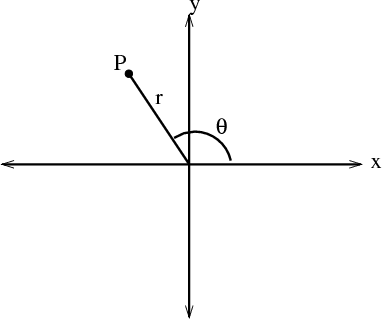
Differentiating polar functions directly is awkward because they are defined in terms of and , not and . Our usual idea of a derivative, the slope of the tangent line at a point, does not translate cleanly in polar form.
To work around this, convert polar equations to Cartesian form using these relations:
Another useful conversion is:
Converting Polar to Cartesian: Example 1
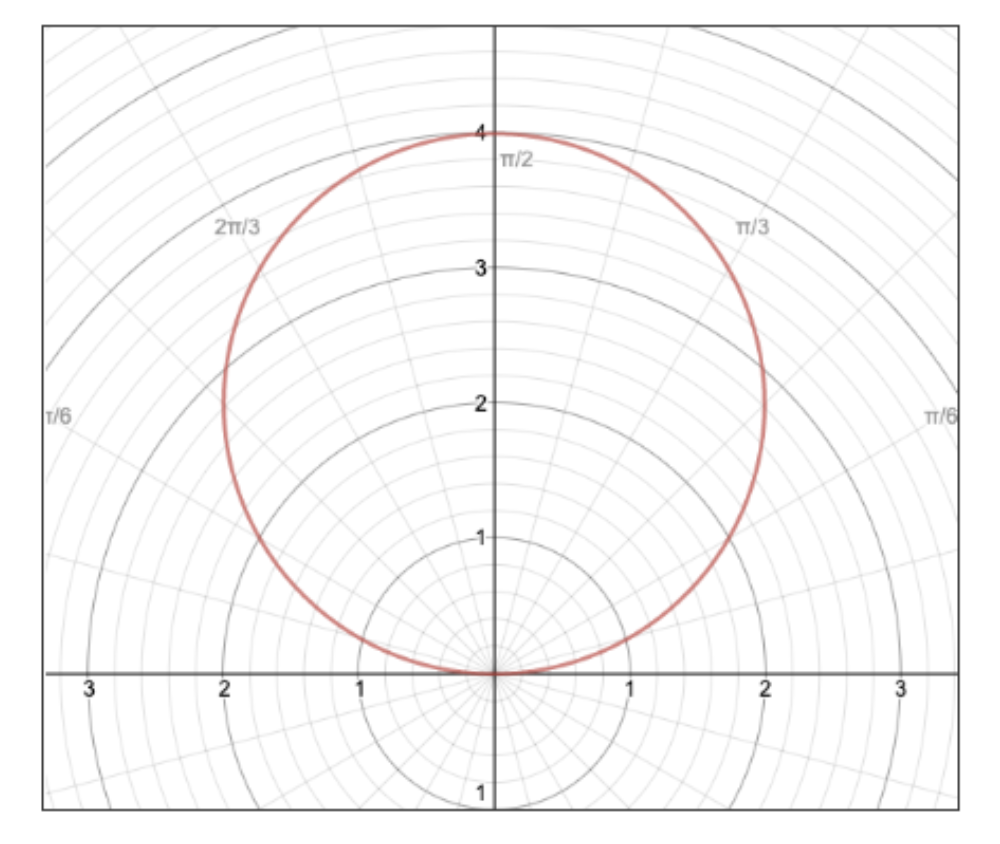
Convert the following polar function to a Cartesian function:
Rearrange the equation:
Now bring in , rearrange it, and set it equal to the equation above:
Use :
Complete the square to get the final Cartesian function:
This is a circle. Converting between polar and Cartesian comes down to familiarity with the three relations connecting , , , and .
Converting Polar to Cartesian: Example 2
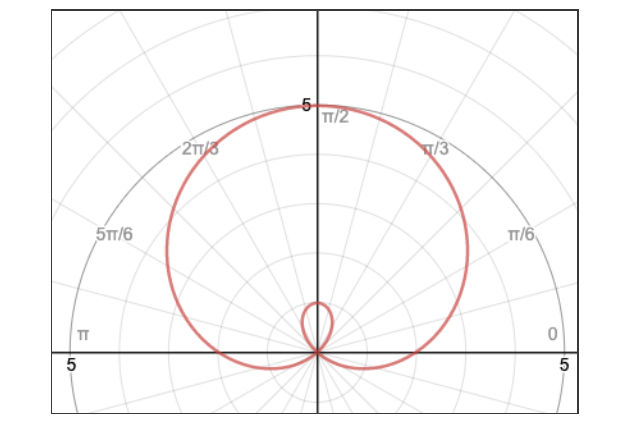
Find the values of on where .
You have two pieces here: the equation and the equation. Connect them. Plug into :
Substitute the equation:
Using a calculator solver, you get:
The general approach stays the same: use the relations to connect , , , and .
Derivatives of Polar Functions
When you take , you find the angles where reaches its relative maximum or minimum distance from the origin. You find the same way you find any derivative: differentiate the polar function.
Polar Function Derivative Walkthrough
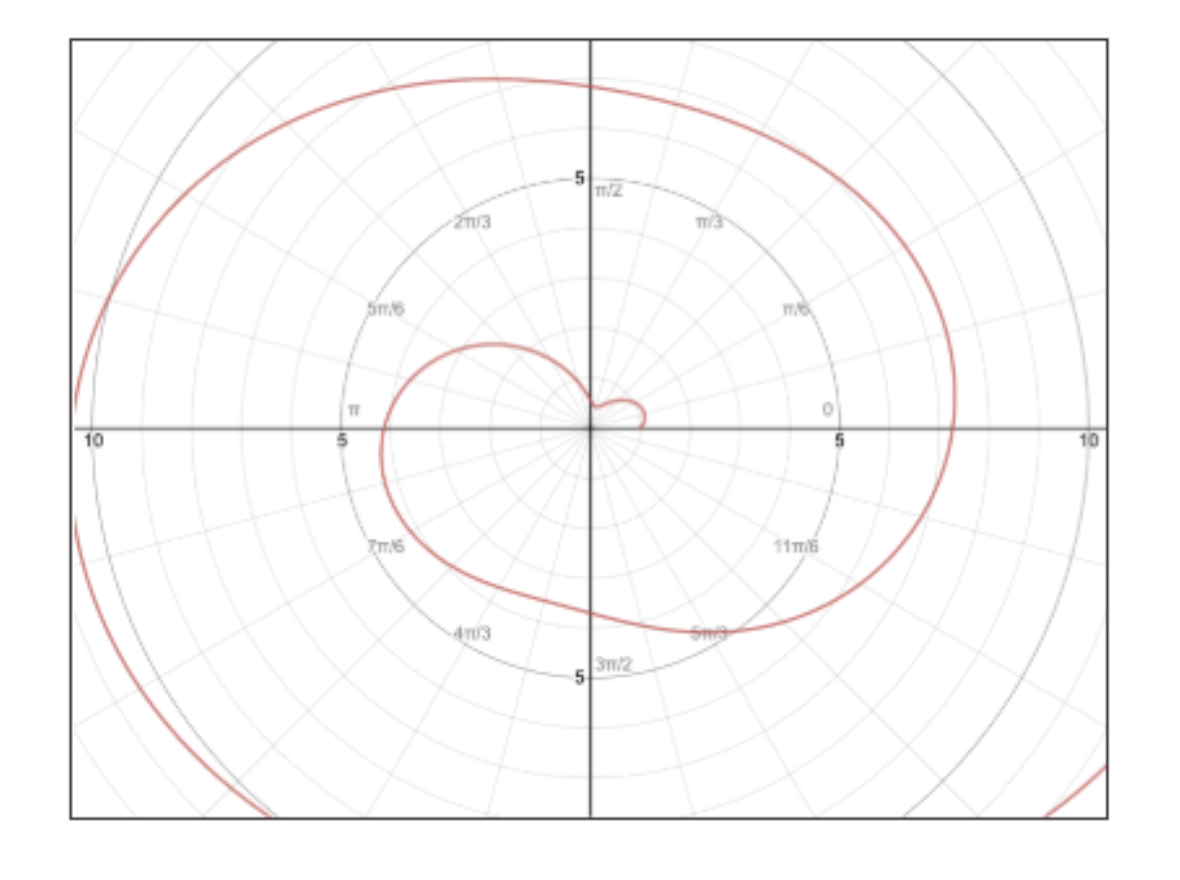
Find the points closest and furthest from the origin for on .
Differentiate with respect to , then set :
Using the unit circle, where does equal ?
The question asks for points, not angles, so plug these values back into the original equation to get :
Now check the endpoints, and :
Since stays positive on this interval, is the distance from the origin. The point closest to the origin has (at ), and the point furthest from the origin has (at ). The values and fall in between.
Note that tells you about relative max and min distances, but not the slope of the tangent line. For the tangent line slope, you need in the Cartesian system.
Slope of the Tangent Line of Polar Functions
The key formula for this section:
You can memorize this, but most students find it easier to derive it with the product rule and chain rule each time.
Practice: Finding the Tangent Line to a Polar Function
Find the equation of the line tangent to the polar curve at .
This is the same polar function from the last example, but now you want :
Substitute :
Find the and coordinates of the point using :
The tangent line in point-slope form is:
For a polar curve , derivatives of , , and with respect to , along with the first and second derivatives of with respect to , all give information about the curve.
- describes how fast the distance from the origin changes as changes. Setting it to zero finds where is largest or smallest.
- and let you find and , which describe how the point moves in the plane.
- Using the chain rule with these gives , the slope of the tangent line, and you can extend to for concavity.
Choosing Between dy/dx and dr/dθ in Polar Problems
Problem Solving:
- When you see , set up and before differentiating anything for slope.
- For slope, find and separately, then divide. Apply the product rule carefully since both and the trig factor depend on .
- Read the question. If it asks for points furthest or closest to the origin, use . If it asks for the tangent line, use .
- Always convert angle answers back to or to points when the question asks for points, not angles.
Common Trap:
- A horizontal tangent needs while . A vertical tangent needs while . Setting does not give tangent line information.
- Keep your calculator in radian mode and remember to differentiate the inside of trig functions like , which brings down a factor of .
Common Misconceptions
- Misconception: The derivative of r with respect to θ is the slope of the tangent line.Actually: is not the slope of the tangent line. It tells you how the distance from the origin changes. The tangent slope is .
- Misconception: You find by dividing by .Actually: is wrong as written; the correct rule is . Do not just divide by .
- Misconception: You do not need the product rule when differentiating or .Actually: When you differentiate or , you must use the product rule because depends on . Forgetting this is a common error.
- Misconception: Polar curves are a separate system from parametric equations.Actually: Polar curves are a special case of parametric equations, not a separate system. The same chain rule ideas apply, just with instead of .
- Misconception: A point closest to the origin is found from the angle.Actually: A point closest to the origin is found from values, not from the angle. Always plug the angle back in to get when the question asks for points. >💡 Key Idea: For a curve given by a polar equation , derivatives of , , and with respect to , and the first and second derivatives of with respect to all provide information about the curve.
Related AP Calculus Guides
- 9.1 Defining and Differentiating Parametric Equations
- 9.4 Defining and Differentiating Vector-Valued Functions
- Unit 9 Review: Parametric Equations, Polar Coordinates, and Vector-Valued Functions
- 9.2 Second Derivatives of Parametric Equations
- 9.3 Finding Arc Lengths of Curves Given by Parametric Equations
- 9.8 Find the Area of a Polar Region or the Area Bounded by a Single Polar Curve
Practice Questions for 9.7
1 of 10
The graph of , the derivative of the twice-differentiable function , is shown above. A polar curve is defined by .
Which of the following expressions represents the rate of change of the -coordinate of the polar curve with respect to at ?
A.
B.
C.
D.
Vocabulary
The following words are mentioned explicitly in the AP® course framework for this topic.Term | Definition |
|---|---|
derivative | The instantaneous rate of change of a function at a specific point, representing the slope of the tangent line to the function at that point. |
polar coordinates | A coordinate system in which points are located by their distance from a fixed point (the pole) and an angle measured from a fixed direction (the polar axis). |
polar equation | An equation that describes a curve using polar coordinates, typically in the form r = f(θ). |
See Fiveable more often in Google
Mark Fiveable as a preferred source and Google is more likely to show you our guides in Top Stories, with a "preferred" badge in AI Mode and AI Overviews.