6.3 Riemann Sums, Summation Notation, and Definite Integral Notation

♾️AP Calculus AB/BC Unit 6 Review
6.3 Riemann Sums, Summation Notation, and Definite Integral Notation
♾️ AP Calculus AB/BC
6.1
Integration and Accumulation of Change
6.2
Approximating Areas with Riemann Sums
6.3
Riemann Sums, Summation Notation, and Definite Integral Notation
6.4
The Fundamental Theorem of Calculus and Accumulation Functions
6.5
Interpreting the Behavior of Accumulation Functions Involving Area
6.6
Applying Properties of Definite Integrals
6.7
The Fundamental Theorem of Calculus and Definite Integrals
6.8
Finding Antiderivatives and Indefinite Integrals: Basic Rules and Notation
6.9
Integrating Using Substitution
6.10
Integrating Functions Using Long Division and Completing the Square
6.11
Integrating Using Integration by Parts
6.12
Integrating Using Linear Partial Fractions
6.13
Evaluating Improper Integrals
6.14
Selecting Techniques for Antidifferentiation (AB)
TLDR
A definite integral is the exact limit of a Riemann sum as the rectangle widths shrink to zero. In AP Calculus, this topic is about writing a Riemann sum in summation notation, recognizing the limit of that sum as , and translating back and forth between the two forms.
Riemann Sums and Definite Integral Notation Summary
Riemann sums approximate accumulated area or change by adding products of function values and subinterval widths. A definite integral represents the limiting case of those Riemann sums as the subinterval widths approach zero.
For AP Calculus, you need to translate both directions: from a Riemann sum or summation notation into a definite integral, and from a definite integral into the related limiting Riemann sum. Track the interval, subinterval width, sample point, integrand, and limits of integration carefully.
Why This Matters for the AP Calculus Exam
Unit 6 carries a lot of weight on the AP Calculus exam, and this topic is the bridge that turns approximation into exact area. Once you see that a definite integral is just a Riemann sum pushed to the limit, the Fundamental Theorem of Calculus in later topics makes much more sense.
On the exam you may be asked to:
- Match a given limit of a Riemann sum to the correct definite integral, or vice versa.
- Set up a Riemann sum from a function, interval, and number of subintervals.
- Interpret the sum of products (function value times subinterval width) as accumulated change or signed area.
Being precise with notation matters for clear exam work, especially the integrand, the limits of integration, and the differential .
Key Takeaways
- A Riemann sum splits an interval into subintervals and adds up products of a function value times a subinterval width: .
- The definite integral is the limit of those sums as the widths shrink: .
- With equal subintervals, , and the limit can be written as .
- For a right Riemann sum with equal widths, .
- You should be able to go both directions: turn a definite integral into the limit of a Riemann sum, and read a limit of a sum as a definite integral.
- The result is exact, not an approximation, once you take the limit.
Summation Notation
Before connecting to integrals, you need a faster way to write a Riemann sum. Summation notation lets you use algebra instead of adding each rectangle by hand.
Consider over the interval from 0 to 5.
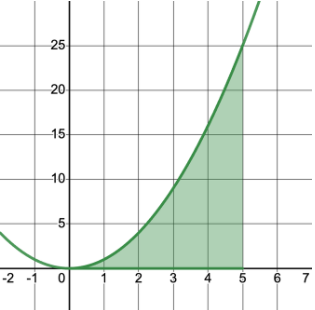
Use a left Riemann sum with 5 subintervals to approximate the area.
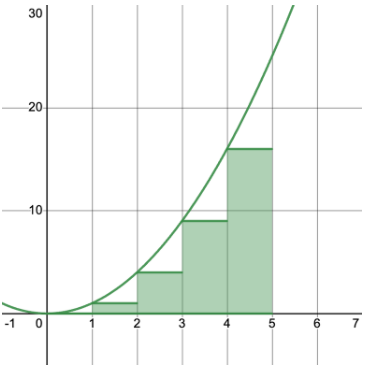
To convert this to summation notation, build a function that gives the area of each rectangle. Call it , so gives the area of the th rectangle:
The area of each rectangle is , where is the base width and is the height.
The base width is constant. Divide the whole interval by the number of subintervals:
The height is the value of at each left endpoint. To find the th x-value, start at 0 and add 1 (the subinterval width) repeatedly.
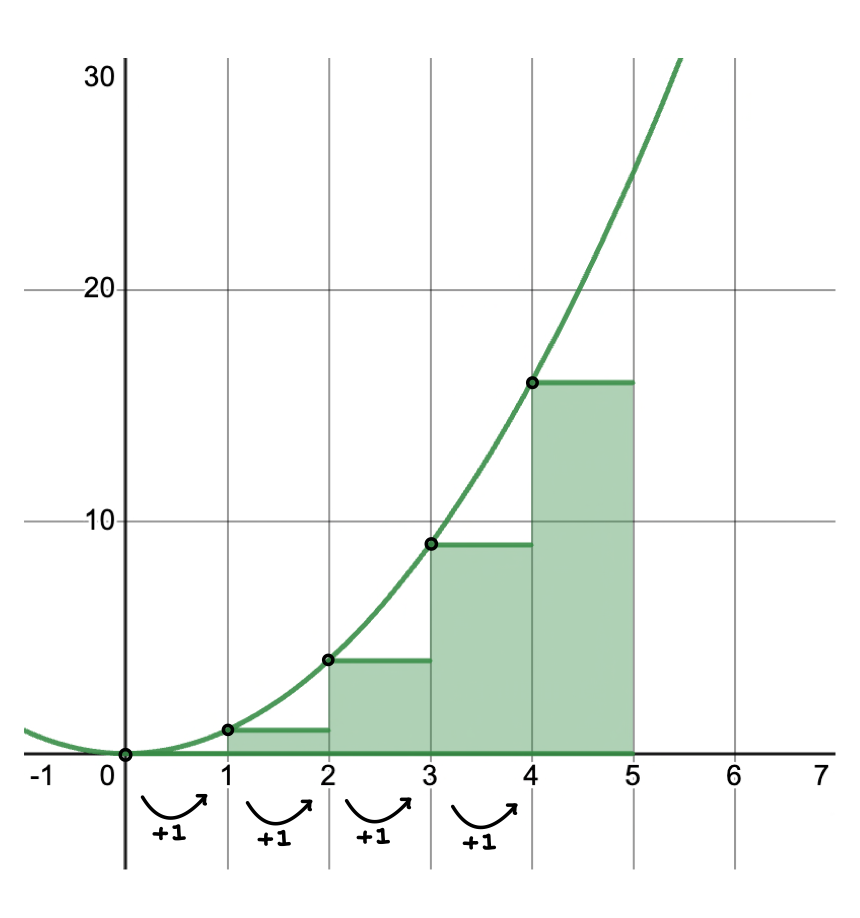
The x-value is , or just . Plug it into the function to get the height: . Combine these in the area formula:
which simplifies to
Plug that into the summation:
General Form of a Riemann Sum
The general form in summation notation is:
for left endpoints, and
for right endpoints.
Here is what each symbol means:
- : the number of subintervals, usually given in the problem.
- : the lower bound of the interval.
- : the upper bound of the interval.
- : the width of each subinterval, found with .
- : the right endpoint of each rectangle, .
- : the original function with plugged in.
- : add up the values from for left Riemann sums or for right Riemann sums.
Connecting to Definite Integrals
In the last topic you saw that a Riemann sum gets more precise as you use more rectangles, meaning a larger . What if you had infinitely many rectangles with infinitely tiny widths?
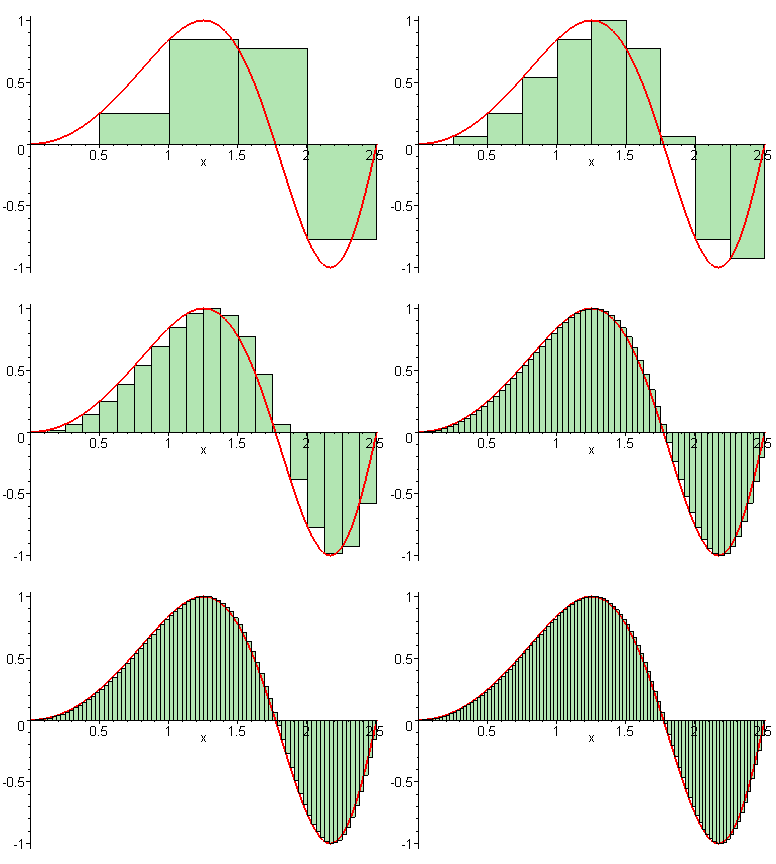
As , the approximation gets closer and closer to the exact area. That connects the Riemann sum to the definite integral:
where and .
This limit gives the exact value of the definite integral, not just an approximation.
Walkthrough
Given over , write the summation notation for the right Riemann sum with 10 subintervals and find its value. Then write the definite integral as the limit of the right Riemann sum as approaches infinity.
1) Summation Notation
Write the general form first:
Define . Then . Plug into the function: . The right Riemann sum with 10 subintervals is:
To calculate it, plug in through and add:
2) Writing the Definite Integral
First write the definite integral:
Recall the general form:
Since is the limit variable, define every term in terms of :
- .
- .
- .
Put it together:
These take practice, but once finding and becomes automatic, they get very doable.
How to Use This on the AP Calculus Exam
Problem Solving
When you convert a definite integral into the limit of a Riemann sum, use the same steps every time:
- Find .
- Find .
- Substitute into the function to get .
- Assemble .
MCQ
A common multiple-choice task gives you a limit of a sum and asks for the matching definite integral, or the reverse. Read the pieces: the factor that looks like is your , and the expression inside the function tells you , which reveals , , and the function. Break the complicated expression into familiar parts instead of trying to read it all at once.
Common Trap
Watch parentheses carefully when you substitute into a function with a square or other power. Writing when you mean changes the answer.
Riemann Sum Practice
Try these three, then check the solutions.
Practice Problems
- For , express as the limit of a Riemann sum.
- Express as the limit of a Riemann sum.
- The velocity function is on the interval . Express as the limit of a Riemann sum.
Solutions
Practice Problem 1
Define . Then . Plug into :
Assemble:
Practice Problem 2
Define . Then . Plug into :
Assemble:
Practice Problem 3
Define . Then . Plug into :
Assemble:
Common Misconceptions
- Misconception: The definite integral is an approximation.Actually: The definite integral is not an approximation. A Riemann sum with a fixed approximates, but once you take the limit, the value is exact.
- Misconception: A Riemann sum is just "the area."Actually: A Riemann sum is not just "the area." It is a sum of products of function value times subinterval width, and it gives signed area, so regions below the x-axis count as negative.
- Misconception: has to be a left or right endpoint.Actually: does not have to be a left or right endpoint. The sample point can be anywhere in the subinterval, including the midpoint. For continuous functions on , the limit comes out the same.
- Misconception: applies no matter how the subintervals are divided.Actually: only when the subintervals are equal in width. With a nonuniform partition, each can differ, which is why the general definition uses .
- Misconception: You can drop the when writing a definite integral.Actually: Do not drop the when writing a definite integral. The differential shows the variable of integration and is part of correct notation.
Related AP Calculus Guides
- Unit 6 Overview: Integration and Accumulation of Change
- 6.11 Integrating Using Integration by Parts
- 6.1 Integration and Accumulation of Change
- 6.12 Integrating Using Linear Partial Fractions
- 6.4 The Fundamental Theorem of Calculus and Accumulation Functions
- 6.5 Interpreting the Behavior of Accumulation Functions Involving Area
Practice Questions for 6.3
1 of 10
The graph of the function is shown above.
Which of the following limits of a Riemann sum represents the definite integral ?
A.
B.
C.
D.
Vocabulary
The following words are mentioned explicitly in the AP® course framework for this topic.Term | Definition |
|---|---|
continuous | A function that has no breaks, jumps, or holes in its graph over a given interval. |
definite integral | The integral of a function over a specific interval [a, b], representing the net signed area between the curve and the x-axis. |
limit | The value that a function approaches as the input approaches some value, which may or may not equal the function's value at that point. |
limiting case | The value or behavior that a mathematical expression approaches as a parameter (such as the width of subintervals) approaches zero. |
partition | A division of an interval into subintervals used to construct a Riemann sum. |
Riemann sum | A sum of the form ∑f(x_i*)Δx_i used to approximate the area under a curve by dividing the interval into subintervals and summing the areas of rectangles. |
subinterval | One of the smaller intervals created by dividing a larger interval [a,b] into n parts. |
Frequently Asked Questions
What is a Riemann sum in AP Calculus?
A Riemann sum approximates accumulated area or change by partitioning an interval into subintervals and adding products of a function value and a subinterval width.
How does a Riemann sum become a definite integral?
A definite integral is the limiting case of Riemann sums as the subinterval widths approach zero. In that limit, the approximation becomes exact for a continuous function on the interval.
What does summation notation mean in a Riemann sum?
Summation notation is a compact way to add all the rectangle areas in a Riemann sum. The index tracks each subinterval, while the expression inside the sum gives the function value times the width.
How do you translate a Riemann sum into a definite integral?
Identify the interval, the subinterval width, the sample point expression, and the function being evaluated. Then use those pieces to determine the limits of integration and the integrand.
What should students track in definite integral notation?
Track the lower and upper limits, the integrand, and the differential. The differential tells the variable of integration, while the limits show the interval over which accumulation is measured.
What is a common mistake on Riemann sum notation questions?
A common mistake is matching the function correctly but missing the interval or subinterval width. Always identify the width, sample point, and limits before writing the definite integral.