AP Calculus Unit 6 Cheatsheet: Integration and Accumulation of Change

AP Calculus Unit 6 Cheatsheet: Integration and Accumulation of Change

Start with the first 3 sections of the Unit 6 one-page cheatsheet below. The full sheet is a PDF you can print.

6.1 Accumulation + Net Change

  • If R(t) is a rate, net change on [a,b] is ∫abR(t)dt. New amount = initial amount + net change.
  • Area above the axis contributes positive change; below contributes negative change. Total change ≠ total amount.
  • Units: (rate units)(input units). Example: gallons/min × min = gallons.
  • On the interval [a, b]: displacement = ∫_a^b v(t) dt (net change in position, can be negative); total distance traveled = ∫_a^b |v(t)| dt (split the integral at times where v(t) = 0 to evaluate).

On a graph of a rate, use signed geometric area whenever possible.
6.2–6.3 Riemann Sums → Definite Integral

Σ f(xi*)Δxi → ∫abf(x)dx as max Δxi → 0

MethodHeight on [xi−1,xi]
Leftf(xi−1)
Rightf(xi)
Midpointf((xi−1+xi)/2)
Trapezoid[f(xi−1)+f(xi)]/2
  • Each term is height × width. For nonuniform partitions, every width is Δxi = xi−xi−1.
  • Uniform width: Δx = (b−a)/n. Do not confuse n subintervals with n+1 endpoints.
  • If f increasing: LRAM under, RRAM over. If decreasing: LRAM over, RRAM under.
  • If f concave up: trapezoid over, midpoint under. If concave down: trapezoid under, midpoint over.
  • A Riemann-sum limit must show endpoints/sample points, width, and n→∞ before translating to an integral.

Signed area: a definite integral is not automatically geometric area. Regions below the x-axis subtract.

Table + Graph Setup Checks

  • Table: subtract adjacent x-values for each width; do not assume equal spacing.
  • Graph: split at x-intercepts or shape changes; use signed triangle, rectangle, or semicircle area.
  • Context: state whether the result is accumulated change, final amount, displacement, or total distance.
  • Estimate direction: justify with increasing/decreasing or concavity—not the picture alone.

The rest of the Unit 6 sheet

8 more sections are on the one-page PDF:

  • 6.4–6.5 Accumulation Functions + FTC Part 1

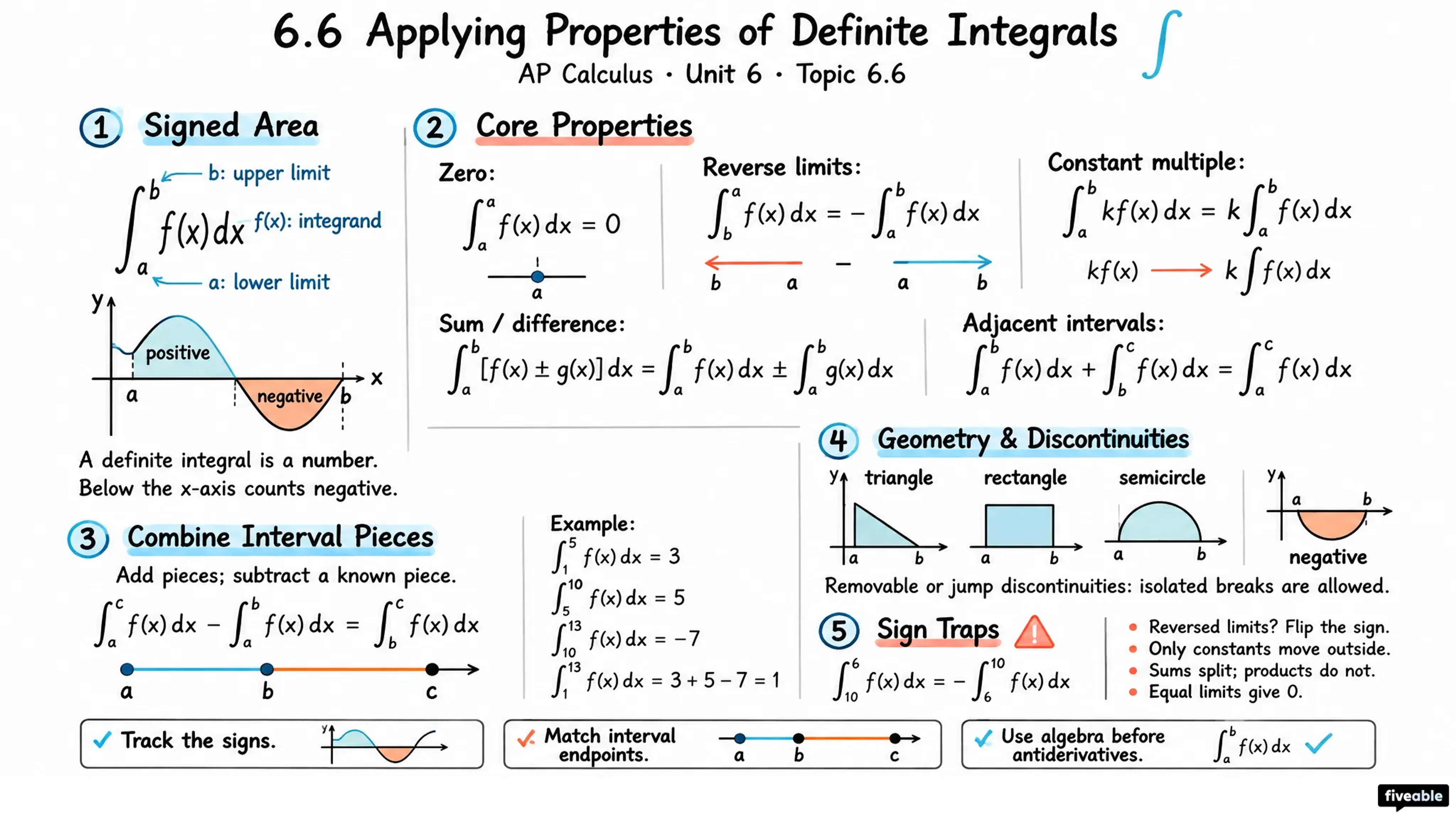
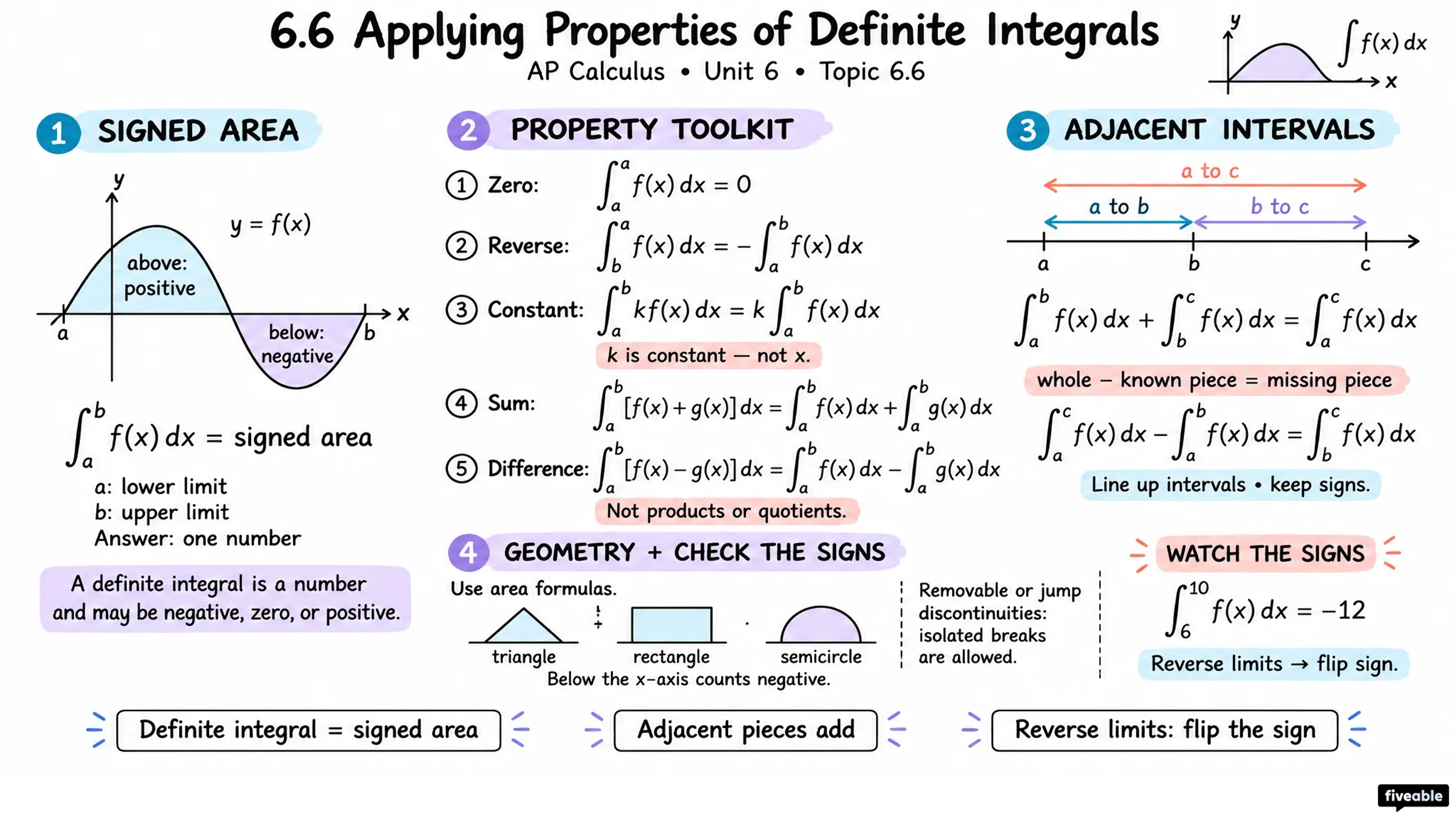
  • 6.6 Integral Properties

  • Read g(x) = ∫axf(t)dt from f

  • Variable-Limit Derivative Checklist

  • 6.7 FTC Part 2: Evaluate

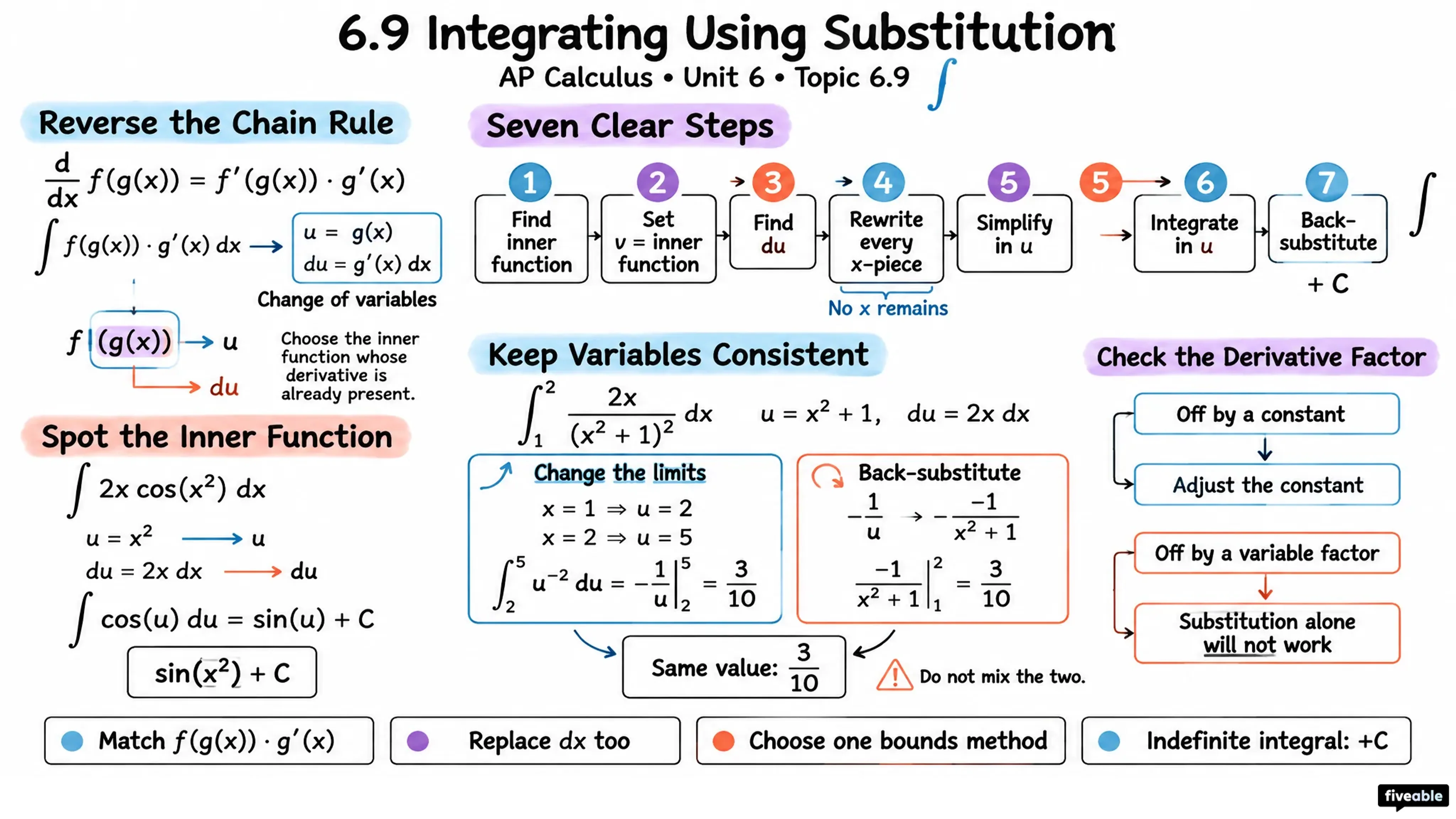
  • 6.8–6.10 Antiderivatives + Techniques

  • 6.14 Technique + FRQ Checklist

  • Common Antiderivative Errors

Made by you

Visual Cheatsheets

Pick a Unit 6 topic and a format: flowchart, comparison chart, vocab sheet, Cornell notes and more. Ready in about a minute.

Visual Cheatsheets

One topic, the format you pick, ready in about a minute

Format

Topic

Takes 30–60 seconds

Preview: Standard

Unit 6: Integration and Accumulation of Change, topic by topic

Each topic has a full study guide. See the whole unit.