11.2 Normal Shock Waves and Oblique Shocks

🧊Thermodynamics II Unit 11 Review
11.2 Normal Shock Waves and Oblique Shocks
🧊 Thermodynamics II
Normal Shock Waves and Oblique Shocks
Normal shock waves and oblique shocks describe what happens when supersonic flow undergoes sudden compression. Across these thin discontinuities, pressure, temperature, density, and entropy all jump while velocity drops. Mastering the governing relations for each shock type is essential for analyzing supersonic inlets, nozzles, and external aerodynamic flows.
Top images from around the web for Formation and Characteristics
Shock Waves – University Physics Volume 1 View original
Is this image relevant?

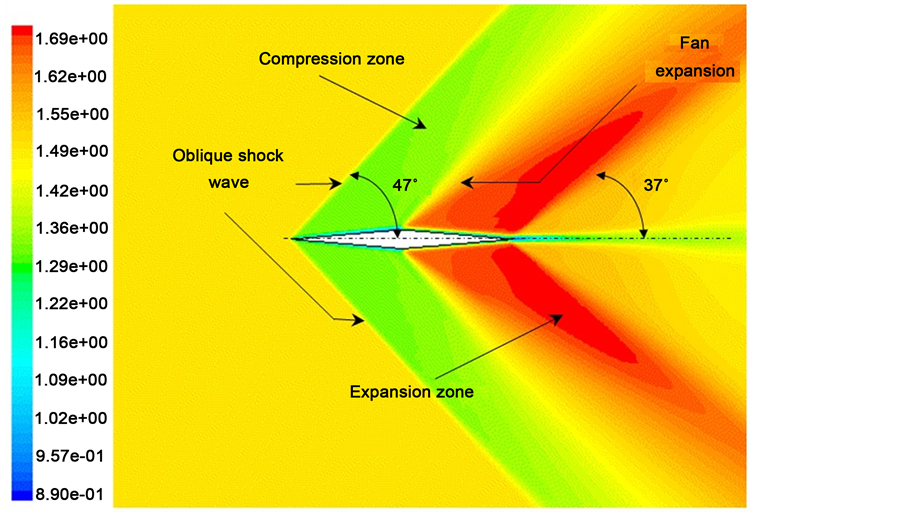
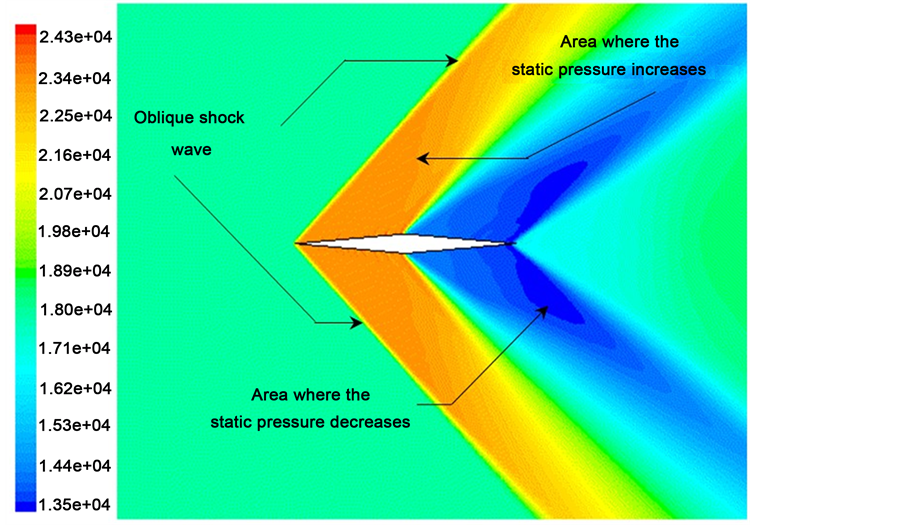
Evaluating Oblique Shock Waves Characteristics on a Double-Wedge Airfoil View original
Is this image relevant?
Evaluating Oblique Shock Waves Characteristics on a Double-Wedge Airfoil View original
Is this image relevant?
Shock Waves – University Physics Volume 1 View original
Is this image relevant?
Evaluating Oblique Shock Waves Characteristics on a Double-Wedge Airfoil View original
Is this image relevant?
Normal Shock Waves in Compressible Flow
Formation and Characteristics
A normal shock wave is a thin, planar discontinuity oriented perpendicular to the flow direction. It forms when supersonic flow is forced to decelerate abruptly, such as when it encounters an obstruction or a back-pressure condition that cannot be communicated upstream through pressure waves.
Key properties of a normal shock:
- Upstream flow is always supersonic (); downstream flow is always subsonic ().
- Across the shock, static pressure, density, temperature, and entropy all increase, while velocity decreases.
- The process is irreversible and non-isentropic: total pressure drops across the shock, even though total temperature is conserved (adiabatic).
- Shock strength scales with the upstream Mach number. A barely supersonic produces a weak shock with small property changes; a high produces a strong shock with large jumps.
- The physical thickness of the shock is only a few molecular mean free paths, so for engineering purposes it's treated as a discontinuity.
Practical examples:
- A supersonic aircraft engine inlet uses a normal shock (or a terminal normal shock after a series of oblique shocks) to decelerate the captured airflow to subsonic speeds before it enters the compressor.
- In a converging-diverging nozzle operating at an off-design back pressure, a normal shock can stand inside the diverging section, causing a sudden pressure rise and a drop to subsonic flow downstream.
Normal Shock Relations
Equations and Calculations
The normal shock relations come directly from applying conservation of mass, momentum, and energy across the shock, combined with the ideal-gas equation of state. The only inputs you need are the upstream Mach number and the specific heat ratio .
Static pressure ratio:
Static temperature ratio:
Density ratio (also obtainable from the pressure and temperature ratios via the ideal-gas law):
Notice that the density ratio has a finite upper limit as : it approaches , which equals 6 for air (). Pressure and temperature, by contrast, grow without bound.
Downstream Mach Number and Total Pressure Ratio
Downstream Mach number:
You can verify that for any , and that as (infinitely weak shock).
Total (stagnation) pressure ratio:
This ratio is always less than 1 for , reflecting the irreversible entropy increase. The stronger the shock, the larger the total-pressure loss.
Worked Example
For a normal shock in air () with :
- Pressure ratio:
- Downstream Mach number:
- Temperature ratio:
- Density ratio:
These values match standard normal-shock tables for .
Oblique Shock Waves in Supersonic Flow
Formation and Behavior
When supersonic flow encounters a wedge, compression corner, or any surface that turns the flow into itself, an oblique shock wave forms at an angle to the incoming flow. Unlike a normal shock, the flow downstream of an oblique shock can remain supersonic.
- The wave angle is the angle between the incoming flow direction and the shock surface.
- The deflection (turning) angle is the angle through which the flow is redirected.
- For a given , there is a maximum deflection angle . If the required turning exceeds , no attached oblique shock solution exists and a detached bow shock forms instead.
- The component of velocity normal to the shock undergoes a normal-shock-type jump; the tangential component is unchanged. This is the key to converting between normal and oblique shock analysis.

Classification and Limiting Cases
For any combination of and , two solutions exist:
- Weak shock: smaller , higher downstream Mach number (usually still supersonic). This is the solution that occurs in practice for most external flows.
- Strong shock: larger , lower (often subsonic). This solution typically requires a downstream pressure condition to be realized.
Two important limiting cases:
- As , the weak oblique shock degenerates into a Mach wave with . A Mach wave is an infinitely weak, isentropic disturbance.
- As , the oblique shock becomes a normal shock (flow is entirely perpendicular to the wave).
Practical examples:
- Supersonic aircraft use swept-back wings and carefully shaped forebodies to produce oblique shocks rather than normal shocks, significantly reducing wave drag.
- Supersonic inlets often use a sequence of oblique shocks (external compression ramps) followed by a terminal normal shock. Each oblique shock produces a smaller total-pressure loss than a single normal shock at the same freestream Mach number, so the overall pressure recovery is much better.
Oblique Shock Relations
Equations and Calculations
The oblique shock relations follow from the same conservation laws as normal shocks, but applied only to the velocity component normal to the shock surface, . The tangential component is preserved.
-- relation (connects geometry to the upstream Mach number):
This equation is implicit in , so you typically solve it iteratively or read from oblique-shock charts for a given and .
Downstream Mach number:
The left side gives the normal component of the downstream Mach number; dividing by yields .
Static pressure ratio:
Temperature, Density, and Total Pressure Ratios
Because only the normal velocity component changes across the shock, you can reuse every normal-shock formula by substituting in place of :
- Temperature ratio: use the normal-shock expression with .
- Density ratio: use the normal-shock expression with .
- Total pressure ratio: use the normal-shock expression with .
This substitution principle is the single most useful shortcut for oblique shock calculations. Once you find , you effectively reduce the problem to a normal shock at Mach .
Worked Example
For a 10° wedge half-angle in a flow of air ():
- Find : Solve the -- relation (or read from charts). The weak-shock solution gives .
- Normal Mach component:
- Pressure ratio:
- Downstream Mach number: Compute from the normal-shock relation at , giving . Then . The flow remains supersonic.
- Total pressure loss is modest because is only 1.33, confirming why oblique shocks are preferred over a single normal shock for pressure recovery.
See Fiveable more often in Google
Mark Fiveable as a preferred source and Google is more likely to show you our guides in Top Stories, with a "preferred" badge in AI Mode and AI Overviews.