10.1 Gibbs Phase Rule and Phase Diagrams

🧊Thermodynamics II Unit 10 Review
10.1 Gibbs Phase Rule and Phase Diagrams
🧊 Thermodynamics II
Gibbs Phase Rule

Top images from around the web for Applying the Gibbs Phase Rule
Phase transitions – TikZ.net View original
Is this image relevant?
Gibb’s Phase Rule – Foundations of Chemical and Biological Engineering I View original
Is this image relevant?
Phase Diagrams | Chemistry for Majors View original
Is this image relevant?
Phase transitions – TikZ.net View original
Is this image relevant?
Gibb’s Phase Rule – Foundations of Chemical and Biological Engineering I View original
Is this image relevant?
Applying the Gibbs Phase Rule
The Gibbs Phase Rule connects three quantities for any system at equilibrium: the number of independent components (), the number of coexisting phases (), and the degrees of freedom ():
The "+2" accounts for the two intensive variables temperature and pressure. (If one of these is held fixed, the rule becomes , which is why many binary diagrams drawn at constant pressure effectively lose one degree of freedom.)
Some quick definitions:
- Components (): The minimum number of chemically independent species needed to describe every phase in the system. For a water–salt solution, .
- Phases (): Physically distinct, homogeneous regions. Ice, liquid water, and steam each count as separate phases, but a mixture of two miscible liquids is a single phase.
- Degrees of freedom (): The number of intensive variables (temperature, pressure, composition) you can change independently without altering how many phases are present.
The rule applies whenever every component has equal chemical potential across all phases in which it appears. That's the equilibrium requirement. If the system isn't at equilibrium, the phase rule doesn't hold.
Relationship Between Components, Phases, and Degrees of Freedom
The trade-off in is straightforward: more phases means fewer degrees of freedom, and more components means more.
Single-component systems ():
| Situation | Meaning | ||
|---|---|---|---|
| One phase (e.g., liquid water) | 1 | 2 | You can vary both and freely |
| Two phases coexist (e.g., along the boiling curve) | 2 | 1 | Only one variable is free; fixing fixes |
| Triple point | 3 | 0 | Everything is fixed; no variable can change |
Three is the maximum number of coexisting phases for a pure substance, because can't be negative.
Binary systems ():
The maximum coexisting phases jump to four (). These invariant points show up as eutectic or peritectic points on binary phase diagrams, where temperature, pressure, and all phase compositions are fully determined.
Terminology worth knowing:
- Invariant (): The system is locked. Any change in an intensive variable eliminates a phase.
- Univariant (): One variable is free. This corresponds to phase boundary lines on a diagram.
- Bivariant (): Two variables are free. This corresponds to single-phase regions on a – diagram.

Phase Diagrams for Systems
Single-Component and Binary Phase Diagrams
Phase diagrams are graphical maps of which phases are stable under given conditions. They translate the Gibbs Phase Rule into something visual.
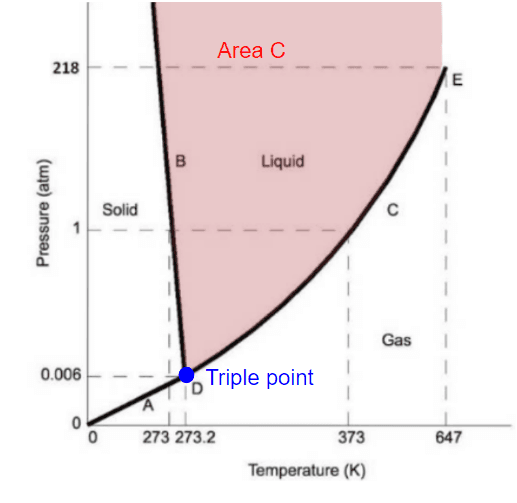
Single-component diagrams plot pressure (y-axis) vs. temperature (x-axis). You'll see:
- Regions of solid, liquid, and gas stability (each is a bivariant area, )
- Phase boundary curves where two phases coexist (univariant lines, ): the fusion curve (solid–liquid), the vaporization curve (liquid–gas), and the sublimation curve (solid–gas)
- A triple point where all three boundaries meet (invariant, ). For water, this is at 273.16 K and 611.7 Pa.
- A critical point at the terminus of the vaporization curve. Beyond this point, liquid and gas become indistinguishable (the supercritical fluid region).
Binary diagrams typically plot temperature (y-axis) vs. composition as mole fraction (x-axis) at a fixed pressure. Because pressure is fixed, the effective rule is . These diagrams show:
- Single-phase regions (liquid solution, solid solution, etc.)
- Two-phase regions where two phases of different composition coexist
- Invariant points such as eutectics (where a liquid transforms into two solid phases simultaneously) and peritectics

Interpreting and Analyzing Phase Diagrams
Reading a phase diagram is a skill that comes up repeatedly. Here's a systematic approach:
For a single-component diagram:
- Identify each single-phase region and label the phase.
- Locate the triple point and critical point.
- Trace a path (e.g., heating at constant pressure) and note which phase boundaries you cross to predict the sequence of transitions.
For a binary diagram:
- Identify single-phase and two-phase regions.
- In any two-phase region, draw a horizontal tie line at the temperature of interest. The endpoints of the tie line give the compositions of the two coexisting phases.
- Apply the lever rule to find the relative amounts of each phase.
The lever rule works like a balance. If your overall composition sits between the two endpoints of a tie line at compositions and :
The fraction of phase is proportional to the "lever arm" on the opposite side. This is the most common source of sign errors on exams, so pay attention to which arm goes with which phase.
- Check the degrees of freedom at any point using the phase rule. Inside a two-phase region of a binary system at fixed pressure: , so specifying temperature fixes the compositions of both phases (though not the amounts, which require the lever rule).
Phase Transitions
Types of Phase Transitions
Phase transitions are transformations between phases, and they're classified by how the Gibbs free energy behaves.
First-order transitions have a discontinuity in the first derivatives of the Gibbs free energy with respect to or . That means volume and entropy jump at the transition. Melting, boiling, and sublimation are all first-order. You can spot them by the presence of latent heat: energy is absorbed or released at constant temperature during the transition.
Second-order (continuous) transitions have continuous first derivatives (no jump in volume or entropy) but discontinuous second derivatives, such as heat capacity or isothermal compressibility. The classic example is the ferromagnetic-to-paramagnetic transition at the Curie temperature: no latent heat, but diverges at the transition point.
Other important categories:
- Solid–solid transitions: Transformations between crystal structures of the same substance (allotropes). Iron's BCC FCC transition at 912 °C is a well-known example.
- Liquid–liquid phase separation: A homogeneous liquid mixture splits into two immiscible liquid phases of different composition. This occurs below an upper critical solution temperature (UCST) or above a lower critical solution temperature (LCST), depending on the system.
- Glass transitions: Not true thermodynamic phase transitions. A supercooled liquid gradually becomes rigid as it's cooled, without crystallizing. There's no sharp discontinuity in , but properties like viscosity change dramatically over a narrow temperature range.
Characteristics of Phase Transitions
The thermodynamic signatures differ between transition types:
- First-order: Latent heat , discontinuous changes in and . The Clausius–Clapeyron equation relates the slope of the phase boundary to these discontinuities:
- Second-order: No latent heat (), but , compressibility, and thermal expansion coefficient show discontinuities or divergences.
Equilibrium transition conditions (the temperature and pressure at which a transition occurs) are read directly from the phase diagram. But real systems don't always follow equilibrium predictions:
- Nucleation barriers can delay a transition. A liquid can be supercooled below its freezing point if nucleation is slow, and a superheated liquid can persist above its boiling point.
- Hysteresis means the transition temperature differs depending on direction. Cooling a substance might produce the transition at a lower temperature than heating it. This is common in solid-state transitions and is a sign that kinetics, not just thermodynamics, matter.
- Microstructure depends on how fast the transition occurs. Slow cooling of a melt tends to produce large crystals; rapid quenching can produce fine-grained structures or even amorphous (glassy) solids. The phase diagram tells you what phases form at equilibrium, but kinetics determines how they form.
See Fiveable more often in Google
Mark Fiveable as a preferred source and Google is more likely to show you our guides in Top Stories, with a "preferred" badge in AI Mode and AI Overviews.