14.1 Neural Mechanisms of Postural Control

⛹️♂️Motor Learning and Control Unit 14 Review
14.1 Neural Mechanisms of Postural Control
⛹️♂️ Motor Learning and Control
Neural Structures for Postural Control
Staying upright sounds simple, but it requires constant coordination between your brain, spinal cord, and sensory systems. These neural mechanisms process incoming information about your body's position and generate the muscle responses that keep you balanced. This topic connects directly to everything else in the postural control unit, so getting a solid handle on the neural architecture here will pay off.

Top images from around the web for Central Nervous System and Spinal Cord
Autonomic Reflexes and Homeostasis | Anatomy and Physiology I View original
Is this image relevant?
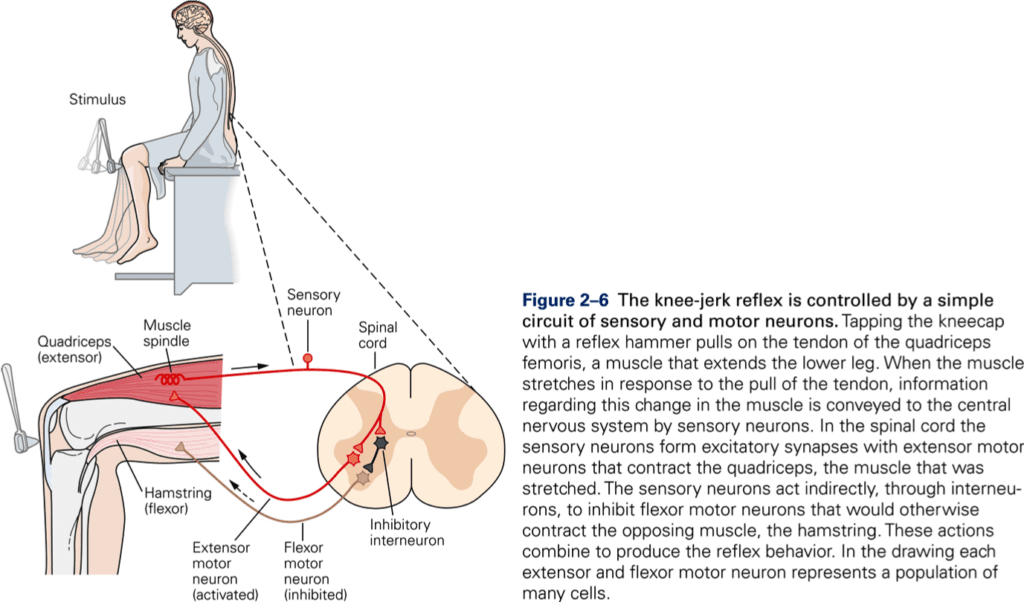
Spinal Reflexes – KINES 200: Introductory Neuroscience View original
Is this image relevant?
Autonomic Reflexes and Homeostasis | Anatomy and Physiology I View original
Is this image relevant?
Autonomic Reflexes and Homeostasis | Anatomy and Physiology I View original
Is this image relevant?
Spinal Reflexes – KINES 200: Introductory Neuroscience View original
Is this image relevant?
Central Nervous System and Spinal Cord
The CNS acts as the command center for postural control. The primary motor cortex and supplementary motor area in the cerebral cortex plan and execute voluntary movements that contribute to maintaining posture. But not all postural adjustments require input from the brain. The spinal cord contains its own neural circuits that handle rapid, automatic corrections.
Two spinal reflexes are especially relevant:
- Stretch reflex: A monosynaptic reflex where a muscle contracts in response to being stretched. This helps maintain muscle tone and keeps you from collapsing when gravity pulls you off-center. Think of your ankle muscles firing when you start to sway forward.
- Crossed extensor reflex: A polysynaptic reflex that coordinates both sides of the body. If you step on something sharp and lift one foot, the extensors on the opposite leg contract to keep you from falling. It pairs extension on one side with flexion on the other.
The speed of these spinal reflexes matters. They kick in faster than anything the cortex could produce, buying your brain time to organize a more complex response.
Subcortical Structures
Several structures below the cortex play major roles in postural control:
Cerebellum: Fine-tunes postural adjustments and coordinates balance. It receives sensory input from multiple systems and uses that information to smooth out motor commands. (More detail in the next section.)
Brainstem: The reticular formation and vestibular nuclei are the two key players here.
- The reticular formation is a network of neurons involved in arousal, attention, and motor control. It helps set the baseline level of muscle tone needed for posture.
- The vestibular nuclei receive input from the inner ear's vestibular organs and project to the spinal cord and cerebellum. They're critical for controlling balance and coordinating eye movements during head motion.
Basal ganglia: This group of subcortical nuclei helps initiate and regulate voluntary movements, which directly affects postural stability. The main components include:
- Striatum (caudate nucleus and putamen): Receives cortical input and relays it to the globus pallidus and substantia nigra.
- Globus pallidus and substantia nigra: Regulate thalamic activity, which in turn influences motor cortex output.
When the basal ganglia are compromised, as in Parkinson's disease, postural control deteriorates significantly.
Cerebellum's Role in Balance

Sensory Integration and Motor Modulation
The cerebellum is sometimes called the brain's "error-correction center" for movement. It receives sensory information from the vestibular system, proprioceptors, and visual system, giving it a comprehensive picture of where the body is and how it's moving.
Here's how the processing works:
- Sensory signals arrive at the cerebellar cortex.
- Purkinje cells, the primary output neurons of the cerebellar cortex, integrate this information.
- Purkinje cells send inhibitory signals to the deep cerebellar nuclei (dentate, interposed, and fastigial nuclei).
- The deep nuclei then project to brain regions involved in motor control, modulating the final motor output.
The cerebellum constantly compares what you intended to do with what you actually did. When there's a mismatch, it adjusts future motor commands. This is how you adapt your balance strategy over time, like getting steadier on a wobble board with practice.
Cerebellar Regions and Dysfunction
Different regions of the cerebellum handle different aspects of motor control:
- Cerebellar vermis (the central strip): Particularly important for balance and postural adjustments. Its anterior lobe controls proximal muscles and posture, while the posterior lobe coordinates voluntary movements and fine motor control.
Damage to the cerebellum results in ataxia, which is characterized by:
- Uncoordinated, jerky movements
- Intention tremors (tremor that worsens as you reach toward a target)
- Difficulty maintaining balance, especially during dynamic tasks
Cerebellar lesions can result from stroke, tumors, or neurodegenerative disorders such as spinocerebellar ataxia and multiple system atrophy.
Vestibular System in Postural Control

Vestibular Organs and Sensory Transduction
The vestibular system sits in the inner ear and detects two types of head movement:
- Semicircular canals (three canals oriented at right angles to each other): Filled with a fluid called endolymph, they detect rotational acceleration. When you turn your head, the fluid lags behind, bending hair cells that generate electrical signals.
- Otolith organs (utricle and saccule): Contain hair cells topped with otoconia, tiny calcium carbonate crystals. The weight of these crystals makes the hair cells sensitive to linear acceleration and changes in head tilt relative to gravity.
Hair cells in both structures transduce mechanical stimuli into electrical signals, which travel via the vestibular nerve to the brainstem and cerebellum.
Vestibular Reflexes and Dysfunction
The vestibular nuclei in the brainstem don't just relay vestibular signals. They integrate vestibular input with visual and proprioceptive information to build an internal model of where your body is in space.
Two reflexes driven by this system are critical for daily function:
- Vestibulo-ocular reflex (VOR): Generates eye movements that are equal and opposite to head movements, keeping your vision stable. Try reading this page while shaking your head side to side. The VOR is what keeps the text in focus.
- Vestibulospinal reflex (VSR): Generates compensatory postural adjustments in response to head movements. If your head tilts unexpectedly, this reflex activates muscles to prevent a fall.
Vestibular dysfunction produces some of the most disorienting symptoms in clinical practice:
- Benign paroxysmal positional vertigo (BPPV): Otoconia become displaced into the semicircular canals, causing brief but intense episodes of vertigo triggered by specific head positions. It's the most common vestibular disorder.
- Vestibular neuritis: Inflammation of the vestibular nerve, producing sudden-onset vertigo, nausea, and imbalance that can last days to weeks.
Sensorimotor Integration in Posture
Multisensory Integration and Internal Representation
Sensorimotor integration is the process by which the CNS combines information from multiple sensory sources to create a unified picture of the body's position and movement. Three systems contribute:
- Visual system: Provides information about the environment and your orientation relative to vertical. You can test this by closing your eyes while standing. You'll likely sway more because you've removed one source of input.
- Proprioceptive system: Receptors in muscles, tendons, and joints report the position and movement of body segments. This is how you know where your limbs are without looking at them.
- Vestibular system: Detects head position and acceleration, as described above.
The brain doesn't treat all three inputs equally at all times. It uses sensory reweighting, dynamically adjusting how much it relies on each source based on context. For example, when you stand on a foam pad, proprioceptive information from your ankles becomes less reliable, so the brain shifts toward relying more on visual and vestibular inputs. This reweighting happens automatically and is a key concept for understanding balance in changing environments.
Adaptation and Rehabilitation
Sensorimotor integration allows the body to update its internal model and modify motor responses when conditions change. Walking on sand requires different postural strategies than walking on pavement, and carrying a heavy backpack shifts your center of mass, demanding new muscle activation patterns. The nervous system handles these transitions by continuously recalibrating.
When sensorimotor integration breaks down, postural control suffers:
- Parkinson's disease: Degeneration of dopaminergic neurons in the basal ganglia impairs movement initiation and postural adjustments, increasing fall risk.
- Peripheral neuropathy: Damage to peripheral nerves reduces proprioceptive feedback, particularly from the feet and ankles, making balance more difficult.
- Aging: Even without specific pathology, older adults often show slower sensory processing and reduced ability to reweight sensory inputs, contributing to increased fall rates.
Rehabilitation targets these deficits through specific strategies:
- Balance training: Exercises that challenge postural control by manipulating sensory inputs or introducing perturbations. Examples include single-leg stance, tandem walking, and standing on unstable surfaces.
- Sensory substitution: Using alternative sensory channels to replace impaired ones. For instance, vibrotactile feedback devices can provide balance cues to individuals with vestibular disorders, giving them real-time information about their body sway through touch rather than inner-ear signals.
See Fiveable more often in Google
Mark Fiveable as a preferred source and Google is more likely to show you our guides in Top Stories, with a "preferred" badge in AI Mode and AI Overviews.