9.1 Causes of War and Armed Conflict

🏴☠️Intro to International Relations Unit 9 Review
9.1 Causes of War and Armed Conflict
🏴☠️ Intro to International Relations
Theoretical Perspectives

Top images from around the web for Realist and Liberal Approaches to War
Public Opinion: How is it formed? | United States Government View original
Is this image relevant?
Foreign Policy: Approaches – United States Government View original
Is this image relevant?
File:SLECO chart.png View original
Is this image relevant?
Public Opinion: How is it formed? | United States Government View original
Is this image relevant?
Foreign Policy: Approaches – United States Government View original
Is this image relevant?
Realist and Liberal Approaches to War
Two major IR theories offer competing explanations for why wars happen.
Realism starts from a core assumption: the international system is anarchic, meaning there's no world government that can enforce rules or protect states. Because of this, states have to look out for themselves. They compete for power and resources, and military strength becomes the main tool for survival. Realists argue that conflict is a natural outcome of this competition. The balance of power concept is central here: stability exists only when no single state can dominate others, and war often breaks out when that balance shifts.
Liberalism takes a more optimistic view. It argues that cooperation can reduce the likelihood of war through three main mechanisms:
- Democratic peace theory: Democracies rarely go to war with each other. Shared norms of negotiation and public accountability make leaders less willing to fight fellow democracies.
- Economic interdependence: When countries rely on each other for trade, the cost of war goes up and the incentive to fight goes down.
- International institutions: Organizations like the UN and WTO create forums for resolving disputes peacefully and establish rules that constrain state behavior.
Social Constructivism and Diversionary War Theory
Constructivism argues that the causes of war aren't purely material (like power or resources) but also shaped by ideas, identities, and norms. States don't have fixed interests; instead, their identities and threat perceptions are socially constructed through interaction. For example, the U.S. and Canada both have large militaries near each other's borders, but neither perceives the other as a threat because of shared norms and identity. Change those shared understandings, and the same military capabilities could look very different.
Diversionary war theory focuses on domestic politics. The idea is that leaders sometimes start or escalate external conflicts to distract their population from problems at home, like economic downturns or political scandals. A foreign enemy can rally national unity and boost a leader's approval ratings.
- The 1982 Falklands War is a classic example: Argentina's military junta invaded the islands partly to redirect attention from a domestic economic crisis. It backfired when Britain won decisively, and the junta collapsed.
- This strategy isn't limited to authoritarian regimes. Democratic leaders facing low approval ratings may also be tempted to adopt more aggressive foreign policies.

Domestic Factors
Nationalism and Ethnic Conflict
Nationalism is a strong sense of identification with one's nation and a belief that the nation's interests should be prioritized. It can be a powerful force for unity, but it also has a darker side. Leaders frequently harness nationalist sentiment to build public support for war. The outbreak of World War I is a textbook case: nationalist fervor across Europe made populations eager to fight and made compromise politically difficult.
One specific form of nationalism to know is irredentism, which is the push to annex territory in another state because it contains members of the same ethnic or national group. This was a major factor in conflicts like Nazi Germany's annexation of the Sudetenland.
Ethnic conflict arises from tensions between different ethnic groups, often within the same country. These conflicts typically stem from:
- Historical grievances and legacies of discrimination
- Competition for political power or economic resources
- Political leaders deliberately inflaming ethnic divisions to consolidate support
The Yugoslav Wars of the 1990s illustrate how these factors combine. Political elites exploited ethnic identities that had coexisted for decades, turning them into justifications for violence and ethnic cleansing. Ethnic conflicts can also draw in outside powers, turning internal wars into broader regional crises.

Resource Scarcity and Power Vacuums
Resource scarcity can drive conflict when states or groups compete over access to essentials like water, arable land, or energy sources (especially oil). Climate change is making this worse by intensifying droughts, flooding, and competition over shrinking resources, particularly in already-unstable regions like the Sahel.
A related but counterintuitive concept is the resource curse: countries with abundant natural resources (like oil or diamonds) are actually more prone to civil war, not less. The wealth from these resources gives armed groups something to fight over and fund their operations with, while often weakening governance.
Power vacuums emerge when effective authority collapses in a region. This can happen through state failure, regime change, or the withdrawal of a dominant power. When no one is clearly in charge, armed factions compete to fill the gap. The Syrian Civil War is a prime example: as the Assad regime lost control over parts of the country, dozens of rebel groups, extremist organizations, and foreign-backed militias rushed in, each vying for territory and influence.
International Dynamics
Territorial Disputes and Misperceptions
Territorial disputes are among the most common triggers for interstate war. They involve disagreements over who controls a piece of land, and they can stem from historical claims, strategic value, or resource competition. What makes them especially hard to resolve is that territory is often tied to national identity, making compromise feel like a betrayal. The Kashmir conflict between India and Pakistan has persisted since 1947 for exactly this reason: both sides view the territory as integral to their national identity.
Misperception is when states misread each other's intentions, capabilities, or resolve. This can happen because of:
- Cultural differences that lead to misinterpreting signals
- Poor or incomplete intelligence
- Cognitive biases (like assuming the worst about an adversary's motives)
The Cuban Missile Crisis (1962) shows how dangerous misperception can be. Both the U.S. and Soviet Union initially misjudged how far the other side was willing to go, bringing the world to the brink of nuclear war. It also shows how recognizing misperception can prevent war: once Kennedy and Khrushchev understood each other's actual red lines, they found a way to de-escalate.
Security Dilemmas and Preemptive War
The security dilemma is one of the most important concepts in security studies. It describes a situation where one state takes steps to make itself more secure (building up its military, forming alliances), but those same steps make other states feel less secure. Those states then build up their own forces in response, which makes the first state feel threatened, and so on. The result is a spiral of mutual distrust and arms buildup that can lead to war even when no one actually wanted to fight.
The Cold War arms race is the classic example. Both the U.S. and USSR kept expanding their nuclear arsenals not because either side planned to attack, but because each feared falling behind. The security dilemma is so difficult to escape because states can never be fully certain about each other's intentions.
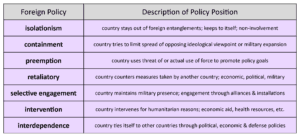
Preemptive war takes the security dilemma a step further. A state strikes first because it believes an attack from the other side is inevitable and that hitting first offers a strategic advantage. The danger is obvious: the "inevitable" attack may not have been coming at all.
- Preemptive war can be framed as self-defense, but it's highly controversial under international law.
- The 2003 Iraq War is a key example. The U.S. justified the invasion partly on the claim that Iraq possessed weapons of mass destruction and posed an imminent threat. That intelligence turned out to be wrong, illustrating how preemptive war based on faulty information can have devastating consequences.
See Fiveable more often in Google
Mark Fiveable as a preferred source and Google is more likely to show you our guides in Top Stories, with a "preferred" badge in AI Mode and AI Overviews.