1.3 Levels of Analysis in International Relations

🏴☠️Intro to International Relations Unit 1 Review
1.3 Levels of Analysis in International Relations
🏴☠️ Intro to International Relations
Levels of Analysis
International relations scholars use levels of analysis to organize the many forces that drive how countries behave. Think of it as zooming in and out: you can look at a single leader's personality, pull back to examine a country's government and economy, or zoom all the way out to study the global system itself. Each level highlights different causes and gives you a different explanation for the same event.
The three main levels are individual, state, and system. No single level tells the whole story, so most IR analysis draws on more than one.

Top images from around the web for Individual Level Analysis
The Decision Making Process | Organizational Behavior and Human Relations View original
Is this image relevant?
Cognitive Biases - Sensemaking Resources, Education, and Community View original
Is this image relevant?
The Decision Making Process | Organizational Behavior and Human Relations View original
Is this image relevant?
Cognitive Biases - Sensemaking Resources, Education, and Community View original
Is this image relevant?
Individual Level Analysis
This level zooms in the closest. It asks: how do specific people shape what countries do?
Foreign policy doesn't just emerge from abstract forces. Real human beings make the calls, and their personalities, beliefs, and mental habits matter. A risk-tolerant leader may escalate a crisis that a cautious one would defuse. A president haunted by a past military failure may avoid intervention the next time around.
Key factors at this level include:
- Personal beliefs and worldview of leaders, such as whether they see the world as fundamentally cooperative or threatening
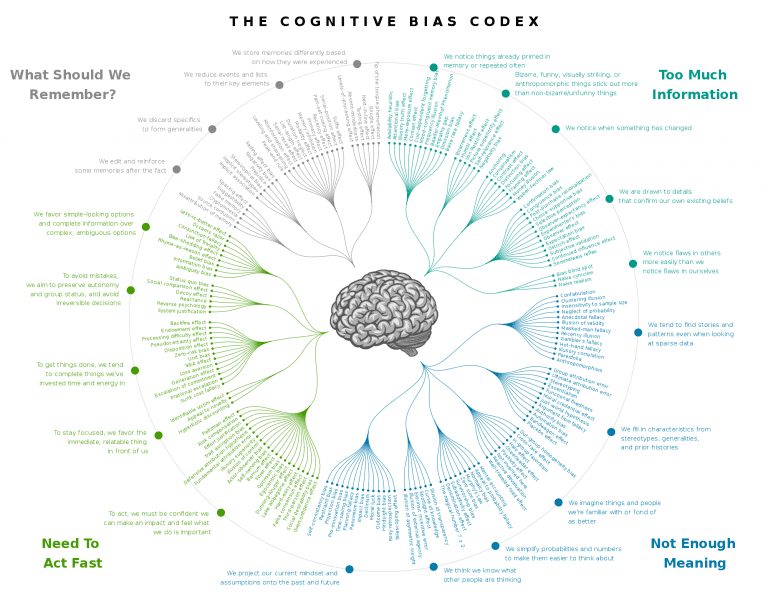
- Cognitive biases like groupthink, where advisors reinforce each other's assumptions instead of challenging them
- Leadership style, from highly centralized decision-makers (think Putin controlling Russian foreign policy personally) to leaders who delegate heavily
- The inner circle of advisors, cabinet members, and confidants who filter information and frame options before a leader ever sees them
State Level Analysis
Pull back one step and you're looking at the country itself. This level asks: how do a state's internal features shape its foreign policy?
Two countries facing the same external threat may respond very differently because of what's happening inside them. A democracy where the public opposes war faces different pressures than an autocracy where one person decides. A country in economic crisis may act more aggressively abroad to distract from domestic problems.
Key factors at this level include:
- Type of government: Democracies and autocracies tend to behave differently. Democratic peace theory, for example, argues that democracies rarely go to war with each other.
- Economic conditions: A state's GDP, trade relationships, and resource dependence all shape what it can and will do internationally.
- National identity and culture: Historical experiences like colonialism or past wars create lasting patterns in how a country approaches the world.
- Bureaucratic politics and interest groups: Foreign policy often results from competition among government agencies, lobbying groups, and political parties, not a single rational calculation.
System Level Analysis
Zoom all the way out and you're looking at the international system as a whole. This level asks: how does the structure of global politics constrain or push states toward certain behaviors?
The core idea here is that the system itself shapes outcomes regardless of who's in charge or what kind of government a state has. The most important structural feature is anarchy, which in IR doesn't mean chaos. It means there's no world government above states that can enforce rules. States have to look out for themselves.
Key factors at this level include:
- Distribution of power: Is the system unipolar (one dominant state, like the U.S. after the Cold War), bipolar (two superpowers, like the U.S. and USSR during the Cold War), or multipolar (several major powers, like pre-WWI Europe)? Each configuration creates different dynamics.
- International norms and institutions: Treaties, organizations, and shared expectations constrain what states feel they can do, even without enforcement.
- Economic interdependence: When countries depend on each other for trade and investment, the costs of conflict rise.
- Balance of power: States tend to form alliances against whichever state or bloc grows too powerful, a pattern that recurs across centuries.
State-Level Factors

Domestic Political Structures and Processes
Since the state level comes up constantly in IR, it's worth digging into the specific mechanisms inside a country that shape foreign policy.
- Form of government matters directly. In democracies, leaders who pursue unpopular foreign policies risk being voted out. In autocracies, leaders face fewer public constraints but may worry more about military coups or elite rivals.
- Legislatures can check executive power. The U.S. Senate, for instance, must ratify treaties and can block foreign aid funding.
- Public opinion and media set boundaries on what's politically possible. A president may want to intervene militarily but back off if polls show strong opposition.
- Interest groups push foreign policy in specific directions. Defense contractors may lobby for higher military spending, while agricultural exporters push for free trade agreements.
Foreign Policy Decision-Making Mechanisms
Beyond broad political structures, the specific organizations that formulate and carry out foreign policy also shape outcomes.
- Foreign ministries and diplomatic corps handle day-to-day international engagement and often favor negotiation over confrontation.
- Military and intelligence agencies bring their own priorities and information. The intelligence a leader receives is already filtered and interpreted by these organizations.
- Crisis management procedures matter enormously in high-stakes moments. During the Cuban Missile Crisis, the structured process Kennedy used to evaluate options (the ExComm group) is often credited with preventing nuclear war.
- Long-term strategic planning sets the direction, but bureaucratic routines and standard operating procedures often determine what actually happens on the ground.
International Actors
International Organizations and Their Influence
States aren't the only players in international relations. International organizations (IOs) create forums for cooperation, set rules, and sometimes act independently.
- Intergovernmental organizations (IGOs) like the United Nations and World Trade Organization bring states together to negotiate, set standards, and sometimes authorize collective action (like UN peacekeeping missions).
- Regional organizations such as the European Union and African Union coordinate policy among neighboring states. The EU is unusually powerful, with its own parliament, court, and shared currency.
- International financial institutions like the World Bank and International Monetary Fund influence state behavior by attaching conditions to loans, often requiring economic reforms in exchange for funding.
- International courts, including the International Court of Justice and the International Criminal Court, shape international law by ruling on disputes and prosecuting individuals for war crimes.
Transnational Actors and Global Networks
Beyond formal organizations, a range of non-state actors operate across borders and influence international relations in ways states can't always control.
- Multinational corporations (MNCs) like Apple or Shell have economic power rivaling some countries. Their investment decisions can shape a state's foreign policy priorities.
- Non-governmental organizations (NGOs) such as Amnesty International and Médecins Sans Frontières pressure governments, document abuses, and deliver aid where states won't or can't.
- Transnational advocacy networks link activists, NGOs, and sympathetic governments across borders to push for changes in international norms, such as the campaign that led to the ban on landmines.
- Terrorist organizations and criminal networks operate outside state control and pose security challenges that don't fit neatly into traditional state-vs-state analysis.
- Diaspora communities can influence both their home and host countries' foreign policies through lobbying, remittances, and political activism.
See Fiveable more often in Google
Mark Fiveable as a preferred source and Google is more likely to show you our guides in Top Stories, with a "preferred" badge in AI Mode and AI Overviews.