1.4 Actors in International Relations

🏴☠️Intro to International Relations Unit 1 Review
1.4 Actors in International Relations
🏴☠️ Intro to International Relations
State Actors

Top images from around the web for Nation-States and Intergovernmental Organizations
UN-Logo-660x330 - Committee for Justice View original
Is this image relevant?
Organization - Wikipedia View original
Is this image relevant?
Member states of the United Nations - Wikipedia View original
Is this image relevant?
UN-Logo-660x330 - Committee for Justice View original
Is this image relevant?
Organization - Wikipedia View original
Is this image relevant?
Nation-States and Intergovernmental Organizations
Nation-states are the primary actors in international relations. A nation-state has sovereignty over a defined territory and population, meaning it exercises supreme authority within its borders and no outside power has the right to interfere in its internal affairs. Nation-states engage in diplomacy, sign treaties, wage wars, and set the rules of the international system.
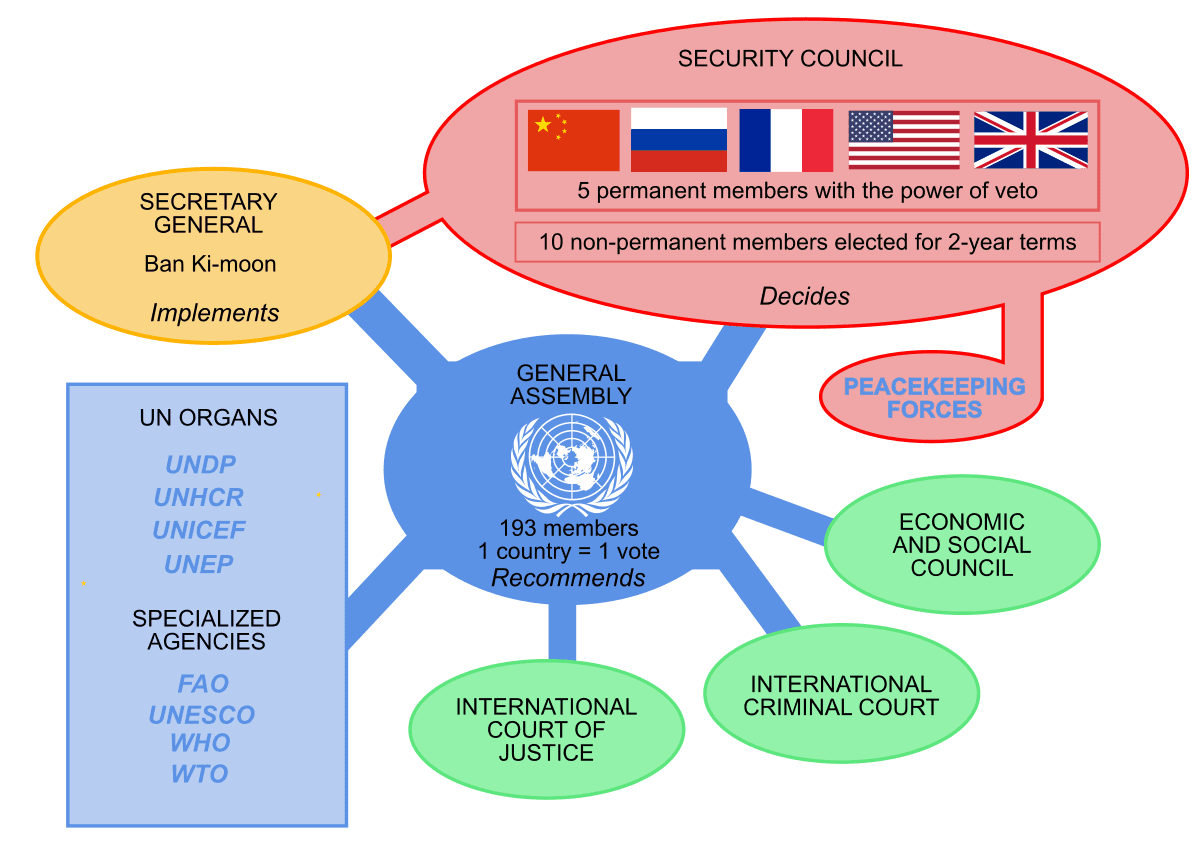
Intergovernmental Organizations (IGOs) are created by member states to address shared problems and promote cooperation. The United Nations, for example, provides a forum where nearly every country in the world can negotiate and resolve disputes. The World Trade Organization sets rules for international trade. IGOs don't replace states; they give states a structured way to work together, implement agreements, and hold each other accountable.
Beyond formal IGOs, international institutions also include informal groupings like the G7 and G20. These don't have binding authority, but they shape state behavior by establishing norms, coordinating policy, and creating expectations about how states should act.

Supranational Organizations and Their Impact
A supranational organization goes a step further than an IGO: it has the authority to make decisions that are binding on its member states. The key distinction is that member states give up some of their sovereignty to the organization.
The European Union is the clearest example:
- Member states share a common currency (the Euro, adopted by 20 of 27 members)
- EU law can override national law in certain areas
- Citizens move freely across borders within the Schengen Area
This transfer of power from the national to the supranational level creates new layers of governance. Member states gain collective bargaining power in international negotiations and deeper economic integration, but they lose some independent decision-making authority. That trade-off between sovereignty and cooperation is one of the central tensions in studying supranational organizations.

Non-State Actors
Non-Governmental Organizations and Multinational Corporations
Non-Governmental Organizations (NGOs) operate independently of any government. They focus on social, environmental, and humanitarian issues. Amnesty International monitors human rights abuses worldwide. Greenpeace campaigns on environmental protection. NGOs advocate for policy changes, raise public awareness, and often provide services in places where governments can't or won't, such as delivering humanitarian aid in conflict zones.
Multinational Corporations (MNCs) are businesses that operate across national borders. Companies like Apple, Shell, and Toyota influence global trade patterns and economic trends. Some MNCs have annual revenues larger than the GDPs of entire countries, giving them significant political leverage. Their decisions about where to build factories, source materials, or invest capital directly affect labor markets and environmental policies in multiple nations.
Both NGOs and MNCs shape the international agenda by participating in global forums, lobbying governments and international organizations, and forming cross-sector partnerships to tackle issues like climate change or public health.
Terrorist Groups and Individuals in Global Politics
Terrorist groups challenge state authority and international security by using violence to pursue political, ideological, or religious goals. They operate across national borders and exploit the tools of globalization, including international finance, communications technology, and open borders. Their actions force states to adapt security policies and deepen international cooperation on intelligence sharing and counterterrorism.
Individuals can also be significant actors in international relations, even without the backing of a state or organization. Greta Thunberg shaped global climate policy debates through activism. Edward Snowden's leaks about U.S. surveillance programs strained diplomatic relationships between allies. Philanthropists like Bill Gates direct billions toward global health initiatives, influencing development priorities in ways that rival some government aid programs.
The growing influence of non-state actors challenges the traditional state-centric model of international relations, which assumes that states are the only actors that really matter. Technology and social media allow individuals and groups to mobilize support, build transnational networks, and exert pressure on governments in ways that were impossible a few decades ago. For an intro IR course, the takeaway is straightforward: states still dominate, but they no longer act alone.
See Fiveable more often in Google
Mark Fiveable as a preferred source and Google is more likely to show you our guides in Top Stories, with a "preferred" badge in AI Mode and AI Overviews.