6.1 Classification and properties of quadrilaterals

🔷Honors Geometry Unit 6 Review
6.1 Classification and properties of quadrilaterals
🔷 Honors Geometry
continue practicing 6.1
Multiple choice
Quadrilaterals are four-sided polygons, and each type has a distinct set of properties governing its sides, angles, and diagonals. Classifying quadrilaterals correctly and knowing their properties is essential for solving proof-based and measurement problems in geometry. This section covers the hierarchy of quadrilateral types, their defining characteristics, and the theorems you'll use to identify and work with them.
Quadrilateral Classification and Properties
Characteristics of quadrilaterals
A quadrilateral is any polygon with exactly four sides and four angles. The interior angles of every quadrilateral sum to , regardless of its shape. This fact alone is one of your most useful tools for finding missing angle measures.
Quadrilaterals fall into several categories, and many of these categories overlap. The main types you need to know are:
- Parallelogram: opposite sides are parallel and congruent
- Rhombus: all four sides are congruent, with opposite sides parallel (a special parallelogram)
- Rectangle: all four angles are , with opposite sides parallel and congruent (a special parallelogram)
- Square: all four sides congruent and all four angles (both a rhombus and a rectangle)
- Trapezoid: exactly one pair of parallel sides, called the bases
- Kite: two pairs of consecutive (adjacent) sides are congruent, but opposite sides are not congruent
Notice the hierarchy here: every square is a rhombus, every square is a rectangle, and every rhombus and rectangle is a parallelogram. When a problem tells you a figure is a rhombus, you can also use every parallelogram property. That layered relationship comes up constantly in proofs and problem-solving.

Classification of quadrilaterals
Each type of quadrilateral has a specific set of properties. Knowing these cold will save you time on proofs and calculations.
Parallelograms
- Opposite sides are parallel and congruent
- Opposite angles are congruent
- Consecutive angles are supplementary (they add to )
- Diagonals bisect each other (each diagonal cuts the other into two equal segments)
Rhombuses (all parallelogram properties, plus the following)
- All four sides are congruent
- Diagonals are perpendicular (they meet at )
- Each diagonal bisects a pair of opposite angles
Rectangles (all parallelogram properties, plus the following)
- All four angles measure
- Diagonals are congruent (equal in length)
Squares (all parallelogram, rhombus, and rectangle properties)
- All four sides congruent
- All four angles
- Diagonals are congruent, perpendicular, and bisect each other
- Each diagonal bisects a pair of opposite angles
Trapezoids
- Exactly one pair of parallel sides (the bases); the non-parallel sides are called legs
- Isosceles trapezoids have congruent legs, congruent base angles (the two angles sharing the same base), and congruent diagonals
- In any trapezoid, each pair of co-interior angles (same-side interior angles between the bases) is supplementary
Kites
- Two distinct pairs of consecutive sides are congruent
- Exactly one pair of opposite angles is congruent (the angles between the non-congruent sides)
- Diagonals are perpendicular
- The diagonal connecting the vertices of the non-congruent angle pair (the "main diagonal") bisects the other diagonal
- The main diagonal also bisects the two vertex angles it connects
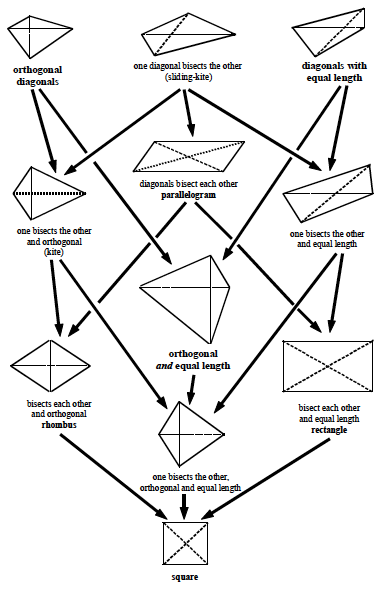
Theorems for quadrilateral properties
These theorems give you ways to prove that a quadrilateral belongs to a specific category. In proofs, you're often starting with a generic quadrilateral and showing it satisfies one of these conditions.
Proving a parallelogram
You can prove a quadrilateral is a parallelogram by establishing any one of the following:
- Both pairs of opposite sides are parallel
- Both pairs of opposite sides are congruent
- One pair of opposite sides is both parallel and congruent
- Both pairs of opposite angles are congruent
- The diagonals bisect each other
Condition 3 is especially useful because you only need information about one pair of sides, not both.
Proving a rhombus
- A parallelogram with all four sides congruent is a rhombus
- A parallelogram whose diagonals are perpendicular is a rhombus
- A parallelogram in which a diagonal bisects a pair of opposite angles is a rhombus
Proving a rectangle
- A parallelogram with at least one right angle is a rectangle (since consecutive angles are supplementary, one right angle forces all four to be )
- A parallelogram with congruent diagonals is a rectangle
Proving a square
- A parallelogram with all sides congruent and one right angle is a square
- A rhombus with one right angle is a square
- A rectangle with all sides congruent is a square
Applications of quadrilateral properties
When solving problems, follow a consistent approach:
- Identify the quadrilateral type from the given information. Use the theorems above if the type isn't stated directly.
- List every property that applies. Remember the hierarchy: if it's a rhombus, you also get all parallelogram properties.
- Set up equations using those properties. For example, if opposite angles of a parallelogram are given as and , set them equal because opposite angles are congruent.
- Solve and verify. After finding your answer, check that it's consistent with all the properties (angles sum to , side lengths are positive, etc.).
Common problem-solving strategies:
- Use the angle sum to find a missing angle when three angles are known
- Apply properties of parallel lines cut by transversals (alternate interior angles, corresponding angles, co-interior angles) when diagonals or sides create those configurations
- Use diagonal properties to find segment lengths. For instance, if a rectangle's diagonals intersect at point , then because the diagonals are congruent and bisect each other.
- In coordinate geometry problems, use the midpoint formula to check whether diagonals bisect each other, or the slope formula to check for parallel or perpendicular sides
A common mistake: students try to prove a figure is a rhombus or rectangle without first establishing that it's a parallelogram. The rhombus and rectangle theorems listed above all start with "a parallelogram with..." so you need that foundation first. The exception is if you prove all four sides congruent and show opposite sides are parallel, which handles both steps at once.
See Fiveable more often in Google
Mark Fiveable as a preferred source and Google is more likely to show you our guides in Top Stories, with a "preferred" badge in AI Mode and AI Overviews.