2.1 Inductive and deductive reasoning

🔷Honors Geometry Unit 2 Review
2.1 Inductive and deductive reasoning
🔷 Honors Geometry
continue practicing 2.1
Multiple choice
Inductive and Deductive Reasoning
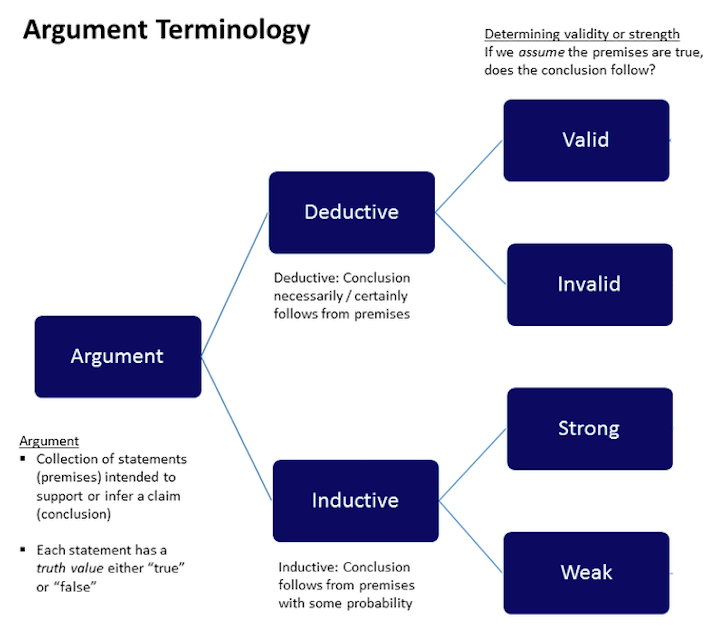
Inductive and deductive reasoning are the two main ways we build arguments and reach conclusions in geometry. Inductive reasoning spots patterns in specific examples and uses them to make general predictions. Deductive reasoning works the other direction: it starts with accepted rules or facts and applies them to reach a specific, guaranteed conclusion.
Both types of reasoning show up constantly in this course. You'll use inductive reasoning to notice patterns and form conjectures, then use deductive reasoning to actually prove those conjectures are true. Understanding the difference between the two is essential for writing proofs.
Inductive vs. Deductive Reasoning
Inductive reasoning draws conclusions based on patterns or observations.
- It moves from specific instances (individual cases) to a general statement (a broader conclusion).
- Conclusions are probable but not guaranteed to be true. There may be exceptions you haven't seen yet.
- Example: You notice that every triangle you've measured so far has angle measures that add up to 180°. You conclude that all triangles have angles summing to 180°. That conclusion feels strong, but inductive reasoning alone can't make it certain.
Deductive reasoning draws conclusions from logical arguments built on accepted premises.
- It moves from general statements (accepted truths, definitions, theorems) to a specific conclusion.
- If the premises are true and the logic is valid, the conclusion is guaranteed to be true.
- Example: You know that all squares are rectangles (general statement). You know that ABCD is a square (specific instance). Therefore, ABCD is a rectangle (specific conclusion). There's no wiggle room here; the conclusion must follow.
The key distinction: inductive reasoning can suggest something is true, but deductive reasoning can prove it's true.
Patterns and Conjectures in Induction
Inductive reasoning follows a process. Here's how it works step by step:
- Observe specific instances. Gather examples, data points, or cases.
- Look for patterns. Identify common features, trends, or relationships among your examples.
- Formulate a conjecture. A conjecture is an educated guess that generalizes the pattern into a broader rule.
- Test the conjecture. Try it on new cases. Actively look for counterexamples that would disprove it.
Here's a concrete example using number patterns:
- You compute the sum of the first few sets of consecutive odd numbers:
- You notice these sums are all perfect squares: .
- You conjecture: The sum of the first odd numbers equals .
- You test it: . It still holds.
The conjecture looks strong, but no amount of testing can prove it with certainty through induction alone. You'd need deductive reasoning (a formal proof) to guarantee it works for every value of .
.svg.png)
Application of Deductive Reasoning
Deductive reasoning starts with general statements or premises assumed to be true. These can be axioms, definitions, postulates, or previously proven theorems. From there, you apply rules of inference to reach a conclusion.
Two rules of inference come up most often:
Modus Ponens (affirming the hypothesis):
- If is true, and is true, then must be true.
- Example: If a number is even (), then it is divisible by 2 (). The number 6 is even ( is true). Therefore, 6 is divisible by 2 ( is true).
Modus Tollens (denying the conclusion):
- If is true, and is false, then must be false.
- Example: If a shape is a square (), then it has four equal sides (). A shape does not have four equal sides ( is false). Therefore, it is not a square ( is false).
The power of deductive reasoning is that valid logic preserves truth. If your premises are true and your reasoning is valid, your conclusion must be true. This is why deductive reasoning is the backbone of geometric proof.
Limitations of Inductive Reasoning
Inductive reasoning is useful for discovering patterns, but it has real limitations:
- It can't guarantee truth. Your observations might not cover all possible cases. A pattern that holds for 100 examples could fail on the 101st.
- Counterexamples can break a conjecture. The classic example: someone who has only ever seen white swans might conjecture that all swans are white. That conjecture collapses the moment they encounter a black swan.
- Conclusions are always provisional. New evidence can force you to revise or abandon a conjecture entirely.
This is exactly why geometry relies on deductive proof rather than inductive observation. Deductive proofs provide certainty within the system's axioms and rules. For instance, the Pythagorean theorem isn't accepted because it worked in thousands of examples. It's accepted because it has been deductively proven from the axioms of Euclidean geometry.
Use inductive reasoning to discover conjectures. Use deductive reasoning to prove them.
See Fiveable more often in Google
Mark Fiveable as a preferred source and Google is more likely to show you our guides in Top Stories, with a "preferred" badge in AI Mode and AI Overviews.