14.3 Applications of vectors in geometry

🔷Honors Geometry Unit 14 Review
14.3 Applications of vectors in geometry
🔷 Honors Geometry
continue practicing 14.3
Multiple choice
Vector Applications in Geometry
Vectors give you an algebraic way to handle geometric relationships that would otherwise require lengthy synthetic proofs. Instead of chasing angle congruences and similar triangles, you can express points and lines as vectors, then use operations like addition, dot products, and scalar multiplication to prove results directly.
These same tools show up throughout physics and engineering, where vectors represent forces, velocities, and fields. This section focuses on how vectors apply to geometric proofs and problems, with a look at the physics connections you'll encounter later.
Vector Proofs for Geometric Theorems
The core idea: represent points and segments as vectors, then use vector algebra to prove geometric facts. Here are the main techniques:
- Proving collinearity. Three points , , are collinear if for some scalar . That means the vectors point in the same (or opposite) direction, so the points lie on one line.
- Proving parallelism. Two lines are parallel if their direction vectors are scalar multiples of each other. If line 1 has direction and line 2 has direction , then means the lines are parallel.
- Proving perpendicularity. Two vectors are perpendicular (orthogonal) when their dot product equals zero: .
These techniques let you prove classic results cleanly. For example:
- Midpoint Formula. If and have position vectors and , the midpoint has position vector .
- Parallelogram Law. If is a parallelogram, then . You can prove the diagonals bisect each other by showing both midpoints equal .
Vector proofs tend to be shorter than traditional proofs because you're working with equations rather than chains of geometric reasoning.
Vectors in Lines and Planes
Vectors provide a compact way to describe lines and planes, especially in three dimensions.
Lines are defined by a point and a direction vector. If a line passes through with direction vector , you can write:
- Parametric equations: , ,
- Symmetric equations:
Each value of gives you a different point on the line.
Planes are defined by a point and a normal vector (a vector perpendicular to the plane). If the normal vector is and the plane passes through :
- Equation of the plane:
Once you have these representations, you can solve several types of problems:
- Intersection of two lines: Set their parametric equations equal and solve the system for the parameter values.
- Angle between two lines or planes: Use the dot product formula. The angle between direction vectors and satisfies .
- Distance from a point to a plane: Use the formula where is the plane equation.
- Classifying line relationships: Two lines in 3D can be parallel (same direction vectors), intersecting (they share a point), or skew (neither parallel nor intersecting).
Vectors for Force and Displacement
In physics, vectors naturally represent quantities that have both magnitude and direction.
Forces are modeled as vectors. When multiple forces act on an object, you find the resultant force by adding the force vectors tip-to-tail (or component-wise). If the resultant is the zero vector, the object is in equilibrium, meaning the forces balance out.
Displacement is the vector from an object's initial position to its final position. It captures the shortest straight-line change in position, regardless of the actual path traveled. This is different from distance, which measures total path length.
Key operations for force and displacement problems:
- Adding force vectors component-wise to find the resultant:
- Resolving a force into components using projection. A force at angle to the horizontal has components and .
- Calculating work using the dot product: . Only the component of force in the direction of displacement does work.

Vector Applications in Physics
Vectors appear across many areas of physics. For an Honors Geometry course, you don't need deep physics knowledge, but understanding the connections helps you see why vector skills matter.
- Mechanics: Newton's Second Law is a vector equation: . Momentum () and impulse are also vector quantities, meaning direction matters as much as magnitude.
- Electromagnetism: Electric and magnetic fields are vector fields, meaning every point in space has an associated vector. The force on a charged particle depends on the direction and strength of these fields.
- Fluid dynamics: The velocity of a fluid at each point forms a vector field. Forces like drag and lift on objects in a fluid are vectors that depend on flow direction and speed.
At more advanced levels, vector calculus tools like gradient, divergence, and curl are used to analyze these fields. That's beyond this course, but the vector foundations you're building now are exactly what those tools build on.
Organizing and Solving Problems with Vectors
Having a consistent problem-solving approach keeps you from getting lost in multi-step vector problems.
Step 1: Organize Given Information Using Vector Notation
Start by translating the problem into vector language.
-
Identify all vector quantities in the problem and assign symbols. Common conventions:
- Position vectors:
- Force vectors:
- Velocity vectors:
-
Write out what you know in vector notation. Convert any magnitudes and angles into component form if needed.
-
Clearly state the unknown. Is it a vector (like a resultant force) or a scalar (like a distance or angle)? Knowing this tells you which operations you'll need.
Step 2: Develop a Solution Plan
Before calculating, map out your approach.
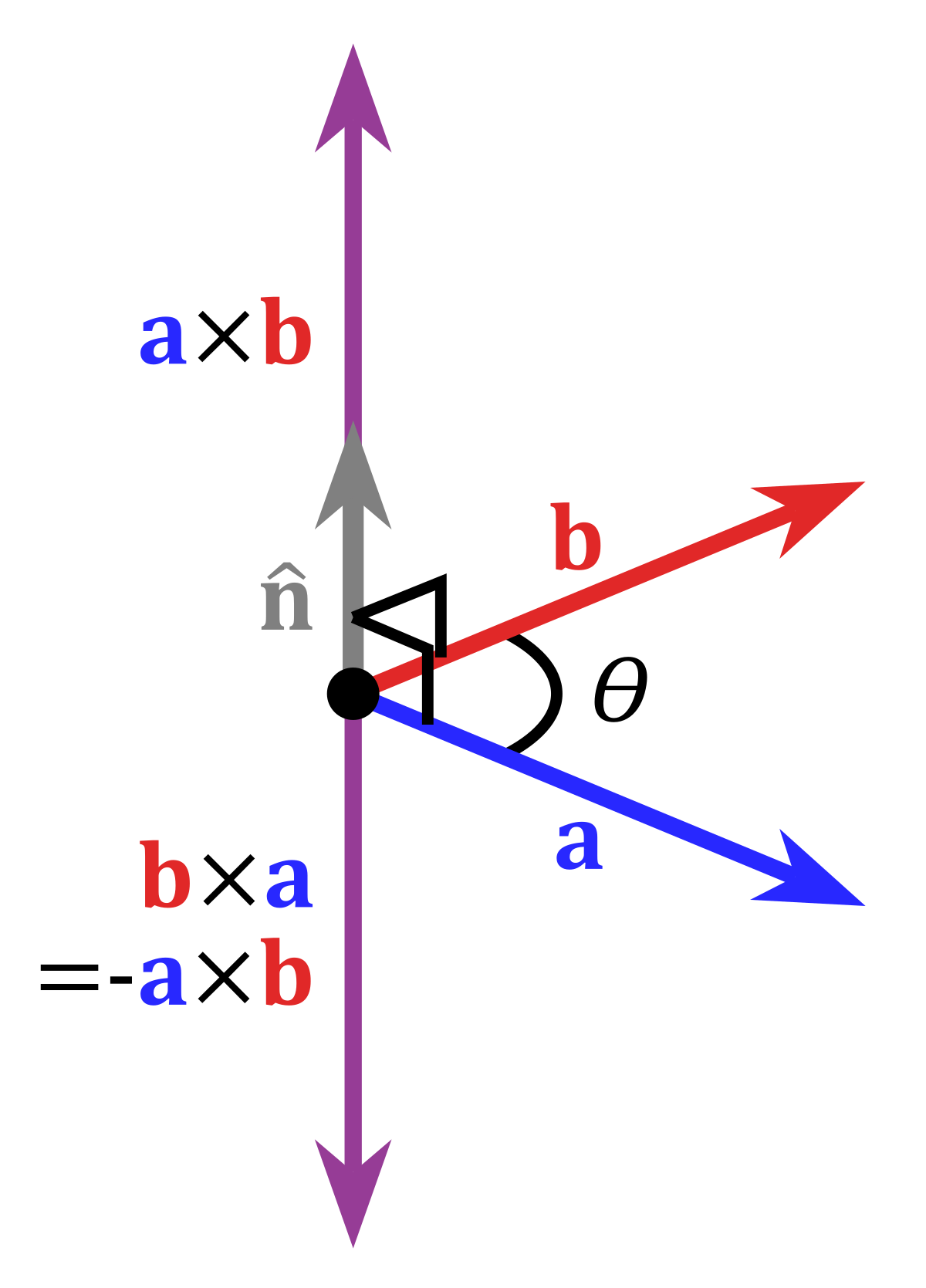
- Identify which operations you need: vector addition, dot product, cross product, scalar multiplication, or projection.
- Determine the order of operations. For example, you might need to resolve forces into components before adding them.
- Recall relevant properties and formulas:
- Parallelogram Law for vector addition
- Commutative property:
- Distributive property:
- Dot product properties for finding angles or checking perpendicularity
- Equations of lines and planes in vector form
Step 3: Execute the Plan
Work through each step carefully.
- Show all intermediate calculations. Don't skip steps, even if they seem simple.
- Use consistent vector notation throughout (don't switch between arrow notation and bold mid-problem).
- Include a diagram or sketch when the problem involves geometric configurations. Even a rough sketch helps you catch errors.
- Justify each step by referencing the property or formula you're using.
Step 4: Verify and Interpret
Once you have an answer, check it.
- Substitute back into the original equations or conditions. Does your answer satisfy them?
- Check units and reasonableness. If you found an angle, is it between and ? If you found a distance, is it positive?
- Interpret the result in context. What does the vector or scalar you found actually mean geometrically or physically?
- Note any assumptions you made (e.g., treating forces as 2D when they might be 3D, or assuming lines are non-parallel). Consider whether those assumptions affect your answer's validity.
See Fiveable more often in Google
Mark Fiveable as a preferred source and Google is more likely to show you our guides in Top Stories, with a "preferred" badge in AI Mode and AI Overviews.