14.1 Vector basics and operations

🔷Honors Geometry Unit 14 Review
14.1 Vector basics and operations
🔷 Honors Geometry
continue practicing 14.1
Multiple choice
Vector Fundamentals
Vectors describe quantities that have both a size and a direction. Unlike regular numbers (scalars), which only tell you "how much," vectors also tell you "which way." This makes them essential for representing things like forces, velocities, and displacements in geometry and physics.
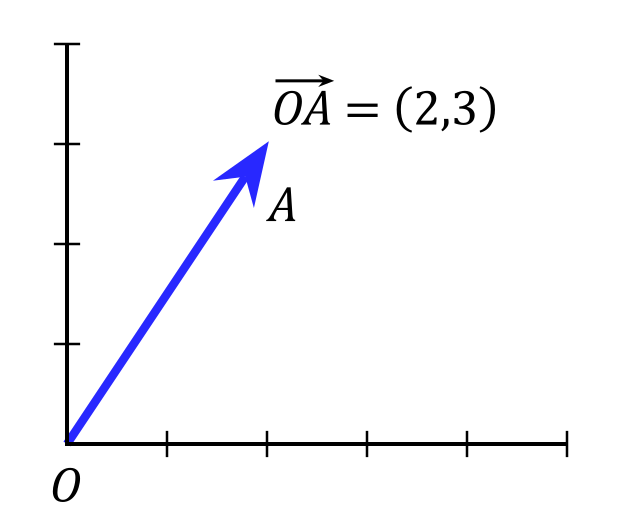
Graphically, a vector is drawn as an arrow. The tail is the starting point, and the head (the tip of the arrow) is the ending point. The arrow's length represents the vector's magnitude, and the way it points represents its direction.
Properties of Geometric Vectors
- Magnitude is the length of the vector, measured as the distance from the initial point to the terminal point.
- Direction is the orientation of the vector in space, typically described as an angle relative to the positive x-axis.
- Two vectors are equivalent if they have the same magnitude and direction, regardless of where they're positioned. You can slide a vector anywhere in the plane without changing it, as long as you don't rotate or resize it.
- Parallel vectors point in the same (or exactly opposite) direction but can differ in magnitude. Scaling a vector changes its length while keeping its direction.
- The zero vector has a magnitude of zero and no defined direction. It's represented as a point rather than an arrow, and it acts as the identity element for vector addition (adding it to any vector leaves that vector unchanged).

Vector Operations
Vector Addition and Subtraction
There are two main ways to add vectors: graphically and algebraically.
Graphical addition (tip-to-tail method):
- Draw the first vector.
- Place the tail of the second vector at the head of the first vector.
- The resultant vector runs from the tail of the first vector to the head of the second vector.
This is called the triangle law of vector addition because the two original vectors and the resultant form a triangle.
Algebraic addition:
Express each vector as an ordered pair in a 2D coordinate system, then add corresponding components:
For example, .
Graphical subtraction:
To subtract from , reverse the direction of (flip the arrow) and then add it to using the tip-to-tail method. The resultant runs from the tail of to the head of the reversed .
Algebraic subtraction:
Subtract corresponding components:
For example, .
Scalar Multiplication of Vectors
Scalar multiplication means multiplying a vector by a real number (a scalar). If is a vector and is a scalar, the result is a new vector whose components are each multiplied by .
Effect on magnitude:
- If , the vector gets longer (stretched).
- If , the vector gets shorter (compressed).
- If , the result is the zero vector.
Effect on direction:
- If , the new vector points in the same direction as the original.
- If , the new vector points in the opposite direction.
For example, if , then . The result is twice as long and points the opposite way.
Magnitude and Direction in the Plane
Magnitude is calculated using the Pythagorean theorem. For a vector :
For example, the magnitude of is .
Direction is described by the angle the vector makes with the positive x-axis:
Be careful with this formula. The arctangent function only gives angles in Quadrants I and IV directly. If your vector points into Quadrant II or III (meaning ), you need to add to the calculator output to get the correct angle.
Unit vectors have a magnitude of exactly 1 and are used to represent direction alone. To find the unit vector in the same direction as :
You're dividing each component by the magnitude. For instance, the unit vector in the direction of is . Unit vectors are useful whenever you need to describe a direction without caring about a specific length.
See Fiveable more often in Google
Mark Fiveable as a preferred source and Google is more likely to show you our guides in Top Stories, with a "preferred" badge in AI Mode and AI Overviews.