11.3 Circumference and area of circles

🔷Honors Geometry Unit 11 Review
11.3 Circumference and area of circles
🔷 Honors Geometry
continue practicing 11.3
Multiple choice
Circumference and Area of Circles
Every circle, regardless of size, shares the same fundamental relationship between its diameter and the distance around it. That ratio is . The formulas in this section all flow from that single fact, so once you internalize it, circumference and area calculations become straightforward.
Circumference Calculation Using Diameter or Radius
Circumference is the distance around the outside edge of a circle. Think of it as the perimeter, but for a curved shape.
There are two equivalent formulas, and which one you use depends on whether you're given the diameter or the radius:
- Using diameter:
- = diameter, the distance across the circle through its center
- Using radius:
- = radius, the distance from the center to the edge
These formulas are interchangeable because . If a circle has a radius of 7 cm, its circumference is cm.
(pi) is the ratio of any circle's circumference to its diameter, approximately 3.14159. Unless a problem tells you to round, leave answers in terms of for exact values.
Area of Circles from Radius or Diameter
Area is the amount of space enclosed inside the circle.
- Using radius:
- Square the radius first, then multiply by
- Using diameter:
- This comes from substituting into the radius formula:
Example: A circular garden has a diameter of 10 ft. Find its area.
- Find the radius: ft
- Apply the formula: ft²
A common mistake is forgetting to square the radius before multiplying by . The exponent applies only to , not to .
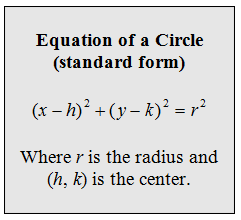
Radius and Diameter from Circumference or Area
Sometimes you're given the circumference or area and need to work backwards. Each formula below is just an algebraic rearrangement of the ones above.
From circumference:
- (divide circumference by to isolate the radius)
- (divide circumference by to isolate the diameter)
Example: A hula hoop has a circumference of ft. Its radius is ft.
From area:
- (divide area by , then take the square root)
- (find the radius, then double it)
Example: A circular rug covers ft². Find its radius.
- Divide by :
- Take the square root: ft
Perimeter and Area of Partial Circles
Partial circles combine a curved arc with one or more straight edges. The key is figuring out what fraction of the full circle you need, then adding back the straight segments for perimeter.
Semicircle (half a circle, cut along a diameter):
- Perimeter:
- The curved part is half the circumference. The straight part is the diameter.
- Area:
Example: A semicircular window has a diameter of 4 ft.
- Perimeter: ft
- Area: ft²
Quarter-circle (one-fourth of a circle, bounded by two radii at a right angle):
- Perimeter:
- The curved part is one-fourth of the circumference. The two straight parts are both radii.
- Area:
Example: A quarter-circle tabletop has a radius of 2.5 ft (so ft).
- Perimeter: ft
- Area: ft²
Watch out: The most common error on partial-circle perimeter problems is forgetting the straight edges. The perimeter isn't just the arc; you must add the diameter (for semicircles) or the two radii (for quarter-circles).
See Fiveable more often in Google
Mark Fiveable as a preferred source and Google is more likely to show you our guides in Top Stories, with a "preferred" badge in AI Mode and AI Overviews.