11.1 Areas of triangles and quadrilaterals

🔷Honors Geometry Unit 11 Review
11.1 Areas of triangles and quadrilaterals
🔷 Honors Geometry
continue practicing 11.1
Multiple choice
Areas of Triangles and Quadrilaterals
Triangles and quadrilaterals are the building blocks for nearly every polygon area problem you'll encounter. Each shape has its own area formula, but they all share a common thread: every formula connects some measure of width to some measure of height. Mastering these formulas (and knowing when to use each one) sets you up for the more complex area problems later in this unit.
Areas of Triangles
Triangle area with base and height
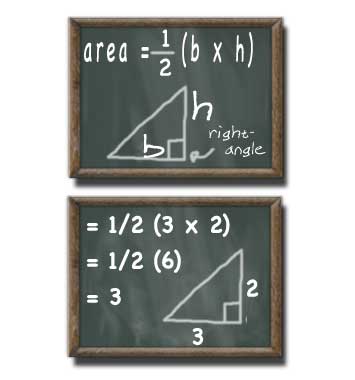
The area of any triangle is given by:
- is the base (you can choose any side as the base)
- is the height, the perpendicular distance from the base to the opposite vertex
The height must be perpendicular to whichever side you pick as the base. In acute triangles, the height falls inside the triangle. In obtuse triangles, the height can fall outside the triangle, which sometimes trips people up on diagrams.
If the height isn't given directly, you'll often need to find it using the Pythagorean theorem or trigonometry.
Example 1: An equilateral triangle with side length 6. Dropping an altitude splits the base in half, creating a right triangle with hypotenuse 6 and one leg 3. By the Pythagorean theorem:
So the area is .
Example 2: A right triangle with legs 3 and 4 (the classic 3-4-5 Pythagorean triple). The two legs are the base and height since they're already perpendicular:
Areas of Quadrilaterals
Parallelogram area calculation
A parallelogram's area works just like a rectangle's, because you can "slide" the slanted part to form a rectangle with the same base and height:
- is the base (either pair of parallel sides)
- is the height, the perpendicular distance between the two parallel sides the base belongs to
Notice this formula does not use the slant side length. The slant side only matters if you need it to calculate the height.
Example 1: Base 8 units, height 5 units → .
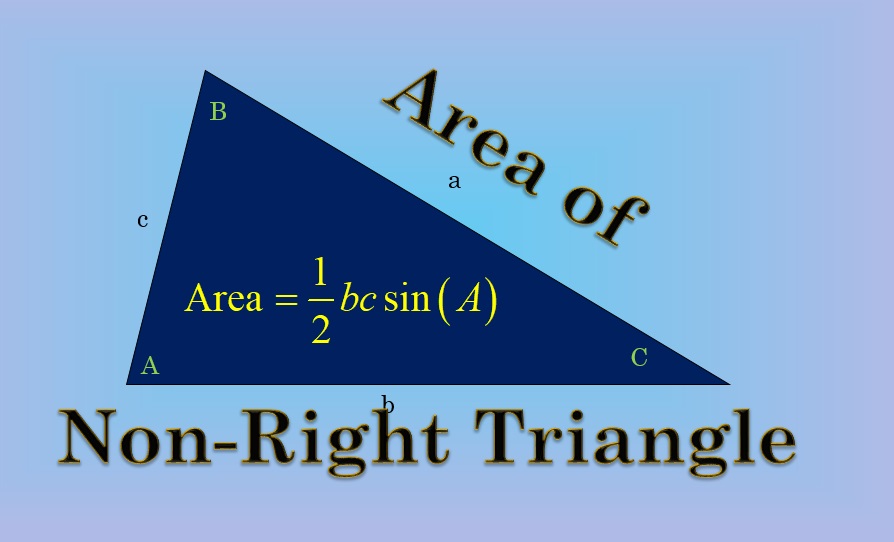
Example 2: Side lengths 6 and 10, with a 60° angle between them. The height drops from the top side perpendicular to the base of length 10. Using the side of length 6 and the given angle:
Trapezoid area using parallel sides
A trapezoid has exactly one pair of parallel sides. Its area formula averages those two parallel sides and multiplies by the height:
- and are the lengths of the two parallel sides (called bases)
- is the perpendicular distance between those parallel sides
Think of as the "average base." You're finding the area of a rectangle whose width equals the average of the two parallel sides.
Example 1: Parallel sides 6 and 10, height 4 → .
Example 2: An isosceles trapezoid with parallel sides 8 and 12, and non-parallel sides of length 5. To find the height, notice the difference in the parallel sides is . That extra length splits equally on both sides (because it's isosceles), so each right triangle at the base has a horizontal leg of and a hypotenuse of 5:
Rhombus and kite area from diagonals
Both rhombuses and kites have perpendicular diagonals, which gives them the same clean area formula:
- and are the lengths of the two diagonals
This formula works because the perpendicular diagonals divide the shape into four right triangles whose combined area simplifies to .
Key diagonal properties to remember:
- Rhombus: Diagonals bisect each other at right angles. Each diagonal cuts the other into two equal halves.
- Kite: Diagonals are perpendicular, but only the main diagonal (the one connecting the two vertices where unequal sides meet) bisects the other diagonal. The shorter diagonal does not bisect the longer one.
These properties come up constantly when you're given half-diagonal lengths and need to reconstruct the full diagonals before applying the formula.
Example 1: A rhombus with diagonals 8 and 6 → .
Example 2: A kite with diagonals 12 and 16 → .
See Fiveable more often in Google
Mark Fiveable as a preferred source and Google is more likely to show you our guides in Top Stories, with a "preferred" badge in AI Mode and AI Overviews.