4.4 Congruence in overlapping and equilateral triangles

🔷Honors Geometry Unit 4 Review
4.4 Congruence in overlapping and equilateral triangles
🔷 Honors Geometry
continue practicing 4.4
Multiple choice
Triangle Congruence
Congruence of Overlapping Triangles
Overlapping triangles show up when two triangles in a figure share a common side or angle. They can be tricky to spot because the triangles are literally on top of each other, so your first job is to mentally "pull apart" the two triangles and redraw them separately.
To prove overlapping triangles congruent, you'll rely on the same postulates and theorems you already know:
- SSS Postulate: Three pairs of congruent sides guarantee congruence.
- SAS Postulate: Two pairs of congruent sides and the included angle (the angle between those sides) prove congruence.
- ASA Postulate: Two pairs of congruent angles and the included side (the side between those angles) establish congruence.
- AAS Theorem: Two pairs of congruent angles and a non-included side confirm congruence.
- HL Theorem: For right triangles only, a congruent hypotenuse and one congruent leg are enough.
The key difference with overlapping triangles is that shared elements count as congruent parts. A side that belongs to both triangles is congruent to itself by the Reflexive Property. The same goes for a shared angle. When you're stuck, look for these shared pieces first; they often supply the "missing" congruence you need to apply a postulate.
Steps for proving overlapping triangles congruent:
- Identify the two triangles you need to prove congruent. Redraw them separately if the overlap makes them hard to see.
- List all given congruent parts, and mark any shared sides or angles as congruent by the Reflexive Property.
- Match corresponding vertices carefully. Overlapping figures make it easy to mix up which vertex corresponds to which.
- Choose the postulate or theorem (SSS, SAS, ASA, AAS, or HL) that fits the congruent parts you've identified.
- Write the congruence statement with vertices in corresponding order, and justify each pair of congruent parts.
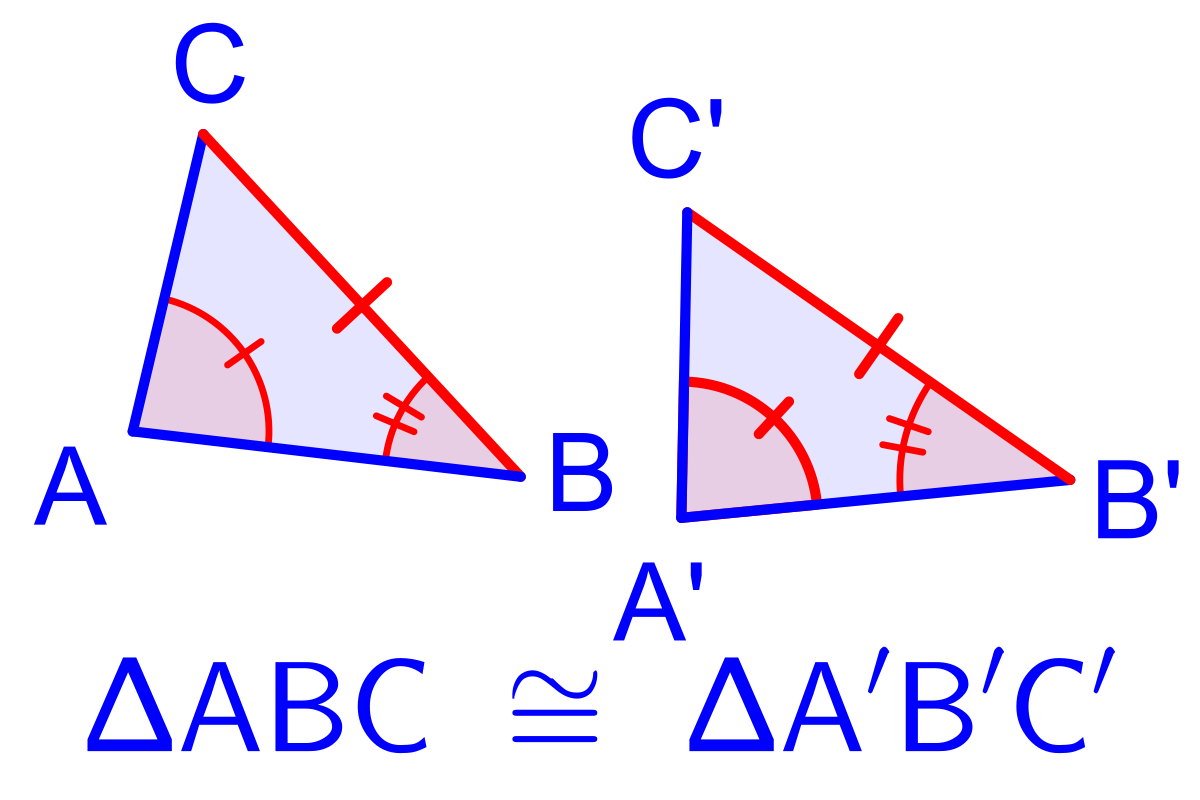
Properties of Equilateral Triangles
An equilateral triangle has three congruent sides and three congruent angles, each measuring . Because every side and angle is the same, equilateral triangles are highly symmetric, and that symmetry gives them several useful properties.
- Every altitude is also a median, an angle bisector, and a perpendicular bisector of the opposite side. In most triangles these are four different segments; in an equilateral triangle they all coincide.
- The centroid, incenter, circumcenter, and orthocenter all land at the same point inside the triangle.
- If you know the side length , the altitude has length . This comes directly from splitting the equilateral triangle into two 30-60-90 right triangles.
To solve problems involving equilateral triangles, set all three side expressions equal to each other (since the sides are congruent) and solve the resulting equation. For example, if the sides are given as , , and , setting gives , and you can verify with the third expression.
A note on AAA: Three pairs of congruent angles (AAA) prove triangles are similar, not congruent. You cannot use AAA alone to prove congruence. For equilateral triangles, you still need to show the sides are congruent (typically via SSS) to prove the triangles are congruent to each other.
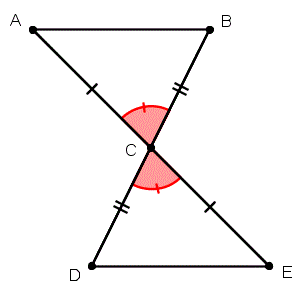
Applying Triangle Congruence
Relationships in Congruent Triangles
Once you've proven two triangles congruent, CPCTC (Corresponding Parts of Congruent Triangles are Congruent) lets you conclude that every pair of corresponding sides and angles is congruent. This is often the real goal of a proof: you prove the triangles congruent so you can then claim a specific pair of sides or angles is congruent.
In overlapping triangles, a shared side appears in both triangles, so it's automatically congruent to itself. After proving congruence, you can use CPCTC to find relationships among the non-shared parts, then set up equations or ratios to solve for missing values.
Problem-Solving with Triangle Congruence
- Identify what you know and what you need. Mark all given congruent parts on the diagram. Look for shared sides or angles (Reflexive Property) and any right angles that might open up HL.
- Separate overlapping triangles. Redraw them side by side with corresponding vertices labeled the same way. This makes the correspondence much clearer.
- Choose and apply a congruence method. Pick SSS, SAS, ASA, AAS, or HL based on the parts you've matched. If the triangles are equilateral, use the angles and equal sides to your advantage.
- Use CPCTC to extend your results. Once congruence is established, state which corresponding parts are congruent.
- Set up and solve equations. Use the congruent parts from CPCTC to write algebraic equations for any unknown lengths or angle measures, and solve using standard algebra.
See Fiveable more often in Google
Mark Fiveable as a preferred source and Google is more likely to show you our guides in Top Stories, with a "preferred" badge in AI Mode and AI Overviews.