8.2 Logarithmic Functions and Their Properties

🍬Honors Algebra II Unit 8 Review
8.2 Logarithmic Functions and Their Properties
🍬 Honors Algebra II
continue practicing 8.2
Multiple choice
Logarithmic functions are the inverses of exponential functions, and they show up constantly when you need to "undo" an exponent. If you can raise a base to a power, a logarithm lets you work backward to find that power. These functions have their own set of properties (product, quotient, power rules) that make simplifying and solving exponential equations much more manageable.
This section covers how logarithms relate to exponential functions, the key properties you'll use to manipulate logarithmic expressions, how to graph them, and how to solve logarithmic equations without falling into the extraneous solution trap.
Logarithmic functions as inverses
Definition and properties
A logarithm answers the question: "What exponent do I need?" If , then . In other words, is the exponent you put on base to get .
- The general form is , where and
- The domain is all positive real numbers: . You cannot take the log of zero or a negative number.
- The range is all real numbers:
Two bases come up so often they get their own notation:
- Common logarithm: base 10, written as or . Your calculator's "log" button uses this.
- Natural logarithm: base , written as or . This appears throughout calculus and science.
One-to-one property
Logarithmic functions are one-to-one, meaning every input gives a unique output and every output comes from a unique input. Graphically, this means any horizontal line crosses the curve at most once (the horizontal line test).
This property is what guarantees the inverse relationship works both ways. It also gives you a useful solving tool: if , then , as long as and are both positive.
Evaluating logarithmic expressions
Properties of logarithms
These three rules let you break apart or combine logarithmic expressions. They come directly from the exponent rules, just translated into log language.
Product Property:
Multiplication inside the log becomes addition outside. For example:
Quotient Property:
Division inside the log becomes subtraction outside. For example:
Power Property:
An exponent inside the log becomes a coefficient outside. For example:
In all cases, and must be positive, and , .
Additional properties and formulas
Change of Base Formula:
This is how you evaluate logs with unusual bases on a calculator. Pick any convenient base (usually 10 or ):
Identity and Zero Properties:
- because
- because
Reciprocal Property:
This follows directly from the quotient property (or the power property with ):
Inverse Cancellation Properties (these are worth memorizing):
- for
- for all real
These say that exponentials and logarithms of the same base undo each other.
Graphing logarithmic functions

Relationship to exponential functions
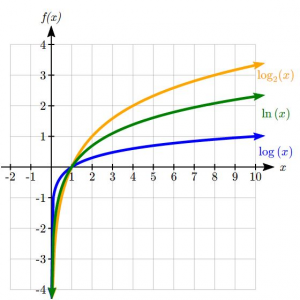
Since is the inverse of , their graphs are reflections of each other across the line . To sketch a log graph, you can plot points for the exponential and then swap every to .
Key features of :
- Vertical asymptote at (the y-axis). The curve approaches it but never touches it.
- x-intercept at , since for any valid base.
- Passes through , since .
Behavior and transformations
- If , the function is increasing (rises from left to right). Larger bases make it rise more slowly.
- If , the function is decreasing (falls from left to right).
Transformations follow the same rules you've used for other function families:
| Transformation | Effect on Graph |
|---|---|
| Shifts up units | |
| Shifts down units | |
| Shifts right units | |
| Shifts left units | |
| Reflects across the x-axis | |
| Reflects across the y-axis | |
| Vertical stretch/compression by factor |
Watch what happens to the asymptote during horizontal shifts. For , the vertical asymptote moves from to , and the domain becomes .
Solving logarithmic equations
Solving techniques
The core strategy is to convert between logarithmic and exponential form.
Single logarithm equations:
- Isolate the logarithmic expression on one side.
- Rewrite in exponential form: if , then .
- Solve for the variable.
Example: Solve . Rewrite as .
Equations with multiple logarithms (same base):
- Use the product, quotient, or power properties to combine into a single logarithm.
- Then convert to exponential form and solve.
Equations with logarithms of different bases:
Use the change of base formula to rewrite everything in the same base, then proceed as above. For instance, to solve , convert to base 2 using .
Solution types and extraneous solutions
Logarithmic equations can have one solution, multiple solutions, or no solution, depending on the domain restrictions.
Extraneous solutions are a real hazard here. They pop up because algebraic steps can produce values that fall outside the domain of the original logarithmic expressions. Every argument of every logarithm in the original equation must be positive.
Example: Solve .
- Combine:
- Rewrite:
- Expand: , so , giving
- Check: makes negative, so it's extraneous. Only is valid.
Always substitute your answers back into the original equation to confirm that no logarithm ends up with a zero or negative argument.
For logarithmic inequalities, the same conversion to exponential form works, but pay attention to the base. If , the inequality direction stays the same. If , the inequality flips when you convert.
Example: Solve . Since , convert directly: .
See Fiveable more often in Google
Mark Fiveable as a preferred source and Google is more likely to show you our guides in Top Stories, with a "preferred" badge in AI Mode and AI Overviews.