12.1 Solving Trigonometric Equations

🍬Honors Algebra II Unit 12 Review
12.1 Solving Trigonometric Equations
🍬 Honors Algebra II
continue practicing 12.1
Multiple choice
Solving trigonometric equations
Trigonometric equations ask you to find the angle(s) that make a trig statement true. Because sine, cosine, and tangent are periodic, a single equation can produce many solutions, so keeping track of intervals and periods is essential. This section covers the algebraic, graphical, and identity-based tools you'll need.
Algebraic techniques and inverse trigonometric functions
The core strategy is to treat the trig function like a variable, isolate it, and then "undo" it with the corresponding inverse function.
General process:
- Use algebra (factoring, combining like terms, substitution) to isolate the trig function on one side of the equation.
- Apply the appropriate inverse trig function to both sides. For example, if , then .
- Remember that the inverse function gives you only one reference angle. You need to use your knowledge of the unit circle to find all angles in the desired interval that share that same sine, cosine, or tangent value.
- Adjust by adding or subtracting full periods ( for sine/cosine, for tangent) to capture every solution within the interval.
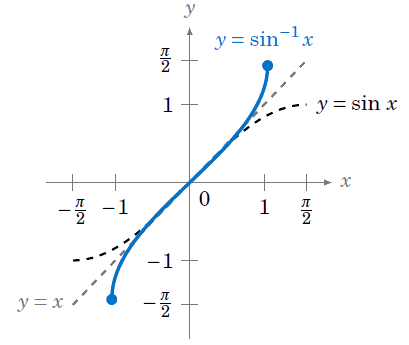
Keep the domain and range of each trig function in mind. For instance, only returns values in , so you'll almost always need a second solution from symmetry.
Solutions in intervals
Periodicity and number of solutions
How many solutions you find depends on the function's period and the width of the interval you're working in.
- Sine and cosine have a period of . Within one full period, an equation like (where ) typically has two solutions (or one if , or zero if ).
- Tangent and cotangent have a period of . Within one period, has exactly one solution for any real .
If the interval spans more than one period, repeat the pattern. If the interval is shorter than one period, some solutions may fall outside and get discarded.
Solving equations in specific intervals
Follow these steps when the problem specifies an interval:
- Solve the equation algebraically to get a reference angle from the inverse trig function.
- Use unit-circle reasoning to find all angles in (or whatever standard cycle applies) that satisfy the equation.
- Identify the period of the trig function involved.
- Keep only the solutions that fall within the given interval. If the interval is wider than one period, add multiples of the period to generate additional solutions.
Example: Solve in the interval .
- The reference angle is .
- Sine is also positive in the second quadrant, giving a second candidate: .
- The period of sine is , and the interval is half that period.
- Both and fall within , so there are two solutions: and .
Note: The original example claimed only one solution here, but is less than , so it's inside the interval. Watch out for this kind of mistake on tests.
Graphical verification of solutions
Intersection points as solutions
Graphing is a reliable way to confirm algebraic answers. Treat the equation as two separate functions and look for where they cross.
- Graph the left-hand side (LHS) as one curve and the right-hand side (RHS) as another.
- Each intersection point gives an -value (angle) that solves the equation.
- Count the intersections within your interval to make sure you haven't missed or added solutions.
This is especially useful on a graphing calculator: enter and , then use the "intersect" feature.

Identifying extraneous solutions
Algebraic manipulation (squaring both sides, for instance) can introduce solutions that don't actually work in the original equation. Graphing catches these.
- Extraneous solutions satisfy the manipulated equation but not the original one. Always substitute back into the original to check.
- No-solution cases also become obvious on a graph. For example, has no solution because cosine's range is . Graphing and shows two curves that never intersect.
Trigonometric identities for solving equations
Simplifying and solving equations using identities
Some trig equations involve multiple trig functions or complicated expressions. Identities let you rewrite everything in terms of a single function so you can solve with standard algebra.
When to reach for an identity:
- The equation has both sine and cosine (try the Pythagorean identity to convert to one function).
- You see or (expand with a double-angle formula).
- You need to combine or factor sums of trig functions (sum-to-product formulas).
After applying an identity, always verify your solutions in the original equation. Identities can change the form of the equation, and substitution errors can sneak in.
Common trigonometric identities
- Pythagorean identity:
- Double-angle formulas: , and
- Sum-to-product formulas:
Example: Solve for in .
This equation already involves only sine, so no identity substitution is needed. Just factor directly:
-
Factor out :
-
Set each factor equal to zero:
-
Solutions:
A quick check: plug each value back into . All three give 0, confirming they're valid.
See Fiveable more often in Google
Mark Fiveable as a preferred source and Google is more likely to show you our guides in Top Stories, with a "preferred" badge in AI Mode and AI Overviews.