4.3 Solving Systems Using Matrices

🍬Honors Algebra II Unit 4 Review
4.3 Solving Systems Using Matrices
🍬 Honors Algebra II
continue practicing 4.3
Multiple choice
Augmented matrices for systems
Representing systems of linear equations
A system of linear equations is two or more equations that share the same variables. An augmented matrix gives you a compact way to write such a system: the coefficients of the variables fill the main columns, and the constants from the right side of each equation go in one extra column at the end.
- Each row corresponds to one equation.
- Each of the first columns corresponds to one variable.
- The final column holds the constants.
When you set up the augmented matrix, make sure every equation lists the variables in the same order. If a variable is missing from an equation, its coefficient is 0.
Dimensions and structure of augmented matrices
For a system with equations and variables, the augmented matrix has rows and columns.
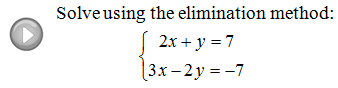
For example, take this 2-equation, 2-variable system:
The augmented matrix is:
This is a matrix: 2 rows (one per equation) and 3 columns (2 variable columns + 1 constant column). A system with 3 equations and 3 variables would produce a augmented matrix.
Solving systems with row operations

Elementary row operations
The goal is to transform the augmented matrix into a simpler form where you can read off the solution directly. There are three operations you're allowed to perform, and none of them change the solution set:
- Swap two rows. (Interchange rows and .)
- Multiply a row by a nonzero constant. (Replace with , where .)
- Add a multiple of one row to another. (Replace with .)
You use these operations to reach one of two target forms:
- Row-echelon form (REF): Every leading entry (first nonzero number in a row) sits to the right of the leading entry in the row above, and any all-zero rows are at the bottom.
- Reduced row-echelon form (RREF): Same as REF, but every leading entry is 1 and it's the only nonzero entry in its column.
RREF is the most useful because the solution can be read directly from the matrix.
Applying row operations strategically
A reliable strategy for reaching RREF:
- Work column by column, left to right. For each column, get a leading 1 on the diagonal (swap rows or multiply if needed).
- Use Type 3 operations to eliminate all other entries in that column (both below and above the leading 1).
- Move to the next column and repeat.
Worked example. Solve , .
Start with the augmented matrix:
Step 1: Divide by 2 to get a leading 1.
Step 2: Replace with to eliminate the 4 below the leading 1.
Step 3: Divide by to get a leading 1 in the second row.
Step 4: Replace with to eliminate the above the second leading 1.
Read the solution: , .
Consistency and independence of systems
Determining consistency
After row-reducing, look at the bottom rows of the matrix to classify the system.
- Consistent: The system has at least one solution. No row reads where .
- Inconsistent: The system has no solution. At least one row translates to (with ), which is a contradiction.
For a 3-equation, 2-variable system, consider these two reduced forms:
— The last row says , which is always true. The system is consistent (solution: ).
— The last row says , which is impossible. The system is inconsistent.
Determining independence
Once you know a system is consistent, the next question is how many solutions it has.
- Independent: Exactly one solution. In RREF, every variable column has a leading 1 (a pivot).
- Dependent: Infinitely many solutions. At least one variable column lacks a pivot, meaning that variable is free and can take any value.
— Both variable columns have pivots. Independent system: .
— The second variable column has no pivot, so is a free variable. Dependent system with infinitely many solutions: for any real number .
Interpreting solutions in context
Modeling real-world situations
Systems of equations show up whenever multiple conditions must be satisfied at the same time. The variables represent unknown quantities, and each equation captures a relationship between them.
For instance, suppose a bakery makes cakes and pies. If ingredients limit total production to 100 items and the bakery needs twice as many cakes as pies, you'd write:
Here is the number of cakes and is the number of pies. Solving the augmented matrix gives the production plan that meets both constraints.
Interpreting solutions and their implications
Always check whether the mathematical answer makes sense in the real situation.
- A negative value for a quantity that must be positive (like a number of items) signals that the model's constraints may be unrealistic.
- No solution means the constraints contradict each other. In the bakery example, it might mean the ingredient limits and the demand ratio can't both be satisfied.
- Infinitely many solutions means there isn't enough information to pin down a single answer. Some quantities can vary freely, and you'd need an additional constraint to narrow things down.
- A unique solution means the constraints fully determine every unknown, which is usually the ideal outcome in applied problems.
See Fiveable more often in Google
Mark Fiveable as a preferred source and Google is more likely to show you our guides in Top Stories, with a "preferred" badge in AI Mode and AI Overviews.