12.3 Polar Coordinates and Complex Numbers in Trigonometric Form

🍬Honors Algebra II Unit 12 Review
12.3 Polar Coordinates and Complex Numbers in Trigonometric Form
🍬 Honors Algebra II
continue practicing 12.3
Multiple choice
Rectangular vs Polar Coordinates
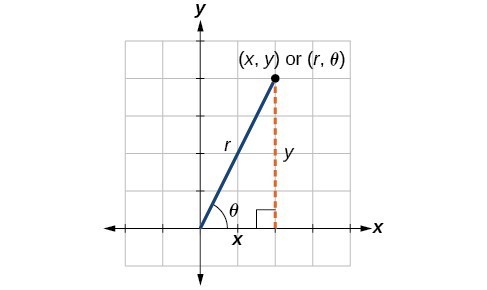
Rectangular coordinates describe a point using horizontal and vertical distances from the origin. Polar coordinates describe the same point using a distance from the origin and an angle measured from the positive -axis. Both systems locate the same points; they just use different measurements to get there.
Converting Between Coordinate Systems
Polar to rectangular is the more straightforward direction:
Example: Convert from polar to rectangular. So the rectangular form is .
Rectangular to polar requires more care:
The catch with : your calculator's only returns values in , which covers Quadrants I and IV. If the point is in Quadrant II or III (meaning ), you need to add to the calculator result to get the correct angle.
One more detail: the origin in rectangular corresponds to in polar, but the angle is undefined there since there's no unique direction from the origin to itself.
Comparing Coordinate Systems
- Rectangular coordinates work well for grid-like settings (maps, standard graphs, linear equations).
- Polar coordinates shine when a problem involves distance and direction from a central point (radar, circular motion, navigation).
- Some equations simplify dramatically in polar form. A circle centered at the origin is in rectangular but just in polar.
Graphing Polar Equations
Plotting Points and Curves
Polar equations have the form . To graph one:
- Build a table of values, usually from to (choose increments like or ).
- Calculate the corresponding for each .
- Plot each point on polar graph paper (or by converting to rectangular).
- Connect the points with a smooth curve.
For example, to graph , you'd evaluate at . This particular equation produces a rose curve with 3 petals.
Common polar curves you should recognize:
- Circles: (centered at origin) or / (passing through origin)
- Cardioids: — heart-shaped, with a cusp at the origin
- Limaçons: — may have an inner loop if
- Rose curves: — petals if is odd, petals if is even
Identifying Symmetry
Testing for symmetry saves you work when graphing because you only need to plot part of the curve and reflect the rest.
- Symmetry about the polar axis (horizontal axis): Replace with . If the equation is unchanged, the curve is symmetric about the polar axis.
- Symmetry about the origin: Replace with (or equivalently, replace with ). If the equation is unchanged, the curve is symmetric about the origin.
- Symmetry about the line (vertical axis): Replace with . If the equation is unchanged, the curve has vertical symmetry.
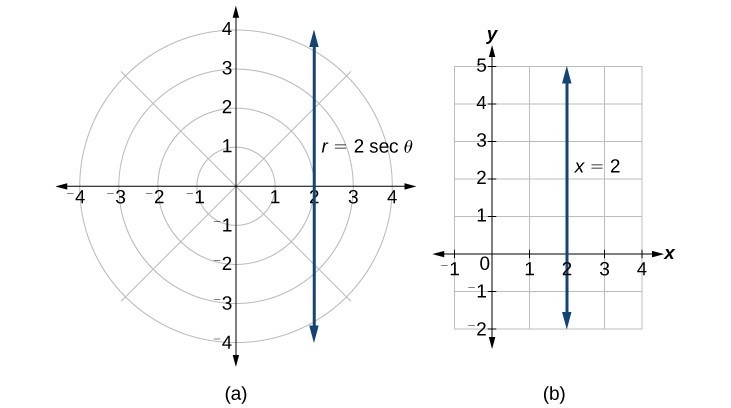
Note: an equation like is actually the vertical line in rectangular form. It's undefined at and because there, producing vertical asymptotes in the polar graph.
Complex Numbers in Trigonometric Form
Representing Complex Numbers
Any complex number can be rewritten in trigonometric (polar) form:
Here is the modulus (the distance from the origin to the point on the complex plane) and is the argument (the angle from the positive real axis).
The conversion formulas are the same as rectangular-to-polar:
Example: Convert to trigonometric form. Since and (Quadrant I), no adjustment is needed. Trigonometric form:
You may also see the shorthand cis notation: .
Euler's formula provides yet another equivalent form: , so . This is useful for understanding why multiplication and division rules work the way they do.
Geometric Interpretation
On the complex plane, the modulus tells you how far the number is from the origin, and the argument tells you the direction. For instance, sits 2 units from the origin at a angle. This geometric view makes operations like multiplication and finding roots much more intuitive.
Operations on Complex Numbers
Multiplication and Division
Trigonometric form turns multiplication and division into simple arithmetic on the moduli and arguments.
Multiplication: Multiply the moduli, add the arguments.
Example:
Division: Divide the moduli, subtract the arguments.
Example:
If your resulting angle falls outside , add or subtract to bring it back into the principal range.
Powers and Roots (De Moivre's Theorem)
De Moivre's Theorem is the key result here. For any complex number and positive integer :
You raise the modulus to the th power and multiply the argument by . This is far faster than multiplying by itself times in rectangular form.
Example:
Finding th roots uses the same theorem in reverse. The th roots of are:
This gives exactly distinct roots, evenly spaced around a circle of radius .
Steps to find th roots:
- Write the complex number in trigonometric form .
- Compute for the new modulus.
- For , the first root has argument .
- Each successive root () adds to the argument.
Example: Find the cube roots of .
- New modulus:
- :
- :
- :
These three roots are equally spaced at apart on a circle of radius 2.
The geometric spacing of roots is a useful check: if your roots aren't evenly distributed around the circle, something went wrong in the calculation.
See Fiveable more often in Google
Mark Fiveable as a preferred source and Google is more likely to show you our guides in Top Stories, with a "preferred" badge in AI Mode and AI Overviews.