Resistance measures how strongly an object opposes charge flow. For a uniform conductor, R = ρℓ/A, where ρ is the material's resistivity, ℓ is length, and A is cross-sectional area. Resistivity is a material property that typically increases with temperature for conductors. Ohm's law, I = ΔV/R, applies to ohmic materials, which have constant resistance regardless of current. On an I-V graph, an ohmic resistor produces a straight line; the slope equals 1/R. Resistors also convert electrical energy to thermal energy (Joule heating), which can raise the temperature of the resistor and its surroundings.
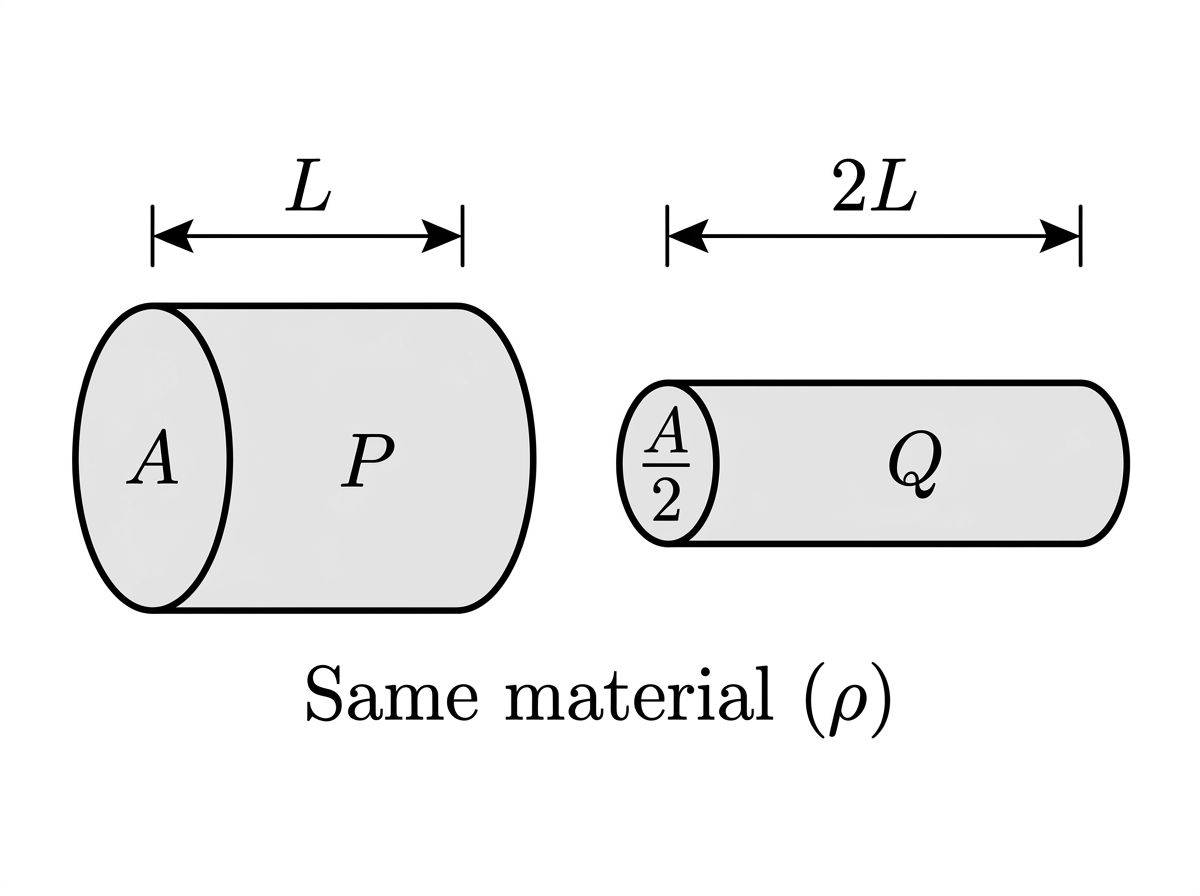
- R = ρℓ/A: Resistance increases with length and resistivity, and decreases with larger cross-sectional area.
- Ohmic material: A material with constant resistivity; its I-V graph is a straight line through the origin.
- Resistivity temperature dependence: For metallic conductors, resistivity increases as temperature rises.
- I-V graph slope: The slope of an I vs. ΔV graph equals 1/R; a steeper slope means lower resistance.
- Joule heating: Thermal energy produced in a resistor when current flows through it, given by P = I²R.
A wire is replaced with one of the same material but twice the length and half the cross-sectional area. By what factor does resistance change? (Answer: R increases by a factor of 4, since both changes multiply resistance.)