14.3 Intellectual Developmental Disorder

😵Abnormal Psychology Unit 14 Review
14.3 Intellectual Developmental Disorder
😵 Abnormal Psychology
Overview of Intellectual Developmental Disorder

Top images from around the web for Definition of intellectual developmental disorder
Facing Autism in New Brunswick: Autism and Intellectual Disability in the DSM5: My Submission to ... View original
Is this image relevant?
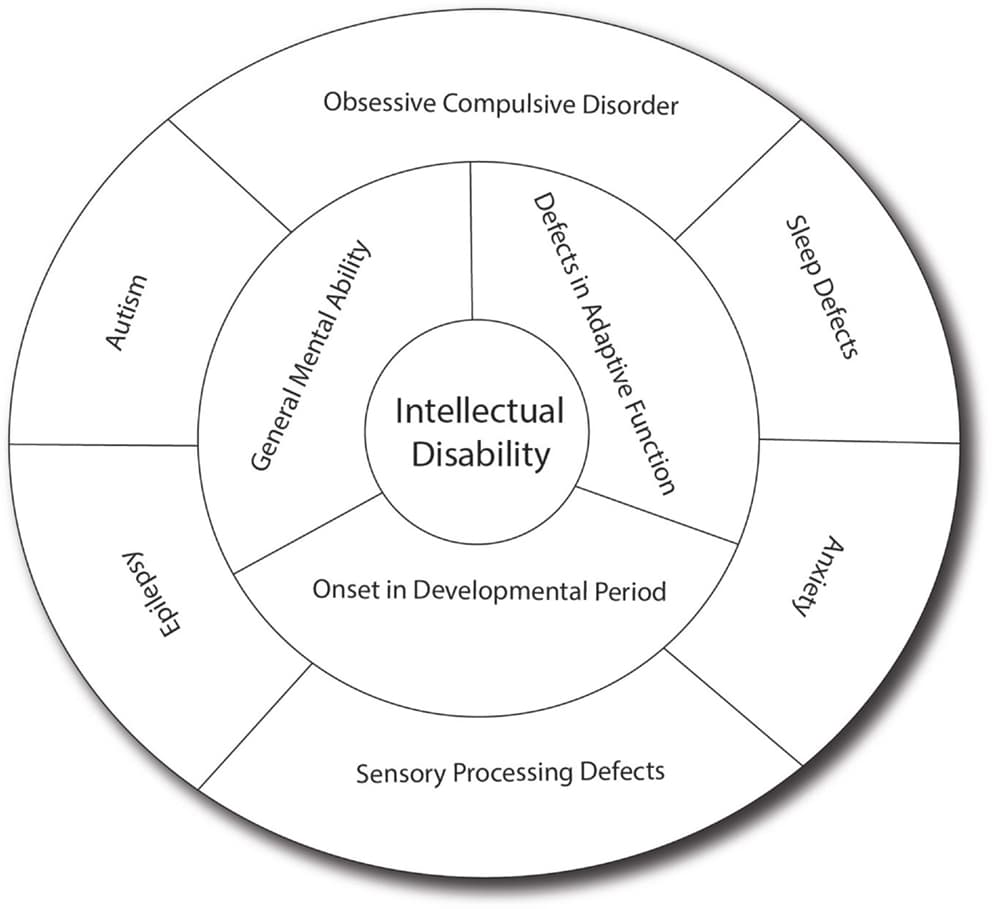
Frontiers | From Learning to Memory: What Flies Can Tell Us about Intellectual Disability ... View original
Is this image relevant?
Frontiers | Future Horizons for Neurodevelopmental Disorders: Placental Mechanisms View original
Is this image relevant?
Facing Autism in New Brunswick: Autism and Intellectual Disability in the DSM5: My Submission to ... View original
Is this image relevant?
Frontiers | From Learning to Memory: What Flies Can Tell Us about Intellectual Disability ... View original
Is this image relevant?
Definition of intellectual developmental disorder
Intellectual developmental disorder (IDD) is a neurodevelopmental disorder defined by deficits in two areas: intellectual functioning and adaptive behavior. Both must be present for a diagnosis. Intellectual functioning covers things like reasoning, problem-solving, planning, abstract thinking, judgment, and the ability to learn from experience. Adaptive functioning refers to how well someone meets everyday expectations for independence and social responsibility given their age and cultural context.
The DSM-5 requires all three of the following for diagnosis:
- Deficits in intellectual functioning, confirmed by both clinical assessment and standardized IQ testing (typically an IQ around 70 or below)
- Deficits in adaptive functioning that result in failure to meet age-appropriate standards for personal independence and social responsibility
- Onset during the developmental period (before age 18)
A key shift in the DSM-5 is that severity is now classified primarily by adaptive functioning, not IQ score alone. This matters because two people with the same IQ can have very different levels of daily functioning.
Classification of severity levels
The DSM-5 identifies four severity levels. Notice how each level is described in terms of what the person can do with varying degrees of support:
- Mild: Most common level. Individuals can often live independently with minimal support. They may struggle with abstract thinking, executive functioning, and short-term memory, but they can develop and maintain relationships. Social interactions may appear somewhat immature compared to same-age peers.
- Moderate: Individuals need some support with daily living activities. Cognitive development is significantly delayed, and understanding of written language is limited. With enough time and structured teaching, they can learn self-care routines and practical skills.
- Severe: Substantial support is needed for most daily activities. Understanding of written language and numerical concepts is very limited. Speech may be restricted to single words or short phrases.
- Profound: Full-time care and support are required for all activities. Co-occurring sensory and physical impairments are common. Communication is typically nonverbal, limited to simple gestures or vocalizations.

Etiology and Interventions for Intellectual Developmental Disorder
Etiology of intellectual developmental disorder
IDD has many possible causes, and they fall into two broad categories: genetic and environmental. In a significant number of cases, no single cause can be identified, and the condition likely results from a combination of factors.
Genetic factors:
- Single-gene disorders such as fragile X syndrome (the most common inherited cause of IDD) and phenylketonuria (PKU), a metabolic disorder that causes intellectual disability if untreated
- Chromosomal abnormalities such as Down syndrome (trisomy 21, the most common chromosomal cause) and Turner syndrome
Environmental factors can act at different stages of development:
- Prenatal: maternal infections (e.g., rubella), exposure to teratogens like alcohol (which can cause fetal alcohol spectrum disorders) or drugs, and maternal malnutrition
- Perinatal: birth complications, premature birth, and low birth weight
- Postnatal: head injuries, infections such as meningitis or encephalitis, and exposure to environmental toxins like lead

Adaptive functioning challenges
Adaptive functioning is assessed across three domains, and deficits in these areas are what most directly shape a person's daily experience:
- Conceptual domain: difficulties with language, reading, writing, math, reasoning, memory, and acquiring new knowledge
- Social domain: challenges with interpersonal communication, social judgment, self-esteem, susceptibility to being taken advantage of (gullibility), and social problem-solving
- Practical domain: difficulties with personal care, job responsibilities, money management, recreation, and organizing school or work tasks
How severe these challenges are depends on the individual and their overall severity level. This is why the DSM-5 emphasizes adaptive functioning over IQ when classifying severity.
Interventions and support strategies
There is no single treatment for IDD. Instead, intervention focuses on building skills, maximizing independence, and providing appropriate levels of support across the lifespan.
Early intervention and education:
- Early intervention programs target cognitive, adaptive, and social skills during the critical early years of development
- Individualized education plans (IEPs) provide tailored academic goals and accommodations in school settings
- Speech and language therapy improves communication abilities
- Occupational therapy builds daily living skills and fine motor coordination
Behavioral approaches:
- Applied behavior analysis (ABA) uses reinforcement principles to teach new skills and reduce problem behaviors
- Positive behavior support (PBS) focuses on understanding the function of challenging behaviors and replacing them with adaptive alternatives
Broader support systems:
- Family education helps caregivers understand the condition and develop effective strategies at home
- Vocational training and supported employment programs promote independence and community participation in adulthood
- Assistive technology and environmental modifications can increase accessibility
- Psychopharmacological treatment may be used when co-occurring mental health conditions or significant behavioral problems are present, but medication treats those specific symptoms rather than IDD itself
See Fiveable more often in Google
Mark Fiveable as a preferred source and Google is more likely to show you our guides in Top Stories, with a "preferred" badge in AI Mode and AI Overviews.