
Definition of sequences
A sequence is an ordered list of numbers following a specific rule. Each number in the list is called a term, and the position of each term matters. Sequences give you a way to study patterns, and they're the starting point for understanding limits and infinite processes in analysis.
Types of sequences
- Finite sequences contain a set number of terms: (1, 2, 3, 4, 5)
- Infinite sequences continue without end: (1, 2, 3, 4, ...)
- Constant sequences repeat the same value: (5, 5, 5, 5, ...)
- Alternating sequences switch sign from term to term: (-1, 1, -1, 1, ...)
Sequence notation
There are several ways to describe a sequence precisely:
- General term notation uses subscripts: represents the nth term
- Explicit formula defines each term directly as a function of its position: . For example, gives you the sequence 3, 5, 7, 9, ...
- Recursive formula defines each term using previous terms: . You always need an initial condition (like ) to get started.
- Set builder notation describes the sequence using set theory:
Arithmetic sequences
In an arithmetic sequence, each term differs from the previous one by a fixed amount called the common difference (). If and , you get 2, 5, 8, 11, ...
- General term formula:
- Sum of the first n terms:
- These model any situation with constant, uniform growth (e.g., adding the same amount to a savings account each month)
Geometric sequences
In a geometric sequence, each term is obtained by multiplying the previous term by a fixed common ratio (). If and , you get 3, 6, 12, 24, ...
- General term formula:
- Sum of the first n terms: for
- These show up in compound interest, population growth, and radioactive decay
Properties of sequences
Once you can identify a sequence, the next step is analyzing its long-term behavior. These properties tell you whether a sequence settles down, blows up, or does something in between.
Convergence and divergence
A convergent sequence approaches a specific finite value (its limit) as grows. We write this as:
A divergent sequence does not approach any finite limit. It might grow without bound, or it might oscillate forever (like 1, -1, 1, -1, ...).
Bounded vs unbounded sequences
- A sequence is bounded above if there's some number where for all
- It's bounded below if there's some number where for all
- A sequence that's both bounded above and below is simply called bounded
- Unbounded sequences have terms that grow arbitrarily large (or arbitrarily negative)
Every convergent sequence is bounded, but not every bounded sequence converges (think of the alternating sequence -1, 1, -1, 1, ...).
Monotonic sequences
A sequence is monotonic if it moves consistently in one direction:
- Increasing: for all
- Strictly increasing: for all
- Decreasing: for all
- Strictly decreasing: for all
A key theorem: every bounded monotonic sequence converges. This is one of the most useful results in analysis.
Recursive sequences
Recursive sequences define each term using previous terms rather than a direct formula. The classic example is the Fibonacci sequence:
with
This gives 1, 1, 2, 3, 5, 8, 13, ... A common goal with recursive sequences is finding a closed-form expression that lets you compute any term directly without calculating all the previous ones.
Series fundamentals
A series is what you get when you add up the terms of a sequence. While a sequence is a list, a series is a sum. This distinction matters because it lets you ask a powerful question: can an infinite sum have a finite value?
Definition of a series
An infinite series is written as:
The sigma notation is shorthand for "add up all the terms." Whether this infinite sum actually equals a finite number depends on the behavior of its partial sums.
Partial sums
The nth partial sum is the sum of just the first terms:
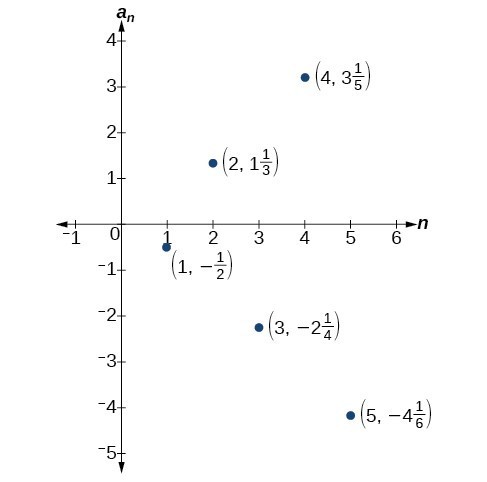
You can think of partial sums as a sequence themselves: If this sequence of partial sums converges to a finite value, the series converges. If not, the series diverges.
Convergence of series
A series converges when:
where is some finite number. One necessary condition: the individual terms must approach zero, i.e., . But be careful: this condition is necessary, not sufficient. The harmonic series shows that terms going to zero doesn't guarantee convergence.
Divergence of series
A series diverges if the partial sums don't settle on a finite value. This can happen in a few ways:
- The partial sums grow without bound (like the harmonic series)
- The partial sums oscillate and never settle down
- The individual terms don't approach zero (which automatically forces divergence)
Types of series
Arithmetic series
The sum of an arithmetic sequence. For a finite number of terms:
An infinite arithmetic series always diverges (the terms don't approach zero unless ). A classic application: the sum .
Geometric series
The sum of a geometric sequence. This is one of the most important series to know:
- Finite sum: for
- Infinite sum: , but only when
For example, . When , the infinite geometric series diverges.
Telescoping series
In a telescoping series, most terms cancel when you write out the partial sums. The general form is:
When you expand this, consecutive terms cancel, leaving only the first and last terms. For instance, collapses to .
Power series
A power series has the form:
This represents a function as an infinite polynomial centered at . Each power series has a radius of convergence : it converges for and diverges for . Power series are the foundation for Taylor and Maclaurin series.
Tests for convergence
When you encounter a new series, you need tools to determine whether it converges. Here are the main tests, each suited to different situations.
Nth term test
The simplest check: if , the series diverges. Period.
But if the limit does equal zero, you can't conclude anything. This test can only prove divergence, never convergence. Use it as a quick first step before trying other tests.
Ratio test
Compute the ratio of consecutive terms:
- If : the series converges
- If : the series diverges
- If : the test is inconclusive (try something else)
The ratio test works especially well for series involving factorials or exponential terms.
Root test
Take the nth root of each term:
The conclusions are the same as the ratio test (converges if , diverges if , inconclusive if ). This test is particularly effective when terms involve nth powers.
Integral test
If is a positive, continuous, decreasing function where , then:
either both converge or both diverge.
This test is the standard way to prove p-series convergence results.
Special series
These series come up so often that you should recognize them on sight.
P-series
- Converges when (e.g., converges to )
- Diverges when
P-series are frequently used as comparison benchmarks when testing other series.
Harmonic series
The p-series with :
This series diverges, even though its terms approach zero. The partial sums grow roughly like , so they increase without bound, just very slowly. The harmonic series is the classic example showing that is not enough for convergence.
Alternating series
Series where terms alternate in sign:
The alternating series test (Leibniz test) says this converges if two conditions hold:
- The terms decrease:
- The terms approach zero:
A bonus: if you approximate the sum using the first terms, the error is at most .

Applications of sequences and series
Taylor series
A Taylor series represents a function as an infinite sum of polynomial terms centered at :
Here is the nth derivative of evaluated at . Taylor series let you approximate complicated functions with polynomials, compute difficult limits, and evaluate integrals that have no closed-form antiderivative.
Maclaurin series
A Maclaurin series is just a Taylor series centered at :
Three Maclaurin series worth memorizing:
Fourier series
A Fourier series represents a periodic function as a sum of sines and cosines:
The idea is that any periodic function can be decomposed into simple oscillating components. This has major applications in signal processing, heat conduction, and solving partial differential equations.
Limits of sequences and series
Limit laws for sequences
When both and exist, you can combine them:
- Sum law:
- Product law:
- Quotient law: , provided the denominator limit
The squeeze theorem is also useful: if and both and converge to the same limit , then also converges to .
Limit comparison test
This test compares an unknown series to a known series (with all positive terms):
If this limit exists and is positive and finite, both series either converge or both diverge. You'll typically compare against a p-series or geometric series whose behavior you already know.
Cauchy criterion
A sequence converges if and only if it's a Cauchy sequence: for any , there exists such that for all .
In plain terms, the terms of a Cauchy sequence get arbitrarily close to each other as you go further out. This criterion is important because it lets you prove convergence without knowing the actual limit. It also connects to the completeness of the real numbers: the fact that every Cauchy sequence of real numbers converges is what makes complete.
Manipulating series
Rearrangement of series
Changing the order of terms in a series can have surprising effects:
- Absolutely convergent series can be rearranged in any order without changing the sum
- Conditionally convergent series are dangerous to rearrange. The Riemann rearrangement theorem states that you can rearrange a conditionally convergent series to converge to any real number, or even to diverge
Absolute vs conditional convergence
- Absolute convergence: converges. This is the stronger condition.
- Conditional convergence: converges, but diverges.
The alternating harmonic series is the standard example of conditional convergence: it converges to , but the harmonic series diverges. Absolute convergence is always preferred because it gives you more freedom to manipulate the series.
Operations on series
- Addition/subtraction: If and both converge, then converges to the sum/difference of their respective sums
- Scalar multiplication: for any constant
- Cauchy product: A method for multiplying two series together
- Term-by-term differentiation and integration: Valid for power series within their radius of convergence
Sequences and series in calculus
Improper integrals
Improper integrals extend definite integrals to infinite intervals or discontinuous functions. They connect to series through the integral test: the convergence of can be determined by checking whether converges, where .
Power series differentiation
You can differentiate a power series term by term:
The radius of convergence stays the same after differentiation (though behavior at the endpoints may change). This technique is valuable for solving differential equations and deriving new series from known ones.
Power series integration
Similarly, you can integrate a power series term by term:
The radius of convergence is preserved (again, endpoints need separate checking). This lets you find antiderivatives and compute definite integrals for functions that are hard to integrate directly.