
Connectedness is a fundamental concept in topology that explores whether a mathematical space is "all one piece" or can be split apart. It plays a crucial role in proving important theorems across analysis, topology, and applied math, and it gives mathematicians a precise way to talk about the structure of spaces.
This topic covers the formal definition of connectedness, its several variations (path connectedness, simple connectedness, local connectedness), key properties, and how connectedness shows up in different mathematical settings.
Definition of connectedness
At its core, connectedness captures whether a space can be split into two separate pieces. A connected space is one that can't be pulled apart into two non-empty open sets that don't overlap. This idea shows up constantly in topology and analysis, from proving the Intermediate Value Theorem to classifying surfaces.
Intuitive understanding
Think of a connected space as a single piece of paper. You can't divide it into two separate sheets without tearing it. A disconnected space, by contrast, is like two separate sheets sitting on a table: they're already apart, no tearing needed.
This intuition applies to many mathematical objects. A closed interval on the real line, a circle, and a solid sphere are all connected. But two disjoint intervals sitting apart on the number line? That's disconnected.
Formal mathematical definition
A topological space is connected if there do not exist two non-empty open sets and such that:
If you can find such and , the space is disconnected, and the pair is called a separation of .
There's an equivalent definition using closed sets: just replace "open" with "closed" everywhere above, and the statement still holds. Connectedness is also preserved under continuous functions and homeomorphisms, which makes it a topological invariant.
Connected vs disconnected sets
Connected sets form a single, unbroken piece. Some key examples:
- Connected: Any interval on the real line (open, closed, or half-open), the real numbers with the standard topology, solid geometric shapes like disks and spheres
- Disconnected: The union of two disjoint intervals like , the set of integers with the subspace topology (each integer is isolated from the others)
The real line is connected because there's no way to split it into two disjoint non-empty open sets. The integers, on the other hand, fall apart into individual points, each of which is its own open set in the subspace topology.
Types of connectedness
Not all forms of "hanging together" are the same. Topology distinguishes several types of connectedness, each capturing a different degree of how tightly a space holds together. These distinctions matter because they have different implications for what you can prove about a space.
Path connectedness
Path connectedness is a stronger condition than plain connectedness. A space is path-connected if for any two points and in , there exists a continuous function with and . In other words, you can always draw a continuous curve from any point to any other point without leaving the space.
Every path-connected space is connected, but the reverse isn't always true. The classic counterexample is the topologist's sine curve: the graph of for together with the segment . This space is connected (you can't separate it into two open pieces), but there's no continuous path from a point on the sine wave to a point on the vertical segment.
Familiar path-connected spaces include line segments, circles, and solid spheres.
Simply connected spaces
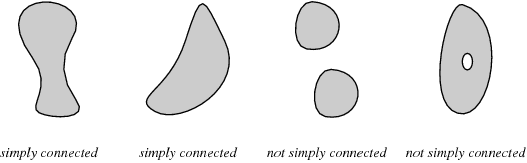
A simply connected space goes one step further: not only can you connect any two points with a path, but every loop in the space can be continuously shrunk down to a single point. Formally, a space is simply connected if it is path-connected and its fundamental group (the algebraic object that tracks loops up to continuous deformation) is trivial.
- Simply connected: The Euclidean plane , the surface of a sphere
- Not simply connected: The torus (a loop going around the hole can't be shrunk to a point), the figure-eight curve (loops around either circle are "stuck")
Simply connected spaces have no "holes" that loops can wrap around, which makes them particularly well-behaved for many purposes in analysis and geometry.
Locally connected spaces
A space is locally connected if every point has arbitrarily small connected neighborhoods. Formally, for every point and every open set containing , there exists a connected open set with .
Local connectedness and global connectedness are independent properties. The real line and the plane are both locally connected and globally connected. The topologist's sine curve is globally connected but not locally connected: points on the vertical segment don't have small connected neighborhoods that include nearby parts of the sine wave.
Properties of connected sets
Connected sets have several important properties that make them powerful tools in proofs. These properties let you transfer connectedness from one setting to another and draw conclusions about functions defined on connected domains.
Preservation under continuous functions
If is a continuous function and is connected, then the image is connected in . This is one of the most frequently used facts in topology.
The intuition: a continuous function can stretch and bend a space, but it can't tear it apart. So if the domain is one piece, the image must be one piece too. Homeomorphisms (continuous bijections with continuous inverses) preserve connectedness in both directions, which is why connectedness is a topological invariant.
Connectedness in product spaces
The product of connected spaces is connected. If and are both connected topological spaces, then is connected. This generalizes to arbitrary (even infinite) products of connected spaces.
This is useful for building up higher-dimensional connected spaces from lower-dimensional ones. Note the contrast with compactness: Tychonoff's theorem tells us arbitrary products of compact spaces are compact, but the proof is much harder and requires the Axiom of Choice. For connectedness, the result is more straightforward.
Intermediate value theorem
The Intermediate Value Theorem (IVT) is one of the most familiar consequences of connectedness. It states: if is continuous and is any value between and , then there exists some with .
Why does this follow from connectedness? The interval is connected, so its image under must also be connected. Connected subsets of are exactly the intervals. So is an interval, which means it contains every value between and .
The IVT generalizes: any continuous function from a connected space to satisfies an analogous property. Applications range from finding roots of equations to analyzing dynamical systems.
Topological connectedness
This section looks more closely at how connectedness interacts with the open/closed set structure of a topological space. These tools are essential for actually proving things about connectedness in practice.
Open and closed sets
A set that is simultaneously open and closed is called clopen. In any topological space, the empty set and the whole space are always clopen. A space is connected if and only if these are the only clopen sets.
This gives you a clean equivalent characterization: to show a space is disconnected, find a non-trivial clopen set (one that's neither empty nor the whole space). To show it's connected, prove no such set exists.
Connected components
Every topological space can be broken into its connected components: maximal connected subsets. Here's what you need to know:
- Every point belongs to exactly one connected component
- Connected components partition the space (they cover everything and don't overlap)
- A space is connected if and only if it has exactly one connected component
- In a discrete space, each individual point is its own connected component
Connected components give you a way to decompose any space into its "connected pieces."
Separation of sets
Two subsets and of a topological space form a separation of if:
- Both and are non-empty and open
- and are disjoint ()
- Their union is the entire space ()
A space is connected if and only if no separation exists. When you want to prove a space is disconnected, the strategy is to construct an explicit separation. This concept also generalizes to ideas like local connectedness and the study of connected components.
Applications of connectedness
Connectedness isn't just an abstract property. It shows up in proofs throughout analysis and topology, and it connects to real-world problems in network theory and economics.
Continuity and connectedness
Since continuous functions preserve connectedness, you can use connectedness to deduce properties of continuous functions on connected domains. For example:
- A continuous real-valued function on a connected domain must have an interval as its range (no "gaps" in the output)
- Connectedness arguments help establish the existence of solutions to differential equations
- In dynamical systems, connectedness of phase spaces constrains how trajectories can behave
Fixed point theorems
Several important fixed point theorems rely on connectedness. The Brouwer Fixed Point Theorem states that every continuous function from a convex compact subset of Euclidean space to itself has at least one fixed point. The one-dimensional case of this theorem is essentially the Intermediate Value Theorem, which is a direct consequence of the connectedness of intervals.
These theorems have applications in economics (proving the existence of market equilibria) and game theory (existence of Nash equilibria).
Connectedness in graph theory
Graphs can be viewed through a topological lens. A connected graph corresponds to a path-connected topological space: you can get from any vertex to any other by following edges. Bridges in graph theory (edges whose removal disconnects the graph) are analogous to cut points in topology.
Algorithms for finding connected components in graphs are fundamental in network analysis, from social networks to communication infrastructure.
Methods for proving connectedness
Proving that a space is connected (or disconnected) requires choosing the right strategy for the situation. Here are the main approaches.
Direct proofs
- For path-connectedness: Explicitly construct a continuous path between any two arbitrary points in the space
- For connectedness: Show directly that no separation can exist, often by assuming you have open sets and with and , then showing one must be empty
- Via continuous functions: If your space is the continuous image of a known connected space, it's automatically connected
Direct proofs work best when the space has enough structure that you can write down paths or argue about open sets explicitly.
Contradiction proofs
When direct construction is hard, assume the space is disconnected and work toward a contradiction. This often involves:
- Assuming a separation exists
- Using properties of the space (continuity, compactness, specific structure) to derive constraints on and
- Showing those constraints force or to be empty, contradicting the assumption
This technique is especially powerful for complex spaces where the structure isn't easy to visualize.
Induction proofs
Induction works well for spaces built up recursively or as increasing unions:
- If are connected sets, and consecutive sets overlap, then is connected
- In graph theory, induction on the number of vertices or edges is a standard technique
- For fractal or self-similar structures, induction captures the recursive construction process
Connectedness in different spaces
Connectedness looks different depending on the space you're working in. Here's how it plays out in some important settings.
Real line connectedness
The connected subsets of are exactly the intervals (including rays and itself). This is a foundational result.
- Any union of overlapping intervals is connected
- The rational numbers are disconnected as a subspace of (you can always separate rationals using an irrational cut)
- The irrational numbers are also disconnected as a subspace
- The Cantor set is a totally disconnected subset of : its only connected subsets are individual points
Plane connectedness
In , connectedness gets richer:
- Simply connected regions have no holes. Star-shaped domains (where one point can "see" every other point via a straight line segment inside the domain) are always simply connected.
- The Jordan Curve Theorem says that a simple closed curve in the plane divides it into exactly two connected components: a bounded interior and an unbounded exterior.
- The punctured plane ( minus a point) is connected but not simply connected, since a loop around the missing point can't be shrunk to a point.
Higher dimensional connectedness
Many concepts from lower dimensions generalize, but new phenomena appear:
- Spheres and balls in all dimensions are connected and simply connected (for in the case of spheres)
- Complements of subspaces behave differently: removing a point from leaves a connected space for , but disconnects
- In dimensions 7 and higher, exotic spheres exist: spaces that are homeomorphic to the standard sphere but not diffeomorphic to it, showing that smooth structure adds subtlety beyond topology
- Manifolds provide a rich setting for studying all types of connectedness
Disconnected spaces
Studying disconnected spaces clarifies what connectedness really means and provides essential counterexamples.
Discrete topologies
In a discrete topology, every subset is open (and therefore also closed). This makes every subset clopen, so the space is as disconnected as possible. The only connected subsets are individual points. Discrete topologies are the natural setting for finite sets and combinatorial structures.
Totally disconnected spaces
A space is totally disconnected if its only connected subsets are single points. These spaces are more "shattered" than merely disconnected. Important examples:
- The Cantor set: uncountable, yet every connected subset is a single point
- The -adic numbers: a totally disconnected metric space that's fundamental in number theory
- These spaces arise naturally in number theory, algebraic geometry, and descriptive set theory
Cantor set
The Cantor set deserves special attention as a rich source of counterexamples:
- Construction: Start with . Remove the open middle third . Remove the middle thirds of the two remaining intervals. Repeat infinitely.
- Properties: It has measure zero (the total length removed adds up to 1), yet it's uncountable, having the same cardinality as
- Topology: It's totally disconnected, compact, and has a self-similar fractal structure
- Universal property: It's homeomorphic to the product of countably many copies of the two-point discrete space, making it a "universal" totally disconnected compact metric space
Relationship to other concepts
Connectedness doesn't exist in isolation. Understanding how it relates to other topological properties helps you see the bigger picture.
Connectedness vs compactness
These two properties are completely independent:
- Compact but not connected: A finite discrete space (e.g., with the discrete topology)
- Connected but not compact: The real line
- Both: The closed interval
- Neither: The union of open intervals
Both properties are preserved under continuous functions. Spaces that are both compact and connected are called continua and have special importance in topology.
Connectedness vs completeness
Completeness (every Cauchy sequence converges) is a metric space property, while connectedness is purely topological. They're independent:
- Connected but not complete: The open interval
- Complete but not connected: The integers with the usual metric
- Both: The real line
Completeness is defined using the metric, so it depends on which metric you choose. Connectedness depends only on the topology.
Connectedness in metric spaces
Metric spaces provide extra structure that tightens the relationship between different types of connectedness:
- Connectedness is still equivalent to having no non-trivial clopen sets
- In locally path-connected metric spaces, connectedness and path-connectedness are equivalent. This is why the distinction rarely matters for "nice" spaces like open subsets of
- Open balls and closed balls in are both connected
- A common (but false) claim is that complete connected metric spaces are always path-connected. This requires additional conditions like local connectedness.